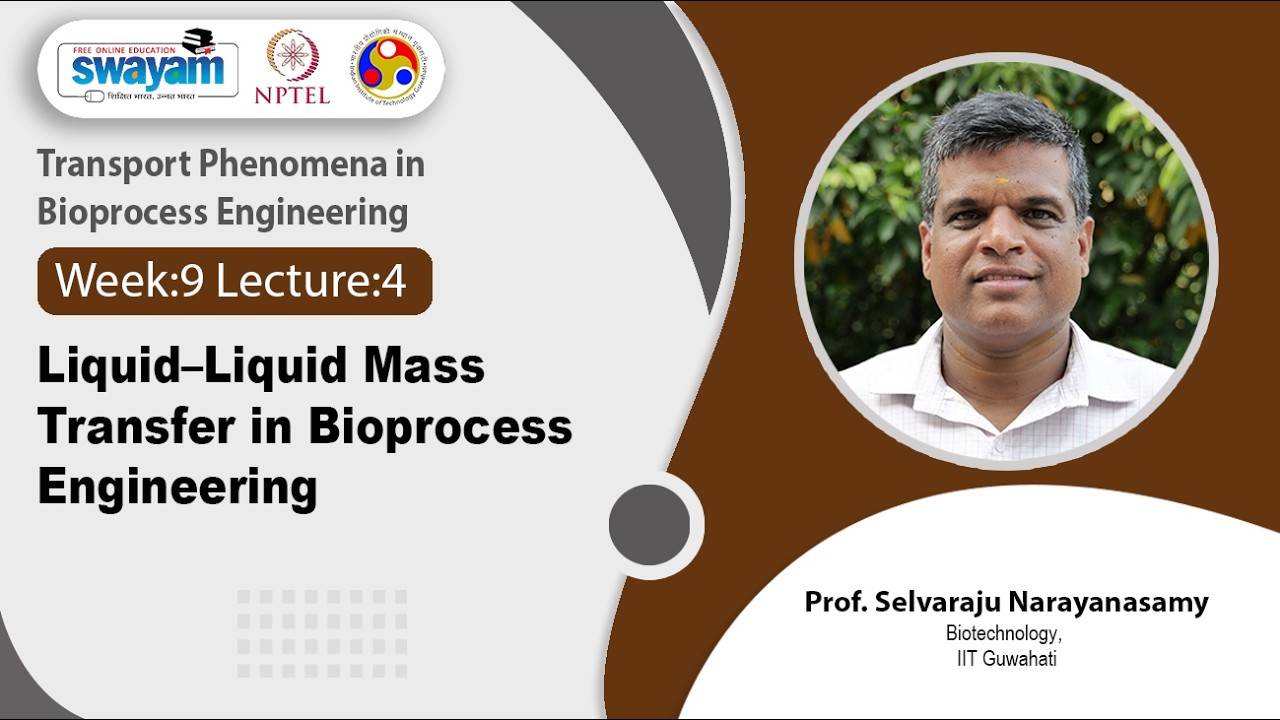
Lec 44: Liquid–Liquid Mass Transfer in Bioprocess Engineering
Keywords
Summary
153 words
Critical Evaluation
Value of the Information & Strength of the Argument
The lecture provides a thorough and systematic explanation of mass transfer principles, starting with simpler liquid–solid systems and extending to more complex liquid–liquid cases. The argumentation is logical: the two-film model is introduced after establishing the single-film scenario, and the derivation of the overall transfer coefficient is clearly presented step by step. The use of concrete examples (activated carbon adsorption, penicillin extraction) grounds the theory in practical bioprocess contexts, enhancing comprehension. The presentation also addresses common industrial concerns such as the trade-off between agitation and emulsion formation, demonstrating a balanced engineering perspective. Overall, the content is valuable for both students and practitioners seeking a clear understanding of mass transfer in biphasic systems.
Scientific Rigor, Source Quality, Title Accuracy
The lecture is scientifically rigorous, typical of NPTEL courses, with accurate terminology and consistent notation. The instructor references earlier lectures and the course structure, embedding the topic within a broader curriculum. No external sources are cited beyond the course materials, but the content aligns with established textbooks on mass transfer and bioprocess engineering. The title precisely matches the focus on liquid–liquid mass transfer, with no misleading elements. The description provides official course links, which increases credibility. The video has no public comments or feedback, so audience reception cannot be assessed, but the technical content stands on its own merits.
226 words
Title / Content Match
Title accurately reflects the lecture's focus on liquid–liquid mass transfer within bioprocess engineering.
Quality & Reliability
9/10
Official NPTEL lecture delivered by a professor at IIT Guwahati, covering fundamentals and applications of mass transfer with clear explanations and correct technical content.
Key Moments
Markers derived by PSI from the transcript: the creator did not define chapters.
- Introduction to the lecture objectives and scope.
- Liquid–solid mass transfer example with activated carbon adsorption.
- Detailed transport steps in liquid–solid systems.
- Identifying rate-limiting steps in mass transfer with surface reactions.
- Applications of liquid–solid mass transfer: immobilized enzymes, cell immobilization, biofilms.
- Introduction to liquid–liquid mass transfer and its importance in product recovery.
- Two-film theory for liquid–liquid systems, resistance in series.
- Interfacial equilibrium and distribution coefficient.
- Derivation of overall mass transfer coefficient for phase 1 and phase 2.
- Factors affecting liquid–liquid mass transfer: hydrodynamics, physical properties, interfacial area.
- Comparison of liquid–liquid vs liquid–solid systems and key takeaways.
Cited Sources
- NPTEL Course: Transport Phenomena in Bioprocess Engineering — Official course page referenced in the video description, providing the full course context and materials.
- Playlist: Transport Phenomena in Bioprocess Engineering — YouTube playlist of the course lectures, from which this video is part.
Contribution & Novelties
The lecture consolidates core mass transfer concepts specifically for bioprocess engineering, bridging chemical engineering theory with biotechnological applications. Its novelty lies in the clear presentation of the two-film model applied to liquid–liquid extractions, such as penicillin recovery, and the emphasis on practical design parameters like interfacial area and agitation. It systematically contrasts liquid–liquid and liquid–solid systems, aiding retention and application.
Pour aller plus loin :
- Mass transfer — Foundation of the phenomena discussed, covering diffusion, convection, and film theory.
- Distribution coefficient — Key concept for partitioning of solutes between phases, directly applied in liquid–liquid extraction.
- Extraction (chemistry) — Practical techniques and equipment for solvent extraction, related to the penicillin example in the lecture.
113 words
Radar Profile
The radar profile shows high scores across quantity, quality, technical level, and reliability, consistent with an authoritative educational lecture. The relatively lower quantity score reflects a 28-minute session that, while dense, does not exhaustively cover every aspect of mass transfer, but the other dimensions are strong, making it a solid resource.