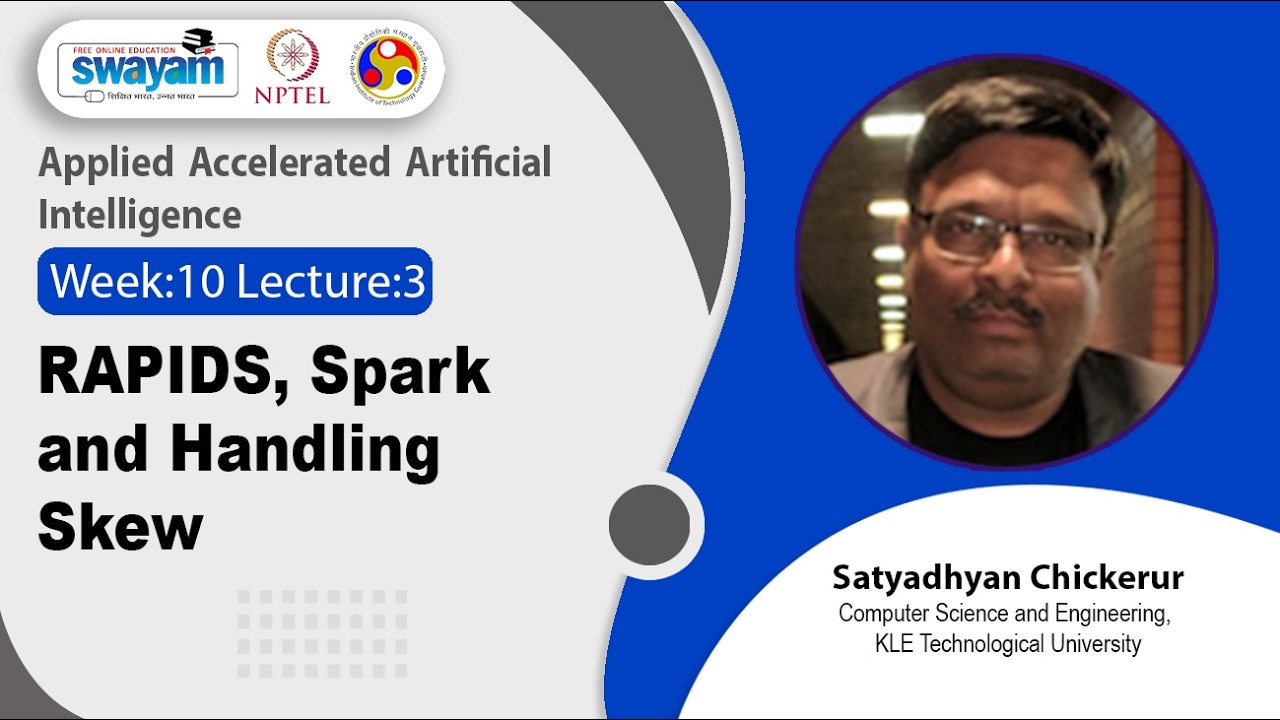
Lec 46: RAPIDS, Spark and Handling Skew
Keywords
Summary
201 words
Critical Evaluation
Value of the Information & Strength of the Argument
The lecture provides a valuable high-level comparison of popular big data frameworks and introduces essential concepts like data skew and mitigation techniques. The analogy of vehicles (bicycle, van, racing car, freight train) effectively abstracts the scale and speed trade-offs, making the material accessible. The argumentation is logical and grounded in practical considerations: it explains when RAPIDS is beneficial (compute-intensive, GPU-friendly data) and when Spark is necessary (petabyte scale, SQL workloads). The salting pattern is clearly illustrated with an example of a bot generating 50% of events, and the trade-off of two shuffles versus one is justified. The mention of Adaptive Query Execution demonstrates awareness of modern Spark capabilities. However, the performance numbers (e.g., 50x speedup) are presented without detailed benchmark protocols, and the argumentation could be strengthened by more quantified evidence. Overall, the reasoning is sound and educational, but the depth is limited by the short duration.
Scientific Rigor, Source Quality, Title Accuracy
The video is a professional academic lecture from a recognized institution (IIT Guwahati) under the NPTEL umbrella, which bolsters its rigor. The content aligns with official documentation of RAPIDS, cuDF, and Spark, accurately reflecting their features (e.g., Catalyst optimizer, AQE). The description provides links to the course page and playlist, which serve as additional sources. The title is precise: it covers RAPIDS, Spark, and data skew handling. No external citations are given within the lecture itself, but the pedagogical nature implies reliance on established knowledge. There is no visible commercial bias; the lecture is purely educational. The adequacy between title and content is high, as all three promised topics are addressed. However, the video would benefit from explicit references to official documentation or research papers for deeper verification.
290 words
Title / Content Match
The title accurately reflects the content: the lecture covers RAPIDS, Spark, and strategies for handling data skew.
Quality & Reliability
8/10
Lecture delivered by IIT Guwahati faculty as part of an NPTEL course; content aligns with official documentation and standard practices, though performance claims are anecdotal and not backed by detailed benchmarks.
Key Moments
Markers derived by PSI from the transcript: the creator did not define chapters.
- Introduction and analogy for Dask, Ray, RAPIDS, Spark
- RAPIDS/cuDF on GPU vs pandas on CPU, performance example
- When cuDF is not effective: small data, I/O-bound, memory-bound
- Spark overview: petabyte scale, SQL optimizer, lakehouse ecosystem
- Data skew problem and salted group-by pattern explanation
- Adaptive Query Execution and common mistakes
Cited Sources
- Applied Accelerated Artificial Intelligence - Course Page — Official course page referenced in the video description for the full course context
- Playlist: Applied Accelerated Artificial Intelligence — Playlist containing all lectures of the course, including this session
Contribution & Novelties
The lecture provides a concise comparative analysis of RAPIDS and Spark, clarifying when each should be used and introducing the salted group-by technique as a practical solution to data skew. Its originality lies in consolidating these advanced topics in a short format, making it a useful tutorial for practitioners.
Pour aller plus loin :
- RAPIDS official documentation — Official site for RAPIDS suite, including cuDF, with detailed API and performance guidance.
- Apache Spark official site — Comprehensive resource for Spark’s architecture, SQL optimizer, and AQE features.
- Adaptive Query Execution in Spark — Official documentation on how AQE works and how to configure it for skew handling.
106 words
Radar Profile
The radar display indicates a well-rounded lecture with strong reliability and technical depth, while the quantity of information is moderate relative to its short duration. The absence of discordant sources suggests internal consistency and alignment with standard practices.