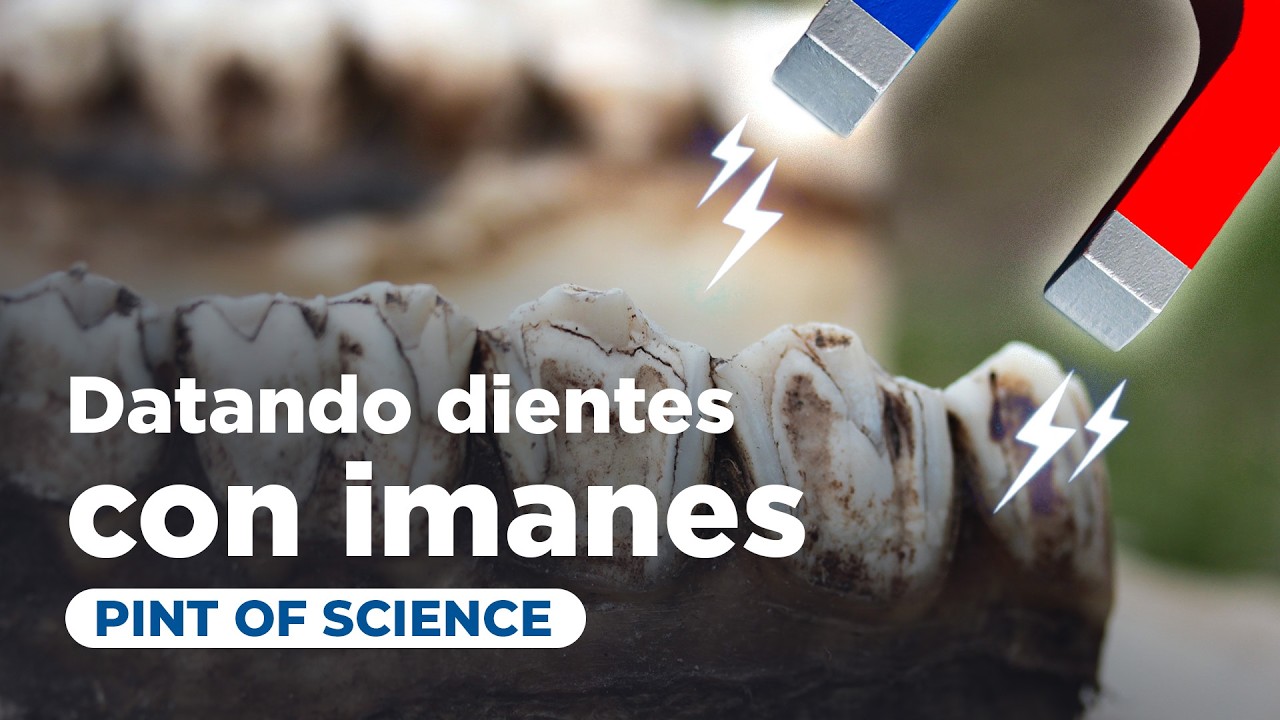
¿Te re-suena? Datando dientes con imanes | Irene Romo Díez
Does it ring a bell? Dating teeth with magnets | Irene Romo Díez
Keywords
Summary
186 words
Critical Evaluation
Value of the Information & Strength of the Argument
The talk provides a clear and accessible introduction to a specialized dating technique. The argumentation is solid: the speaker uses intuitive analogies (resonance breaking glass, the timer metaphor) and presents a logical chain from physical principle to archaeological application. She openly discusses the ’leap of faith’ concerning assumptions about constant radiation dose over time, which enhances credibility. The demonstration of how samples are collected in darkness and the practical constraints of the method adds practical value. However, the talk does not present any quantitative data or specific case-study details beyond a few citations of articles, which limits its depth for a specialized audience.
Scientific Rigor, Source Quality, Title Accuracy
The speaker is a practitioner, which lends authority to her explanation. She mentions several international applications and specific sites, though without naming the articles or issuing precise references. The only external source provided is the UBUinvestiga blog, which is the channel’s page. The title is playful but accurate—‘Does it ring a bell?’ evokes the resonance concept, and the subtitle directly states the topic. No formal citations or data are given, but the talk is appropriate for a science communication event like Pint of Science. The presentation is consistent with standard descriptions of ESR dating in the literature.
215 words
Title / Content Match
The title is playful and matches the content: the talk explains how electron spin resonance is used to date teeth and quartz, and the analogy to resonance (ringing) is central.
Quality & Reliability
7/10
The speaker is a researcher at CENIEH with direct practical experience in ESR dating. She explains the method with analogies and acknowledges limitations (margin of error, 'leap of faith'). The content is consistent with established scientific knowledge, though it remains an introductory presentation without citations of specific studies.
Key Moments
Markers derived by PSI from the transcript: the creator did not define chapters.
- Introduction: who the researcher is and overview of the talk.
- Explanation of resonance and how it applies to electrons.
- How ESR works: spectrometers, magnetic fields, and measuring the signal.
- Applications: dating geological events, animal teeth, and buildings; comparison with carbon-14 and examples from Atapuerca.
- Q&A: sample collection at night, limitations, margin of error, and the 'leap of faith'.
Cited Sources
- UBUinvestiga blog — Official blog of the University of Burgos research communication channel, linked in the video description.
Contribution & Novelties
The video fills a gap in public understanding of ESR dating by presenting it in an engaging and relatable manner, emphasising the ’light reset’ mechanism often overlooked in popular accounts. It clarifies the distinction between ESR and radiocarbon dating and demonstrates the interdisciplinary nature of geochronology.
Pour aller plus loin :
- Electron spin resonance dating (Wikipedia) — Provides a detailed scientific overview and historical context.
- Luminescence dating (Wikipedia) — A complementary method mentioned in the talk, useful for cross-referencing.
- Sierra de Atapuerca (Wikipedia) — The key archaeological site discussed, with context on Homo antecessor.
- Paleodosimetry — The underlying concept of dose assessment; see also CENIEH’s research pages for advanced topics (no URL verified).
113 words
Radar Profile
The radar profile shows balanced scores, with a slight peak in quality of information and a moderate technical level. This reflects a well-structured science communication talk that is scientifically sound but not extremely dense or data-heavy.