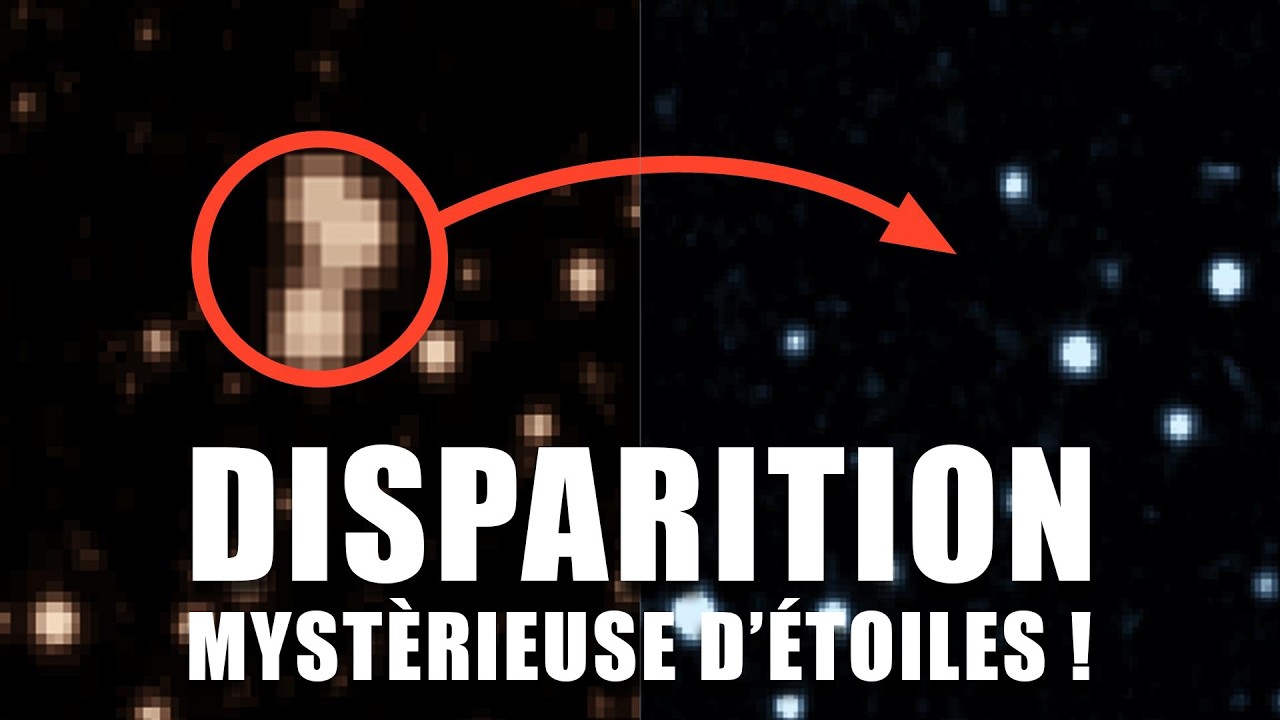
Ces 3 étoiles se sont évaporées sur une photo de 1952 et aujourd'hui encore c'est un MYSTÈRE !
These 3 stars vanished from a 1952 photo and it's still a MYSTERY today!
Keywords
Summary
335 words
Critical Evaluation
Value of the Information & Strength of the Argument
The information density is high and mostly of a concrete kind: instrument apertures and fields, exposure durations, survey dates, candidate counts, brightness ratios, and a chronological chain of studies from the first candidate list to the 2022 selection of 5,399 sources and the later re-analyses. Rather than asserting a single answer, the video constructs a space of explanations and tests them against evidence: outbursting low-mass stars, proper motion between catalogues, asteroids crossing the field, red objects invisible in blue plates, infrared-only counterparts, and physical plate or copy defects. Each is given a mechanism, not just a label, and the reasoning that eliminates or preserves it is stated, for instance that the red/blue filter change can explain the one-hour disappearance but not the absence from later red images, or that the simultaneous fading of three adjacent points points toward the photographic support itself.
The argumentation is strongest where it separates the empirical case from the theoretical one. The authors explicitly acknowledge that N6946-BH1 does not solve the 1952 mystery because it comes from a different observing programme, and they use it only to show that the physical channel exists and has been observed once. The discussion of dust is handled the same way: an opaque ejecta shell would hide a living star, but the absorbed energy must be re-emitted at longer wavelengths, so the hypothesis is testable in the infrared, and the survival of infrared emission from the N6946-BH1 region is presented as a constraint rather than as confirmation.
The main weaknesses are quantitative. The candidate list is discussed by order of magnitude without any estimate of how the 5,399 sources break down among the proposed explanations, and the plausibility of a failed supernova for the 1952 triplet is labelled improbable but not completely impossible without any figure attached. The claim that a real light source would leave a recognisable optical signature is reported as a finding without describing the diagnostic. Finally, the closing reframing of stellar death statistics — that gentle deaths may be more frequent than supernovae but simply less visible — is presented as an expectation of new monitoring programmes rather than as an established result, which is the correct epistemic status but leaves the central question of the video deliberately unresolved.
Scientific Rigor, Source Quality, Title Accuracy
The sourcing is unusually disciplined for the format. Eight references are supplied, most of them with a DOI pointing to peer-reviewed journals, plus a project document and several arXiv preprints; each stage of the narrative corresponds to one of them, and the video explicitly reports that two successive studies reached opposite conclusions about the nature of the missing points rather than retaining only the more spectacular one. Terminology is used precisely: the distinction between a source absent in the visible and a source genuinely gone, the difference between a supernova and a direct collapse, and the separate roles of the visible and infrared are all maintained. The limits of the evidence are stated openly: no distance and no nature can be assigned to the 1952 points, the case cannot be closed without a new detection at that position, and the physical scenario borrowed from N6946-BH1 is transposed to the 1952 triplet only as a possibility. Weak points are the absence of any indication of which links are preprints and which are refereed, the vague attribution of the 2024 and later 2026 studies to unnamed researchers, and the fact that the 2026 result is presented as a single-author counterpoint without mentioning its reception.
On the title, the three points, their 1952 date and the unresolved character of the case are all genuinely the subject of the video; the dramatic wording (’evaporated’, capitalised ‘MYSTERY’) overstates the certainty of a stellar interpretation that the video itself spends most of its runtime questioning, but the gap between promise and delivery remains modest.
647 words
Title / Content Match
The title promises the three 1952 points and a mystery, and the video delivers exactly that, including the explicit statement that the case remains unsolved. The verbs 'evaporated' and the capitalised 'MYSTERY' are dramatised relative to a scholarly framing, but not misleading about the content.
Quality & Reliability
8/10
The video rests on primary literature: eight references are listed in the description, most of them peer-reviewed (MNRAS, RAS Techniques and Instruments) or arXiv preprints, and each major claim is traceable to one of them. The presentation distinguishes hypotheses (plate artefacts, asteroids, outbursting low-luminosity stars, proper motion, dust obscuration, failed supernova) and reports the disagreement between the 2024 artefact study and the later 2026 re-analysis instead of settling it. Reservations: the status (preprint vs peer-reviewed) of each link is not indicated, several attributions stay vague ('two researchers', 'another researcher'), and numerical values are given without uncertainties.
Key Moments
Markers derived by PSI from the transcript: the creator did not define chapters.
- Opening statement of the case: three points recorded on a Palomar plate in July 1952, absent on the following exposure and never recovered since.
- Description of the first Palomar survey (1949-1958), its 1.2 m wide-field telescope and multi-colour plates, and introduction of the VASCO project comparing them with modern catalogues.
- From about a hundred early candidates to the 2022 selection of 5,399 sources present on the old plates with no identified modern counterpart.
- The specific case of the 1952 triplet: simultaneous fading within about an hour, and the fact that the first plate was red-sensitive while the second was blue-sensitive.
- The instrumental hypothesis: a 2024 re-examination of the Palomar archives concluding that most missing objects are probably artefacts, possibly linked to copying procedures.
- The opposing 2026 study reporting deformations on some of the points compatible with real light having passed through the telescope optics.
- Stellar equilibrium, iron core collapse, and the failed-supernova scenario of direct collapse to a black hole without a bright explosion; monitoring campaigns of supergiants since 2008.
- The case of N6946-BH1: a red supergiant of roughly 25 solar masses that brightened in 2009, faded in the visible, and had disappeared from Hubble images by 2015.
- Dust as a way to hide a living star: an opaque ejecta shell re-emits absorbed energy in the infrared, making the hypothesis testable; James Webb observations of the N6946-BH1 region in 2023.
- Closing assessment: the 1952 points remain an enigma, and the long-term value of archival plates as a time baseline for future discoveries.
Cited Sources
- VASCO project document (PDF, Uppsala University server) — Linked in the description; describes the project that compares historical Palomar plates with modern surveys in search of sources that appeared or vanished.
- MNRAS paper, doi:10.1093/mnras/stac1552 — Referenced in the description; corresponds to the 2022 study that produced the selection of 5,399 candidate sources present on the old plates and missing from recent archives.
- arXiv preprint 2310.09035 — Listed in the description among the references supporting the discussion of candidate vanishing sources and their follow-up.
- RAS Techniques and Instruments paper, doi:10.1093/rasti/rzae004 — Presented in the video as the 2024 re-examination of the Palomar archives concluding that most missing objects are probably artefacts, possibly related to plate copying and handling.
- Paper doi:10.33232/001c.172381 — The study, dated October 2026 in the video, reporting deformations on some of the points that are compatible with real light passing through the telescope optics.
- arXiv preprint 1609.01283 — Early reference listed in the description, tied to the first candidate searches comparing Palomar plates with modern observations.
- arXiv preprint 2309.16121 — Listed in the description among the follow-up references for the candidate sources.
- arXiv preprint 2604.05019 — Referenced in the description; corresponds to the 2026 analysis reporting that the luminosity of the N6946-BH1 remnant is about ten times fainter than the final luminosity of the star.
Concurring Sources
- N6946-BH1 — General reference on the supergiant that brightened in 2009 and vanished from visible-light images by 2015, consistent with the sequence described in the video.
- Failed supernova — Overview of the collapse-without-explosion scenario that the video presents as the theoretical channel capable of producing a silent disappearance.
- Palomar Observatory — Institutional context for the 1949-1958 photographic surveys and their wide-field telescope, as described in the opening minutes.
Dissenting Sources
- 2024 re-analysis of the Palomar archives, doi:10.1093/rasti/rzae004 — Concludes that most of the missing objects are probably artefacts, possibly introduced during copying or handling of the plates — a purely instrumental explanation that conflicts with any astrophysical interpretation of the candidates.
- 2026 study, doi:10.33232/001c.172381 — Reports deformations on some of the points compatible with real light having passed through the telescope optics, directly challenging the artefact interpretation, while still leaving the distance and nature of the sources undetermined.
Contribution & Novelties
The video’s distinctive contribution is the assembly of three normally separate strands into one coherent question. It first documents a specific archival anomaly — the 1952 Palomar triplet, with its two successive plates taken about an hour apart in different colour bands — then places it inside the systematic VASCO search, and finally asks the theoretical question that most treatments of the topic skip: does physics allow a star to disappear without a bright explosion? Connecting the archival anomaly to the failed-supernova channel, and that channel to a concrete observed object (N6946-BH1), gives the discussion an empirical anchor instead of leaving it at the level of anecdote. The treatment of dust and infrared emission adds a third, testable layer that transforms a disappearance into a specific observational signature. The closing reframing — that gentle stellar deaths may be more frequent than their visibility suggests, and that surveys of disappearances could correct a selection bias in how stellar mortality is counted — is the most transferable idea in the video.
Pour aller plus loin :
- N6946-BH1 — The reference object used to illustrate a massive star fading in the visible after a moderate brightening, now analysed in the infrared.
- Failed supernova — The physical channel of direct collapse to a black hole without a successful explosion, central to the second half of the video.
- Palomar Observatory — Host of the 1949-1958 photographic surveys whose glass plates constitute the historical time baseline exploited here.
- The VASCO project (Vanishing and Appearing Sources during a Century of Observations) — the systematic comparison programme behind the candidate lists discussed; cited by name because no stable reference page can be guaranteed without verification.
277 words
Radar Profile
The profile is dominated by information quantity and reliability, reflecting a dense, well-referenced narrative built on primary literature. The technical level sits in the middle: the physics of core collapse and failed supernovae is explained in mechanism terms without equations. The weakest axis is the resolution of the central question, since the video deliberately closes on an open case rather than a verdict.