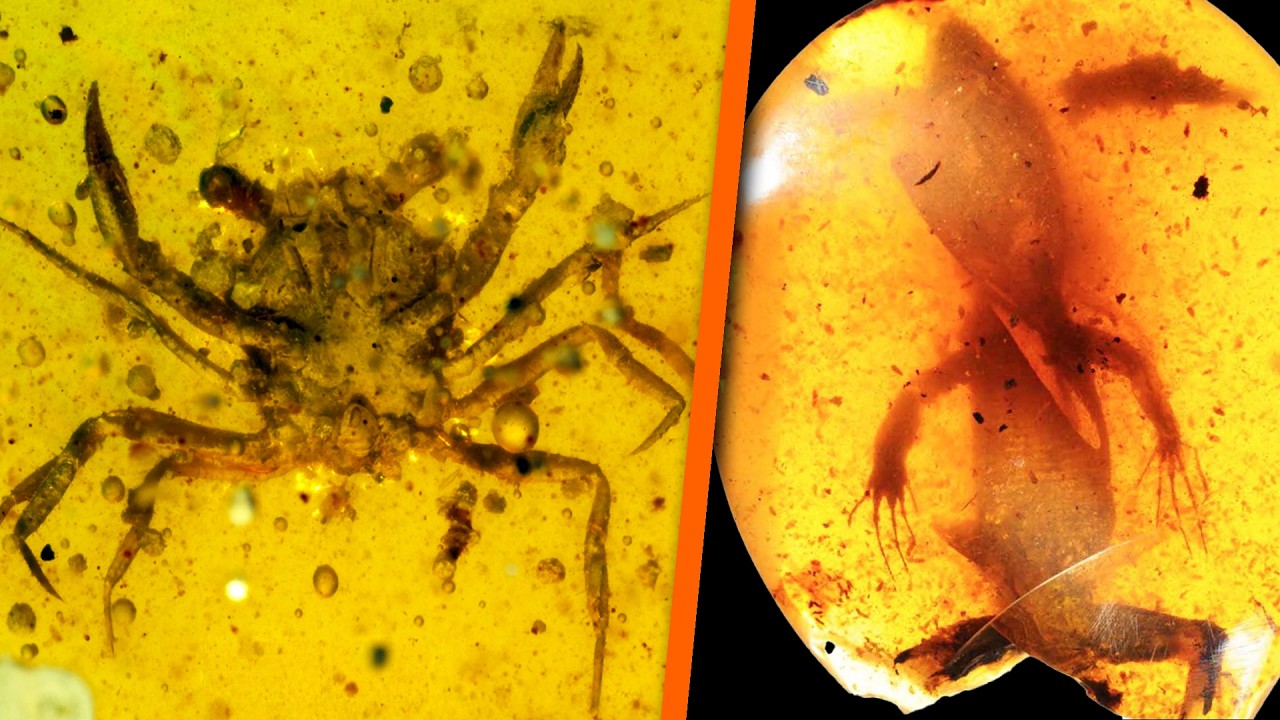
5 Strange Prehistoric Creatures Found Trapped in Amber - Part 2
Keywords
Summary
192 words
Critical Evaluation
Value of the Information & Strength of the Argument
The video’s value lies in its ability to translate complex paleontological findings into engaging, accessible narratives without oversimplifying the science. The presenter explains evolutionary significance (e.g., the crab’s role in dating freshwater crab origins), uses detailed anatomical descriptions to justify taxonomic assignments, and openly discusses a misidentification that was corrected through collaboration. The argumentation is solid: each claim is tied to specific studies, and when multiple interpretations exist, they are presented transparently. For instance, the chameleon misidentification is presented as a learning moment, not a failure, which strengthens credibility.
Scientific Rigor, Source Quality, Title Accuracy
The video demonstrates strong scientific rigor. Every major claim is backed by peer-reviewed sources, with direct links in the description. The sourcing is particularly robust: it includes not only the primary papers but also institutional news releases and ethics-related statements. The title is appropriate and matches the content precisely. The presenter explicitly mentions the ethical complexities of Myanmar amber, including the SVP’s guidance, which adds depth and responsibility. No commercial sponsorship is disclosed in the description, and there is no product placement. The content is well-structured and the sources are consistently referenced throughout, allowing viewers to verify information independently.
203 words
Title / Content Match
The title accurately reflects the content: five strange prehistoric creatures found trapped in amber, plus a bonus sixth entry.
Quality & Reliability
9/10
High-quality content with extensive citation of primary scientific papers, transparent handling of a scientific correction, and a clear ethical disclaimer about Myanmar amber. The presenter distinguishes evidence from interpretation and acknowledges collaboration and revision among researchers.
Chapters
Cited Sources
- Cretapsara athanata crab in amber (Science Advances) — Described the 99-million-year-old freshwater crab and its evolutionary significance.
- Smithsonian news release about the crab fossil — Provided additional press coverage on the crab discovery.
- Lizards and amphibian in amber (Science Advances) — The initial description of 12 lizard specimens, including the misidentified chameleon.
- Correction of chameleon identity to amphibian (Science) — The revisiting paper that reclassified the specimen as Yaksha peretti.
- Inverse article on the mistaken identity — Popular science coverage of the chameleon-to-amphibian correction.
- National Geographic article on the oldest chameleon — Provided background on the initial chameleon interpretation.
- Harvestman with penis preserved (Springer) — Original paper describing the fossil opilionid with preserved genitalia.
- Ammonite in amber (PNAS) — Described the ammonite shell and associated fauna in amber.
- Ammonite in amber (Scientific Reports) — Additional paper on the ammonite specimen.
- Baby dinosaur wings in amber (Nature Communications) — Paper describing enantiornithine wings with feathers.
- Phys.org article on ancient bird wings — News coverage of the wing fossils.
- SVP statement on Myanmar amber — Official guidance from the Society of Vertebrate Paleontology regarding ethical study of amber.
- Science article on the ethical minefield — Detailed discussion of the ethical issues surrounding Myanmar amber.
- Nature news article on amber ethics — Additional coverage of the ethical debate.
- Springer article on Myanmar amber ethics (GCR) — Academic article on conflict amber and its implications.
- Nature Communications paper on Myanmar amber ethics — More recent ethical analysis of amber provenance.
- Spider vs wasp battle in amber (video) — Bonus entry video showcasing a social spider hunting a wasp, also covering the oldest evidence of social behavior.
External References
Contribution & Novelties
This video contributes to science communication by synthesizing multiple recent discoveries in paleontology, highlighting how amber fossils provide exceptional preservation of soft tissues. It uniquely showcases the collaborative nature of science, as seen in the correction of the chameleon misidentification, and raises awareness of the ethical dilemmas in studying Burmese amber. The presenter goes beyond mere recitation of facts, explaining the evolutionary significance of each find and connecting them to broader questions about the Cretaceous biota.
Pour aller plus loin :
- Amber (Wikipedia) — Background on ambar preservation and its importance in paleontology.
- Enantiornithes (Wikipedia) — The extinct avian lineage to which the baby wings belong.
- Burmese amber (Wikipedia) — Detailed information about the source and the ethical concerns.
- Cretaceous (Wikipedia) — Geological context for the 99-million-year-old specimens.
128 words
Radar Profile
The radar chart would likely show high scores in all dimensions: quantity and quality of information are excellent, technical level is moderate (suitable for general audiences but with precise terminology), and reliability is high due to thorough sourcing. The balance indicates a well-rounded, trustworthy science communication piece.
💬 Sur les 30 commentaires analysés, l'orientation est très positive : les spectateurs expriment leur fascination pour les découvertes, félicitent le présentateur pour sa rigueur et la qualité des explications, et certains soulignent l'importance du dialogue scientifique et des considérations éthiques.