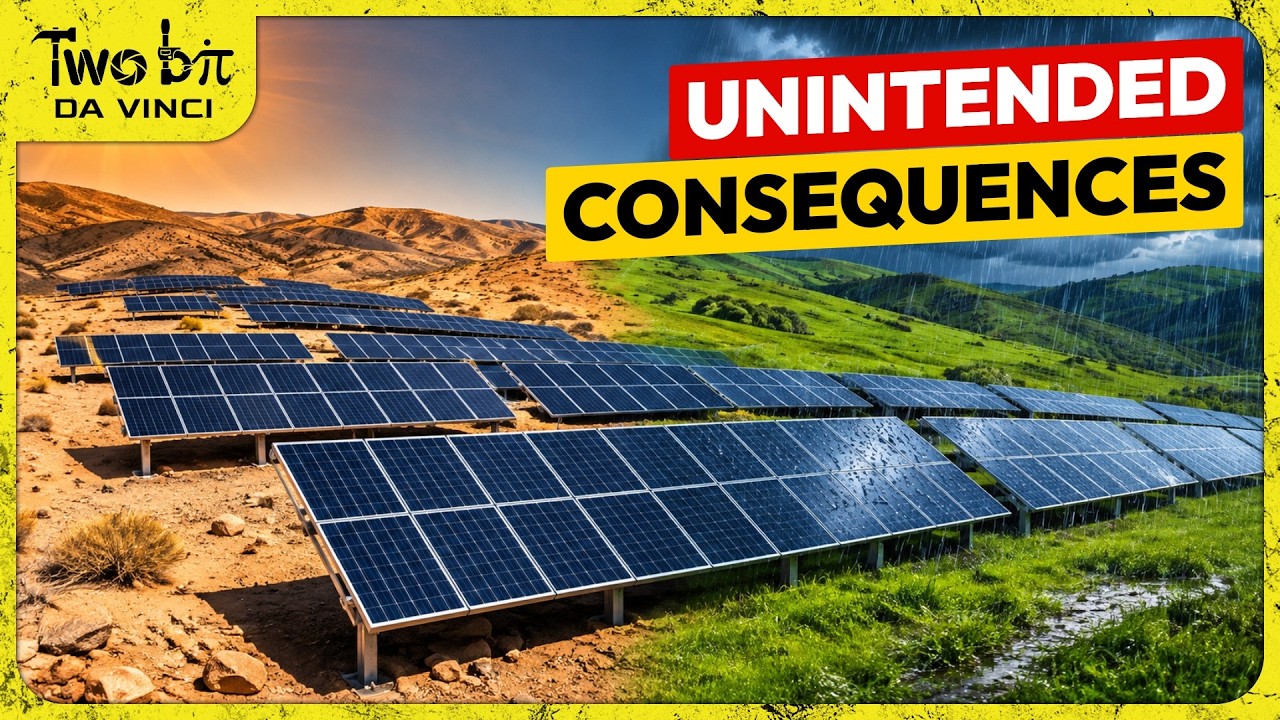
How a Solar Farm Could Make It Rain in the Desert
Title history
- How a Solar Farm Could Make It Rain in the Desert — observed on 20261121-1609 UTC (YouTube)
Keywords
Summary
208 words
Critical Evaluation
Value of the Information & Strength of the Argument
The video provides substantial value by synthesizing historical attempts, a recent scientific model, and practical engineering comparisons. It clarifies misconceptions by distinguishing between idealized black surfaces and real solar panels, and by quantifying the heat differences. The argumentation is solid, logical, and well-structured, walking the viewer through calculations and evidence. However, some calculations are presented as ‘rough estimates’ without full rigor, and the video sometimes speculates beyond the cited studies. The inclusion of a sponsored segment interrupts the flow but does not undermine the core analysis.
Scientific Rigor, Source Quality, Title Accuracy
The video cites several scientific studies, including the UAE rain enhancement model and a 2024 satellite study, but does not provide direct URLs, relying instead on mentions. The description contains only partner and support links, not primary sources. The title is appropriately matched to the content, which thoroughly explores the question. The video adheres to a clear structure and transparently labels its own estimates as such. While the scientific rigor is high, the lack of explicit citations and some unverified claims slightly lower the reliability score.
187 words
Title / Content Match
The title accurately reflects the video's central question, which is thoroughly investigated.
Quality & Reliability
8/10
The video is based on peer-reviewed studies and provides its own calculations, but some rough estimates and lack of direct source URLs reduce its score.
Chapters
Contribution & Novelties
The video offers an original synthesis by analyzing the thermodynamic differences between black-painted surfaces and real solar panels, and by comparing rain enhancement with desalination in terms of water yield. It highlights the efficiency paradox and the unintended climate consequence of solar farms darkening deserts. The ‘Pour aller plus loin’ section suggests exploring related concepts.
Pour aller plus loin :
- Solar Farm — Overview of photovoltaic power stations and their environmental impacts.
- Weather Modification — Historical and modern techniques, including cloud seeding and heat-induced convection.
- Desalination — Process of removing salt from seawater, with energy and environmental considerations.
- Climate Engineering — Interventions to combat climate change, such as solar radiation management.
111 words
Radar Profile
The profile shows high scores in information quantity and quality, indicating a rich and well-researched content. Technical depth and reliability are slightly lower, reflecting the use of approximations and the absence of direct source links. Overall, the radar suggests a scientifically valuable but not perfectly rigorous video.