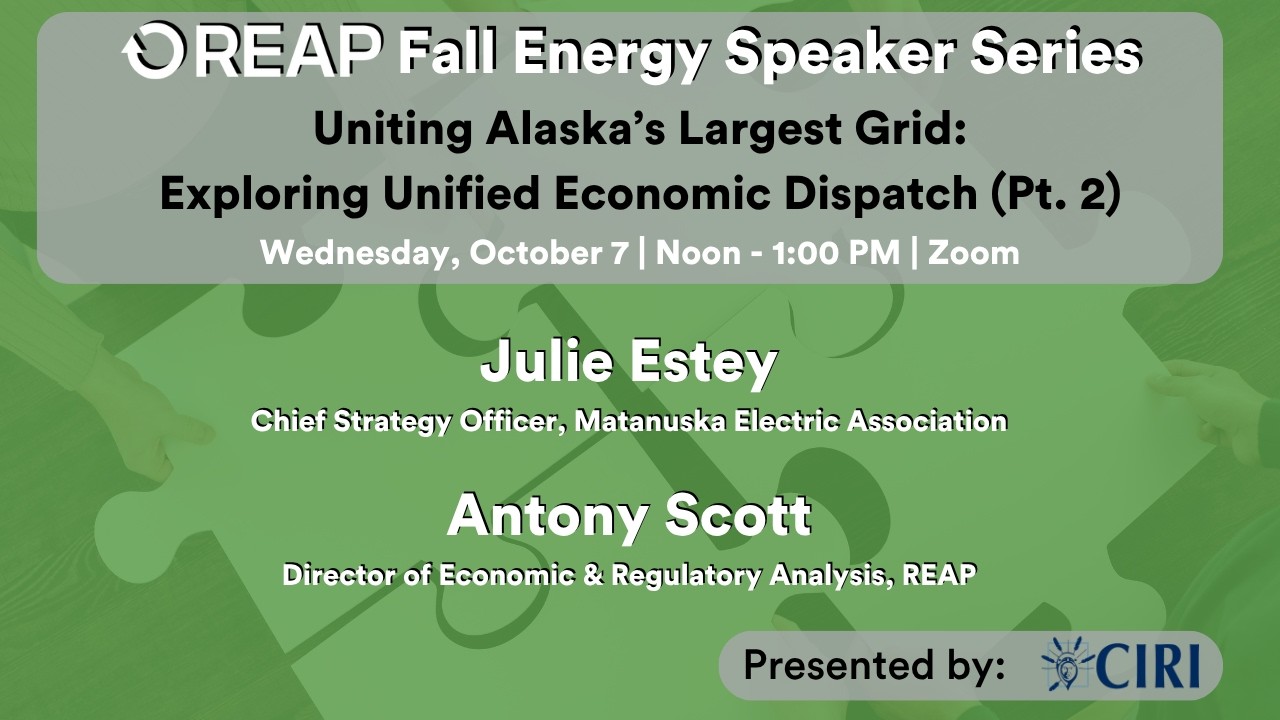
2026 Fall Energy Speaker Series | Exploring Unified Economic Dispatch (Pt. 2)
Keywords
Summary
192 words
Critical Evaluation
Value of the Information & Strength of the Argument
The information provided is valuable for understanding the practical and institutional dimensions of implementing unified economic dispatch in Alaska. The speakers offer concrete examples, such as the tight power pool between MEA and Chugach, including its operational structure, the split of responsibilities (Chugach dispatches, MEA schedules), and the role of an independent auditor. They quantify realized savings at $6.8 million per year, which grounds the discussion in actual outcomes rather than theoretical projections. The argumentation is coherent and balanced: they acknowledge that UED is beneficial but note that savings depend on cost differentials between utilities, and that high reserve margins reduce the urgency for new generation. They also candidly discuss barriers to a single G&T utility, including bond covenants and co-op voting thresholds. The reasoning is logical, moving from definitions to practical models, then to constraints and next steps. However, the argumentation relies heavily on the speakers’ expertise and internal knowledge, with limited external data or modeling presented in the transcript. The discussion of trust and institutional design is insightful but remains qualitative.
Scientific Rigor, Source Quality, Title Accuracy
The webinar maintains a high level of scientific and technical rigor for a policy discussion. The speakers reference specific documents, such as the 2025 auditor’s report for the tight power pool, which found no evidence of gaming, and they mention the RCA’s role in setting rules. They also refer to studies and reports on potential savings, though these are not detailed in the transcript. The sources cited are primarily institutional and regulatory rather than academic, which is appropriate for the topic. The title accurately reflects the content, as the entire discussion centers on unified economic dispatch and its practical implementation in the Railbelt. The host provides a clear recap of the previous session, ensuring continuity. No comments were provided for analysis, so no public trends are assessed.
315 words
Title / Content Match
The title accurately reflects the content: it is the second installment of a speaker series focused on unified economic dispatch in Alaska's Railbelt, and the discussion stays on that topic throughout.
Quality & Reliability
7/10
The speakers are credible experts (a utility chief strategy officer and a regulatory analysis director) and the discussion is grounded in concrete operational experience, including the MEA–Chugach tight power pool, its third-party audit, and the $6.8 million in realized savings. However, the webinar is a conversational expert opinion rather than a peer-reviewed study, and several claims (e.g., future savings, reserve margins) are qualitative or based on internal knowledge without citations in the transcript.
Key Moments
Markers derived by PSI from the transcript: the creator did not define chapters.
- Introduction and land acknowledgment; overview of the webinar series and speakers.
- Recap of the previous webinar: definitions of security-constrained economic dispatch vs. unified economic dispatch.
- Discussion of the baseline: utilities retaining ownership of existing generation; challenges of forming a single G&T utility.
- Julie Estey explains co-op voting thresholds and asset disposition rules that complicate consolidation.
- Antony Scott notes high reserve margins (>50%) and questions the need for new large generation.
- The tight power pool between MEA and Chugach is presented as a working model and potential starting point.
- Discussion of trust, shared responsibilities, and the role of an independent auditor in the power pool.
- Antony Scott highlights the 2025 auditor's report finding no evidence of gaming and $6.8 million in savings.
- Explanation of how savings are calculated: joint dispatch vs. hypothetical standalone dispatch.
- Mention of upcoming RCA order on transmission cost sharing and the RTO legislation.
Contribution & Novelties
This webinar provides an update on the practical steps and current decisions that could affect the adoption of Unified Economic Dispatch in Alaska’s Railbelt. It builds on the introductory session by focusing on implementation pathways, particularly the tight power pool as a scalable model, and discusses institutional safeguards like independent auditing and shared operational responsibilities. The speakers offer candid insights into the political, financial, and cultural barriers to consolidation, and they highlight the role of high reserve margins in shaping the value proposition of UED. The discussion also touches on the upcoming RCA order on transmission cost sharing, which could influence future grid operations.
Pour aller plus loin :
- Unified Economic Dispatch — Wikipedia article on economic dispatch, providing background on the concept.
- Alaska Railbelt — Wikipedia article on the Railbelt region and its energy infrastructure.
- Tight power pool — Wikipedia article on power pools, relevant to the MEA–Chugach agreement.
150 words
Radar Profile
The radar profile shows a strong emphasis on information quality and technical depth, with slightly lower scores for quantity and overall reliability due to the conversational format and reliance on expert opinion. The balance suggests a well-informed discussion that is credible but not exhaustive.