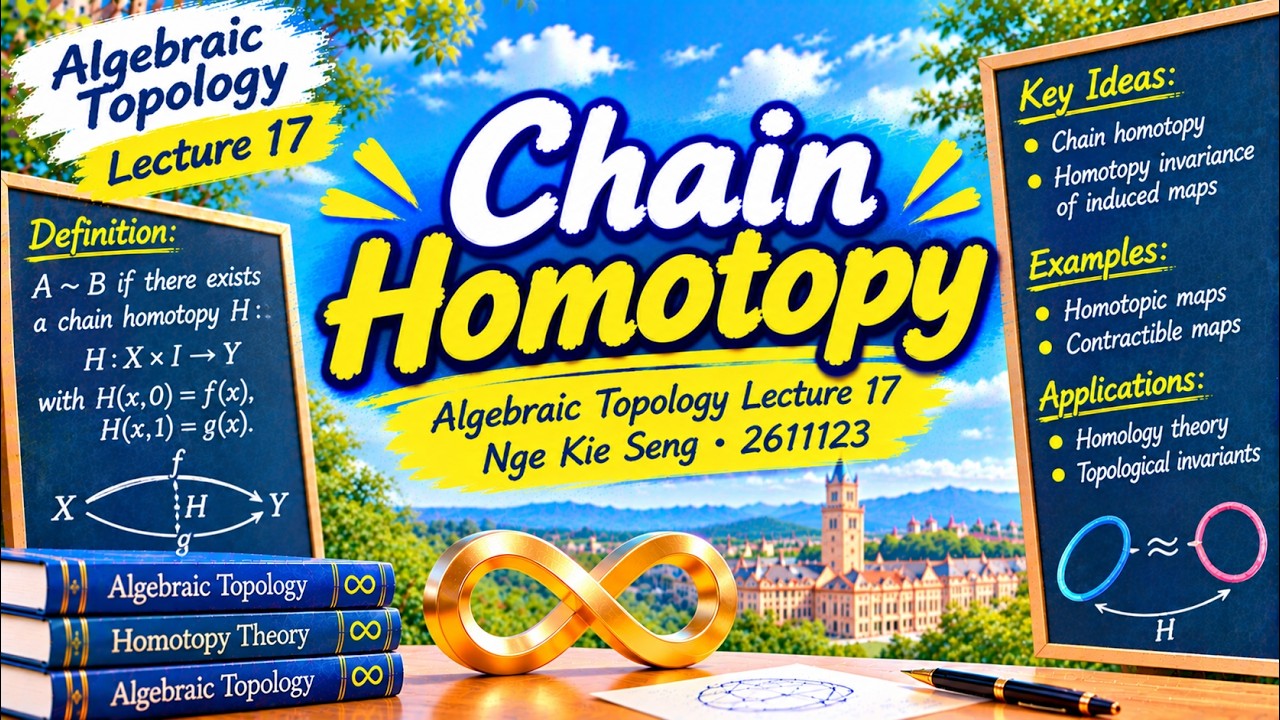
Chain Homotopy | Algebraic Topology Lecture 17 | Nge Kie Seng 2611123
Keywords
Summary
159 words
Critical Evaluation
Value of the Information & Strength of the Argument
The lecture provides a solid foundational treatment of algebraic topology concepts, with clear logical progression from previous results to new definitions and proofs. The instructor emphasizes the intuition behind mathematical constructs, such as why reduced homology is convenient and how chain maps preserve algebraic structure. Arguments are presented step-by-step, with frequent reminders to check verification conditions, which reinforces understanding. However, the presentation is occasionally interrupted by irrelevant tangents and informal address, which slightly detracts from the overall argumentation density.
Scientific Rigor, Source Quality, Title Accuracy
The lecture follows standard mathematical exposition without citing external sources, relying on established material in algebraic topology. The content is consistent with typical graduate-level courses, and the definitions and proofs are mathematically sound. The title ‘Chain Homotopy’ is only partially covered in this session, as the main focus lies on reduced homology and chain maps, with chain homotopies mentioned as a goal for subsequent lectures. Hence, the title may be slightly ahead of the actual content covered.
171 words
Title / Content Match
The title 'Chain Homotopy' accurately reflects a key concept covered, though the lecture also delves into related topics such as reduced homology and chain maps.
Quality & Reliability
7/10
The lecture is mathematically rigorous, providing detailed definitions, proofs, and diagrams. However, frequent digressions about administrative matters and informal asides reduce focus. No external sources are referenced, but the content aligns with standard algebraic topology textbooks.
Key Moments
Markers derived by PSI from the transcript: the creator did not define chapters.
- Opening announcements about a geometry conference and midterm exam, plus schedule reminders.
- Review of the previous result: H0(X) ≅ Z for path-connected spaces, and brief mention of H1.
- Introduction of reduced homology by attaching an augmentation map ε: C0(X) → Z, defining the augmented chain complex.
- Proof that the augmentation map is a chain map and that reduced homology for a point is zero.
- Proposition: H0(X) ≅ H̃0(X) ⊕ Z; strategy using first isomorphism theorem and kernel of ε.
- Discussion on how to prove the isomorphism when X is not path-connected by quotienting further.
- Motivation for homotopy invariance: goal to show homology equivalent spaces have isomorphic homology.
- Definition of induced map on chain complexes via composition with f; introduction of chain map definition.
- Verification that f# is a chain map: proof of f#∘∂ = ∂'∘f#.
- Ending remarks on identity and composition, previewing chain homotopies.
Contribution & Novelties
The lecture adds pedagogical value by linking the abstract notions of reduced homology and chain maps to concrete computational examples and by emphasizing the interplay between topology and algebra. The instructor’s informal style, while occasionally distracting, can help make advanced topics accessible.
Pour aller plus loin :
- Reduced homology (Wikipedia) — Provides a concise definition and properties of reduced homology, complementing the lecture.
- Chain map (Wikipedia) — Explains chain maps and their role in homology, aligning with the second half of the lecture.
- Homotopy (Wikipedia) — Covers the concept of homotopy, which is essential for understanding the upcoming discussion on homotopy invariance.
102 words
Radar Profile
The radar profile shows high technical level and quantitative information, consistent with an advanced mathematics lecture. Quality and reliability are moderate, reflecting the informal delivery and lack of external references, but the mathematical content is sound. The fiabilité_globale score aligns with standard pedagogical practice in university lectures.