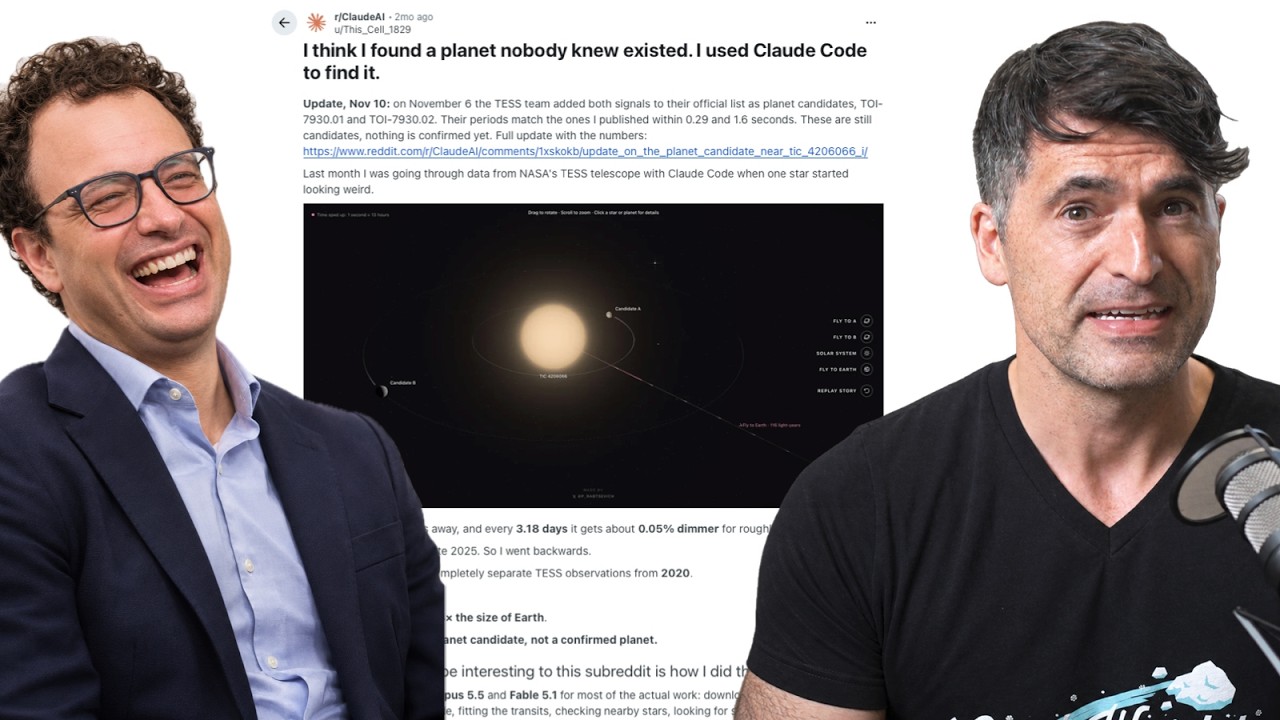
Claude is Detecting Exoplanets?!
Keywords
Summary
302 words
Critical Evaluation
Value of the Information & Strength of the Argument
The informational value is high because the video does not merely relay a viral claim; it re-reads that claim through the operational standards of the field. The most useful contribution is the explicit ladder of credibility — threshold crossing event, TESS object of interest, validated planet below 1% false-alarm probability, confirmed planet with a measured mass — which converts a vague debate about ‘discovery’ into a measurable threshold. The argument is structured as a reviewer’s report: what was done, what was done well, what was overdone, and what was left undone. Kipping is careful to grant credit where it is due, noting that the AI agent installed and ran a standard vetting package and that the request for higher-cadence observations is intrinsically worthwhile at near-zero cost. His central objection is not about competence but about prioritisation: the analysis obsesses over whether the signal recurs, a question already settled by nine periodic transits, while leaving unexamined the degeneracies that actually threaten the planetary interpretation. The reasoning here is sound and is grounded in a concrete, checkable argument — three transits already exceed the Kepler criterion, nine make chance coincidence implausible — and he concedes the residual possibility that a signal could vanish in a later sector while explaining why that scenario is contrived. The comparative framing against contemporaneous AI results in mathematics and physics is the weakest link: those claims are summarised from announcements rather than examined, and the claim that the resulting proofs are thousands of pages long and ‘inelegant’ is attributed to named mathematicians but not analysed. The concluding analogy with supercomputers in the 1960s is a rhetorical device rather than an argument, though it is honestly presented as a personal framing. Overall the reasoning is disciplined, self-limiting about expertise, and explicit about where evidence ends and opinion begins.
Scientific Rigor, Source Quality, Title Accuracy
Sources are the strongest feature: the description lists the primary literature actually discussed, including the TRICERATOPS vetting paper, the Kepler and K2 deep-learning studies, ExoMiner, the withdrawn GJ 774 A preprint, the NASA Exoplanet Archive, Planet Hunters TESS, and the submission policies of JOSS and the Research Notes of the AAS. Each is used for the purpose it was designed for, and numerical claims — 342,199 threshold crossing events, 8,175 objects of interest, 1,027 validated TESS planets, 166 Planet Hunters candidates, 301 ExoMiner validations — are specific and traceable to public catalogues. The claim that TESS team members knew of the source internally since 2020 is attributed to an interview and correctly flagged as unverifiable without a public record, which is exactly the right treatment. Two elements fall short of the same standard: the account of 2026 AI results in mathematics and fundamental physics, and the alleged OpenAI JWST proposal, which is introduced as rumour said to have been confirmed without any named source. The video is also transparent about a structural feature of its own format: it contains a promotional segment of roughly one hundred seconds between the introduction and the main analysis. On the title, ‘Claude is Detecting Exoplanets?!’ is faithful to the content, since the video’s own verdict is that the object is a candidate rather than a planet, and the interrogative framing carries that qualification.
544 words
Title / Content Match
The title matches the content: the video does examine whether an LLM detected an exoplanet, and the question mark correctly signals that the answer is a planetary candidate, not a confirmed planet.
Quality & Reliability
8/10
The analysis is delivered by a practising exoplanet researcher who correctly applies professional criteria (three-transit rule, 1% false-alarm threshold, TRICERATOPS vetting, candidate vs validated vs confirmed tiers) and cites the relevant literature. It is careful to hedge (the candidate is not validated, the 'first discovery' claim is unresolvable without public records, the JWST-proposal anecdote is explicitly flagged as rumour). Points of weakness: several of the 2026 AI mathematics/physics announcements are reported second-hand without independent verification, the video leans on a contested recounting of a withdrawn preprint, and part of the argument rests on personal impressions rather than documented evidence.
Chapters
Cited Sources
- Reddit post: 'I think I found a planet nobody knew existed' — The viral claim under review, in which a non-astronomer reports an AI-assisted exoplanet candidate search in TESS sector 98 data.
- Giacalone, S. et al. (2021), Vetting of 384 TESS Objects of Interest with TRICERATOPS — The false-positive vetting framework the AI agent ran, yielding a 3–4% false-positive rate for the candidate.
- NASA Exoplanet Archive — Source of the population statistics quoted for threshold crossing events, TESS objects of interest and validated planets.
- Zooniverse, Planet Hunters TESS — Citizen-science programme credited with 166 candidate reports in TESS data, used to contextualise the novelty of the claim.
- Shallue, C. J. & Vanderburg, A. (2018), Identifying Exoplanets with Deep Learning — Decade-old precedent for machine-learning exoplanet detection in Kepler data, cited to show that AI planet hunting is not new.
- Yu, L. et al. (2019), Identifying Exoplanets with Deep Learning in K2 Data — Follow-up deep-learning search in K2 photometry, presented as the continuation of that line of work.
- Valizadegan, H. et al. (2022), ExoMiner: A Highly Accurate and Explainable Deep Learning Classifier that Validates 301 New Exoplanets — Example of the scale reached by established AI pipelines, invoked against the novelty framing of the Reddit post.
- Tripp, J. (2026), A Sub-Earth-sized TESS Planet Candidate in the Nearby M-dwarf Binary GJ 774 (withdrawn) — Second AI-assisted claim discussed; withdrawn by arXiv for not meeting standards on generative-AI use.
- OpenAI (2026), AI-generated mathematical research collection — Repository of AI-written mathematics papers with computer-checkable proofs, cited in the opening survey of AI results in mathematics.
- OpenAI (2026), Ten Advances in Mathematics and Theoretical Computer Science — Announcement document referenced when framing the contrast between AI's impact in mathematics and in astronomy.
- Journal of Open Source Software, submission requirements — Policy requiring a six-month development history, cited as an example of journals adapting to AI-assisted submissions.
- Research Notes of the American Astronomical Society, submission guidelines and policies — Venue that tightened its rules against paper spamming describing one or a few new candidates found in a non-systematic way.
- OpenAI announcement of mathematical research results (6 October 2026) — Social-media announcement referenced in the description; discussed in the video as part of the recent wave of AI mathematics claims.
- Durrett, G. (2026), response to AI-generated claims of errors in astrophysics papers — Public rebuttal in which three of the alleged errors flagged by an AI scan of 150,000 theory papers were checked and found not to be errors.
Concurring Sources
- Giacalone, S. et al. (2021), TRICERATOPS vetting of TESS Objects of Interest — Supports the point that a 3–4% false-positive probability does not meet the conventional 1% validation threshold.
- Valizadegan, H. et al. (2022), ExoMiner — Confirms that machine learning has already delivered validated planets at scale, consistent with the video's argument that AI planet hunting is not new.
- Shallue, C. J. & Vanderburg, A. (2018), Identifying Exoplanets with Deep Learning — Independent precedent corroborating the chronology of AI-based transit searches presented in the video.
- NASA Exoplanet Archive — Public catalogue against which the population figures quoted in the video can be checked.
Dissenting Sources
- Reddit post: 'I think I found a planet nobody knew existed' — The headline asserts a planet and an unprecedented discovery, whereas the underlying analysis yields a candidate with a 3–4% false-positive probability and the priority claim cannot be settled without a public record.
- Claim that an AI scan of 150,000 theoretical astrophysics papers found 872 major errors — Presented in the video as an unverified social-media claim; the three alleged errors that were independently scrutinised turned out not to be errors, which undercuts the headline figure.
External References
Contribution & Novelties
The original contribution is not the exoplanet candidate itself, which sits within an existing population of more than eight thousand TESS objects of interest, but the calibration of what an AI-assisted amateur result is actually worth. The video installs a worked example inside a credibility ladder and shows precisely where the claim lands: above a threshold crossing event, level with a TESS object of interest, below the 1% false-alarm bar required for validation, and far below a confirmed planet with a measured mass. It also documents, in near real time, how the surrounding institutions are reacting — arXiv withdrawing a generative-AI preprint and capping submissions, a software journal requiring a six-month development history, a research-notes journal restricting non-systematic candidate papers. The reviewer’s critique of priorities is the sharpest analytical move: nine strictly periodic transits already satisfy the Kepler criterion, so repeated periodicity tests are redundant while the genuinely threatening scenarios — grazing eclipsing binaries, brown dwarfs, hierarchical triples, blending — remain untested, and higher-cadence photometry is valuable for resolving ingress shape and stellar density rather than for confirming recurrence. The closing distinction between AI plus an amateur and AI plus a domain expert is a defensible framing of where the leverage actually lies.
Pour aller plus loin :
- Transit method — Background on the photometric technique underlying every signal discussed, including ingress and egress geometry.
- Transiting Exoplanet Survey Satellite — Context for the sector-based cadence and data products used by the AI search.
- Lean (proof assistant) — Explains the computer-checkable proof language invoked when contrasting AI results in mathematics with those in astronomy.
- Riemann hypothesis — Reference point for the mathematics claims discussed in the opening section.
- Citizen science — Framework for situating Planet Hunters TESS and the amateur-plus-AI configuration the video examines.
- arXiv — Context on preprint moderation and the withdrawal of the second AI-assisted claim.
307 words
Radar Profile
The profile is broad and dense rather than narrowly technical: information quantity and quality are both high because the video combines a specific case study with population statistics and literature history. The moderate technical score reflects an deliberately accessible treatment of transit photometry and vetting statistics rather than any lack of substance, while overall reliability tracks the author's professional standing and his explicit separation of verified fact from rumour.