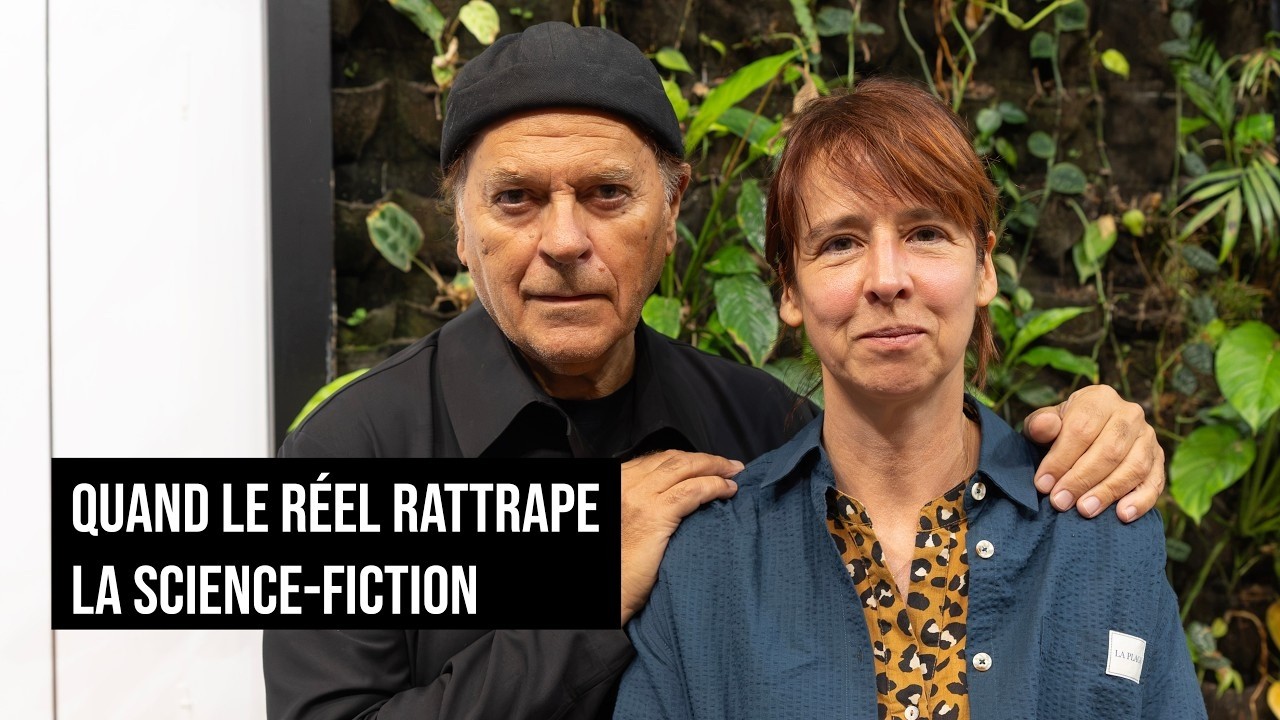
QUAND LE RÉEL RATTRAPE LA SCIENCE-FICTION
WHEN REALITY CATCHES UP WITH SCIENCE FICTION
Keywords
Summary
151 words
Critical Evaluation
Value of the Information & Strength of the Argument
The value of the information lies in the unique perspective of an artist who has long engaged with science fiction and geopolitics. Bilal offers a creative and philosophical lens on contemporary issues, linking personal memory with global trends. His argumentation is largely associative and experiential rather than systematic; he builds a narrative around concepts like the ‘grand basculement’ and the oxymoron of ‘artificial intelligence’ without providing empirical evidence. However, his reflections on the rapid pace of technological change and the persistence of human barbarism are thought-provoking and resonate psychologically, even if not scientifically proven.
Scientific Rigor, Source Quality, Title Accuracy
The rigor of the content is limited by the nature of an interview—subjective and non-referential. Bilal mentions thinkers like Paul Virilio and references films like The Matrix, but these are used to illustrate his points rather than as rigorous sources. The description provides links to WE DEMAIN and Ideas in Science, which are institutional but not research-oriented. The title of the video accurately reflects the conversation’s focus on the intersection of science fiction and reality, without exaggeration.
186 words
Title / Content Match
The title accurately captures the central theme of the discussion: how current technological and political realities increasingly mirror science fiction scenarios.
Quality & Reliability
6/10
The interview offers insightful reflections from a noted artist but relies on personal opinions and anecdotes rather than verifiable data. Claims about AI timelines and political figures are anecdotal and not systematically sourced.
Key Moments
Markers derived by PSI from the transcript: the creator did not define chapters.
- Introduction of Enki Bilal and discussion of his name and background.
- Discussion on the concept of 'grand basculement' and the shift in human narrative.
- Reflection on the impact of AI, the oxymoron of 'intelligence artificielle', and the fear of AI's rapid advancement.
- Comparisons between the war in Ukraine and WWI trenches; critique of political leaders.
- Discussion on art, creativity, and the role of artists in foreseeing the future.
- Consideration of hope, generational shift, and the potential for AI to save the planet.
Cited Sources
- Ideas in Science — Main channel website with over 3000 scientific lectures.
- WE DEMAIN — The magazine that hosted the event and features Enki Bilal on its cover.
- Playlist – Ideas in Science — A playlist associated with the channel, likely containing related content.
- Support Ideas in Science — Donation page for the free scientific video library.
Contribution & Novelties
The interview offers a first-person artistic perspective on how current events mirror science fiction tropes, particularly around AI and societal collapse. Bilal’s notion of the ‘grand basculement’ is a compelling metaphorical framing of our contemporary moment, blending personal biography with global analysis. His critique of political reaction to AI and right to life extension is provocative, though it remains speculative.
Pour aller plus loin :
- Paul Virilio — Theory of speed and acceleration, central to Bilal’s argument.
- Three Laws of Robotics (Asimov) — Reference to AI ethics and safety, related to Bilal’s concerns about AI autonomy.
- The Matrix — Film that illustrates the idea of AI viewing humanity as a virus, as cited in the interview.
- Artificial Intelligence — Overview of AI development and its societal impacts, providing background context.
130 words
Radar Profile
The profile shows a moderate level of information quantity and quality, with low technical complexity and medium reliability. This reflects a conversational, opinion-heavy piece rather than a data-driven analysis.