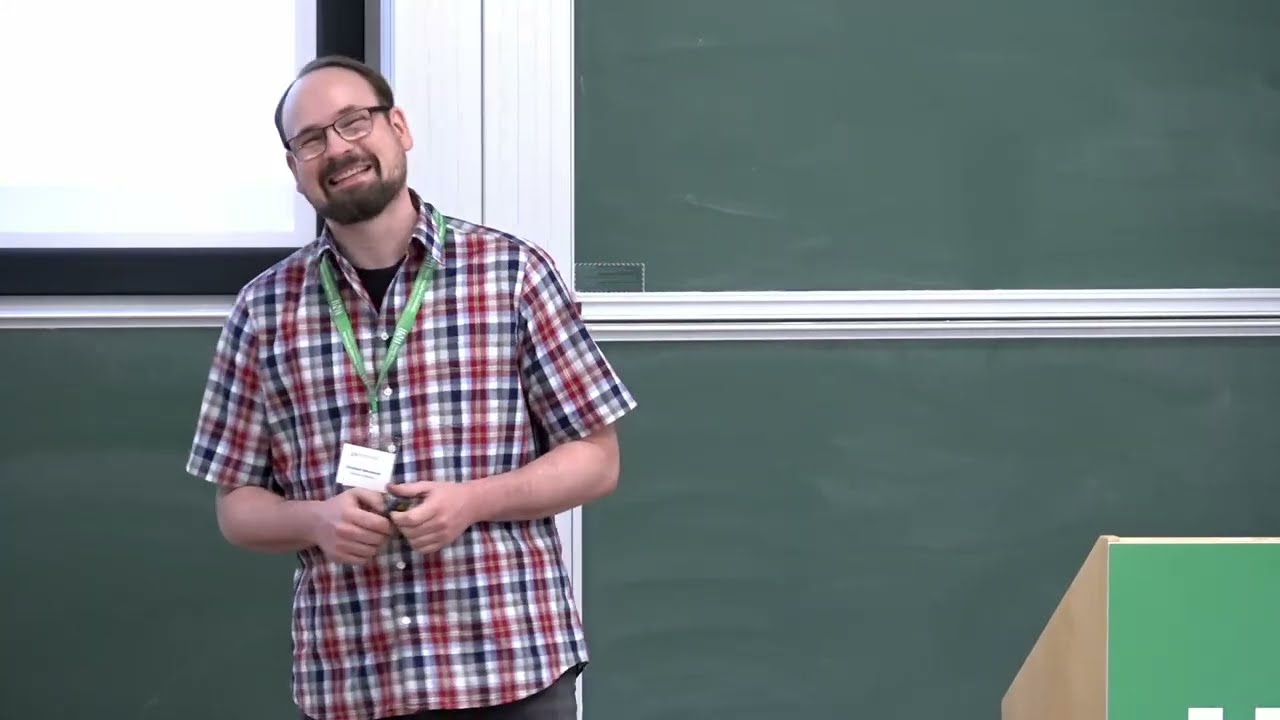
Prof. Christian Ikenmeyer | Kronecker products and iterated matrix multiplication
Keywords
Summary
145 words
Critical Evaluation
Value of the Information & Strength of the Argument
The talk’s primary value lies in offering a fresh, unifying perspective that avoids known pathologies of the determinant-permanent setup. The argumentation is rigorous, with careful attention to definitions and a clear demonstration of how proposed objects satisfy desirable algebraic-geometric and invariant-theoretic properties. The speaker justifies each design choice, ruling out alternatives (e.g., trace variants) by showing they break key results like Nisan’s theorem. The presentation of concrete corollaries (e.g., new algorithms, hardness over all semirings) strengthens the case for the validity and usefulness of the framework.
Scientific Rigor, Source Quality, Title Accuracy
The talk is a technical seminar presentation, likely based on preprints or papers in progress. The only concrete sources provided are the institutional links (newton.ac.uk) and the seminar page, which we list. The speaker references known works by Valiant, Mulmuley–Sohoni, Nisan, and others but does not provide specific citations in the accessible material. The title is highly accurate, as the content indeed revolves around Kronecker products and iterated matrix multiplication, though the talk reaches beyond into broader complexity implications. No comments were available for analysis.
186 words
Title / Content Match
The title precisely describes the mathematical objects (Kronecker products, iterated matrix multiplication) discussed in the talk.
Quality & Reliability
8/10
Lecture by a recognized researcher presenting new formal results in algebraic complexity theory, with rigorous definitions and proofs suggested; however, full verification of claims would require the underlying papers.
Key Moments
Markers derived by PSI from the transcript: the creator did not define chapters.
- Introduction of the determinant vs permanent problem and motivation.
- Issues with the standard setup, characteristic two problem, and need for replacement.
- Definition of the new objects: computant and hypercomputant.
- Discussion of width, its properties, and connection to Nisan's result.
- Presentation of corollaries: division-free algorithms, hardness results, and removal of characteristic restrictions.
- New conjecture and its connection to existing complexity classes.
Cited Sources
- Isaac Newton Institute for Mathematical Sciences — General institutional homepage providing background on the research environment.
- Seminar page: Frontiers in complexity lower bounds — Official seminar details for the talk, including abstract and speaker information.
Concurring Sources
- Seminar page — Confirms the event, speaker, and topic, consistent with the video content.
Contribution & Novelties
The talk presents a novel framework that replaces the determinant and permanent with ‘computant’ and ‘hypercomputant’, which are defined to maximize desirable algebraic, geometric, and invariant-theoretic properties while remaining well-defined over all commutative semirings and for symmetric, tensor, and exterior algebras. This yields a unified approach that avoids characteristic-two failures and leads to several new results, including broadened hardness results and improved algorithms. The contribution is significant for computational complexity theory, potentially providing a cleaner foundation for future lower-bound proofs.
Pour aller plus loin :
- Geometric complexity theory — The research program the talk aims to rehabilitate.
- Algebraic branching program — The computational model underlying the width notion.
- Valiant’s permanent conjecture — The classical conjecture addressed by the talk.
119 words
Radar Profile
The radar chart shows very high technical level and high information quality, but moderate quantity of information (due to focus on a single research thread). The global reliability is high, reflecting the speaker's expertise and formal nature of the content.