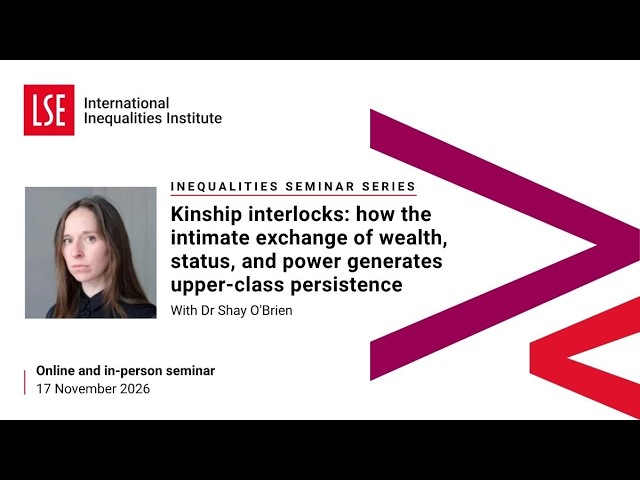
Kinship Interlocks | LSE III Event
Keywords
Summary
141 words
Critical Evaluation
Value of the Information & Strength of the Argument
The value of this presentation lies in the introduction of a new, testable concept—‘kinship interlocks’—which bridges economic sociology and stratification research. The argument is well-constructed, moving from an illustrative example to a theoretical framework, then to data and methods, and finally to evidence. The mixed-methods design strengthens credibility, as population-level patterns are validated with in-depth case studies. The speaker acknowledges limitations (e.g., whiteness of the data) and shows reflexivity about methodological choices. The argument that kinship interlocks function through protection and propulsion is persuasive, supported by historical examples and systematic data analysis. The integration of race, gender, and sexuality into the analysis adds theoretical depth.
Scientific Rigor, Source Quality, Title Accuracy
The talk demonstrates high scientific rigor. The dataset is meticulously hand-built from archival sources, including social registers and elite lists, ensuring detailed kinship mapping. The speaker cites established scholars (e.g., Seamus Khan, Robert Mare, Julia Adams, Granovetter, Burt) and situates her work within existing literature. However, no specific URLs or published works are given in the talk, so the audience must rely on the presenter’s credibility. The title ‘Kinship Interlocks’ accurately reflects the core concept, and the content matches the advertised topic. The presentation is well-organized and appropriately detailed for an academic seminar.
213 words
Title / Content Match
The title accurately reflects the seminar's focus on kinship interlocks and the LSE III event context, matching the content presented.
Quality & Reliability
8/10
The talk presents original research based on a hand-built dataset of over 20,000 elite individuals across 122 years in Dallas, combining quantitative network analysis with qualitative case studies. The methodology is transparent, and the scholar cites key literature in sociology. The concept of 'kinship interlocks' is novel and well-argued, though the full supporting paper is not provided.
Key Moments
Markers derived by PSI from the transcript: the creator did not define chapters.
- Introduction by Mike Savage, presenting Dr Shay O'Brien and her background.
- Opening example: Agnes and Betty, two similar women with vastly different descendant outcomes.
- Literature review: kinship networks, stratification, and elite persistence, plus the concept of kinship interlocks.
- Data and methods: hand-built dataset of Dallas elites, definitions of upper class and elites, reasons for choosing Dallas.
- Results: quantitative overview and case studies illustrating protection and propulsion mechanisms, including gender and race dynamics.
- Summary and implications, followed by Q&A session.
Cited Sources
- The Power Elite (concept of elites) — Referenced via Seamus Khan's definition of elites as individuals with vastly disproportionate access to resources.
- Robert Mare's work on multigenerational inequality — Cited as inspiration for studying inequality in a multigenerational perspective.
- Julia Adams on intimate ties and political economy — Mentioned as part of the tradition framing resource flows through intimate ties.
- Granovetter's weak ties and Burt's structural holes — Referenced as precedents for linking abstract network structures to economic outcomes.
- Board interlocks literature — Used as the basis for the concept of kinship interlocks, comparing corporate and family networks.
Contribution & Novelties
The main contribution is the introduction and empirical grounding of ‘kinship interlocks’, a concept that extends the idea of board interlocks to family networks, showing how intimate ties combine wealth, status, and power to enable multi-generational elite persistence. The mixed-methods approach, using a comprehensive hand-built dataset, offers a novel methodological template for studying elites. The emphasis on gender, race, and sexuality as constitutive of these processes adds a critical dimension often overlooked in elite studies.
Pour aller plus loin :
- Kinship — Provides foundational understanding of kinship systems relevant to the concept.
- Interlocking directorate — The corporate analogue that inspired the author’s concept.
- Social stratification — Broader context of how inequality is reproduced.
- Homophily — The tendency to associate with similar others, underlying elite endogamy.
125 words
Radar Profile
The radar indicates strong performance in qualitative information and methodological rigor, with slightly lower but still good scores in information quantity and technical level, reflecting a detailed yet accessible presentation for a specialized audience.