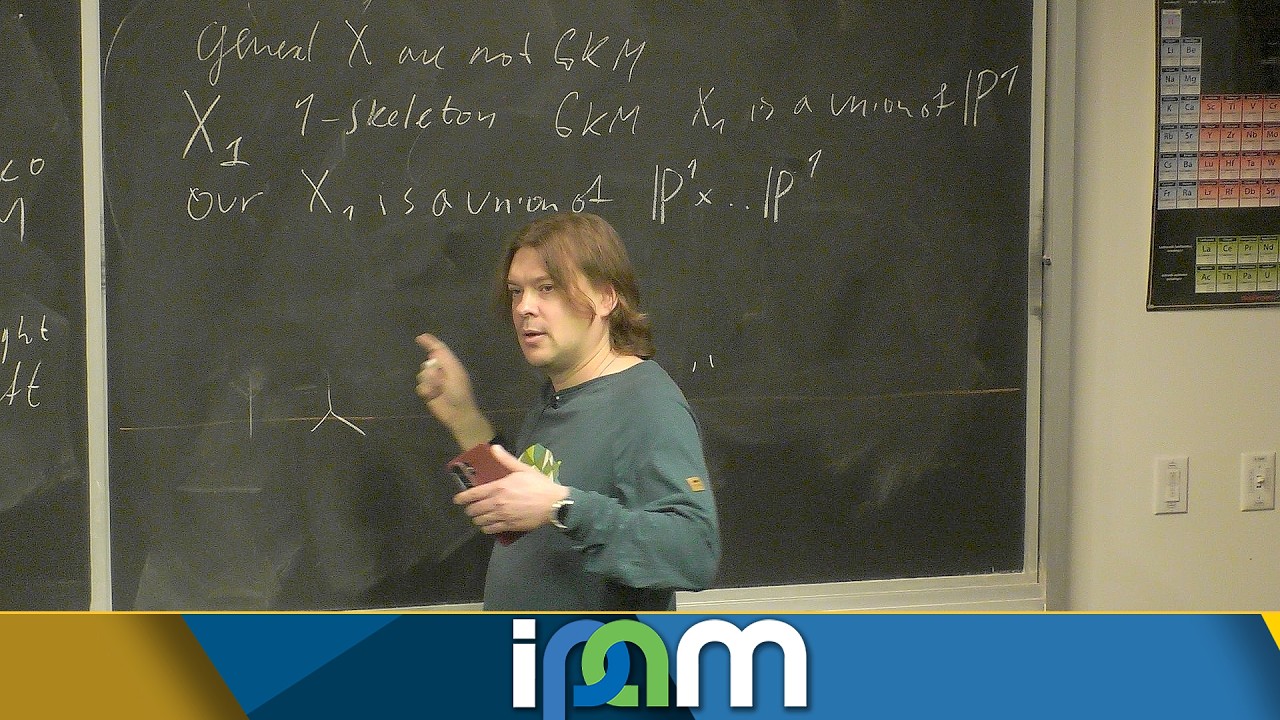
Anton Mellit - Motivification of annular link invariants - IPAM at UCLA
Title history
- Anton Mellit - Motivification of annular link invariants - IPAM at UCLA — observed on 20261121-0316 UTC (YouTube)
Keywords
Summary
180 words
Critical Evaluation
Value of the Information & Strength of the Argument
The talk presents a substantial original contribution: a motivic construction for annular links that refines skein classes. The argumentation is logical and builds on established objects like Soergel bimodules and Hessenberg varieties, showing clear connections to known results. The speaker carefully explains definitions and justifies claims through explicit computations and reduction moves. The value lies in providing a geometric framework that may recover full symmetric functions from triply graded homology, potentially addressing open questions in the field.
Scientific Rigor, Source Quality, Title Accuracy
The scientific rigor is high: the speaker states precise theorems and sketches proofs using structural moves, localization, and dimension counts. Sources cited in the talk are acknowledged in passing (e.g., works by Shand, Truman, Zaslov) but no formal references are given in the description beyond the IPAM workshop page. The title accurately reflects the content, with ‘motivification’ explicitly defined and connected to the annular link invariants. No comments were provided for analysis; thus no public feedback is considered.
170 words
Title / Content Match
The title accurately reflects the content: the talk introduces a motivic approach to annular link invariants via configuration spaces of flags.
Quality & Reliability
8/10
Rigorous mathematical presentation of new results, with proofs sketched via moves and localization, though not peer-reviewed in this format.
Key Moments
Markers derived by PSI from the transcript: the creator did not define chapters.
- Introduction and motivation: from categorification to motivification.
- Definition of annular webs and web varieties with monodromy gamma.
- Geometry of web varieties: flag varieties, merges, splits, and the limit construction.
- Trivial monodromy case: equivariant cohomology is a polynomial ring; relation to Hochschild homology HH_0.
- Regular semisimple monodromy: fixed points via web colorings, smoothness, and Hessenberg varieties.
Cited Sources
- IPAM Workshop: Categorification in Quantum Topology — Workshop at UCLA where this talk was recorded; provides background and related talks.
Contribution & Novelties
The novel contribution is a geometric ‘motivification’ of annular link invariants via web varieties, giving an explicit connection to Hochschild homology and Hessenberg varieties. The construction is more explicit and computable than previous categorical approaches, and recovers known formulas via equivariant localization. The talk provides a framework that may lead to recovering full symmetric functions from triply graded homology.
Pour aller plus loin :
- Hochschild homology — Directly related to the equivariant cohomology description in the trivial monodromy case.
- Soergel bimodule — Category of bimodules appearing in the construction; their Hochschild homology is computed here.
- Categorification — Background concept that motivates the motivification extension.
104 words
Radar Profile
The talk exhibits a very high technical level (niveau_technique 9) with strong qualitative content. The moderate scores on quantity and overall quality reflect the narrow focus and heavy formalism, but the reliability remains high given the speaker's expertise.