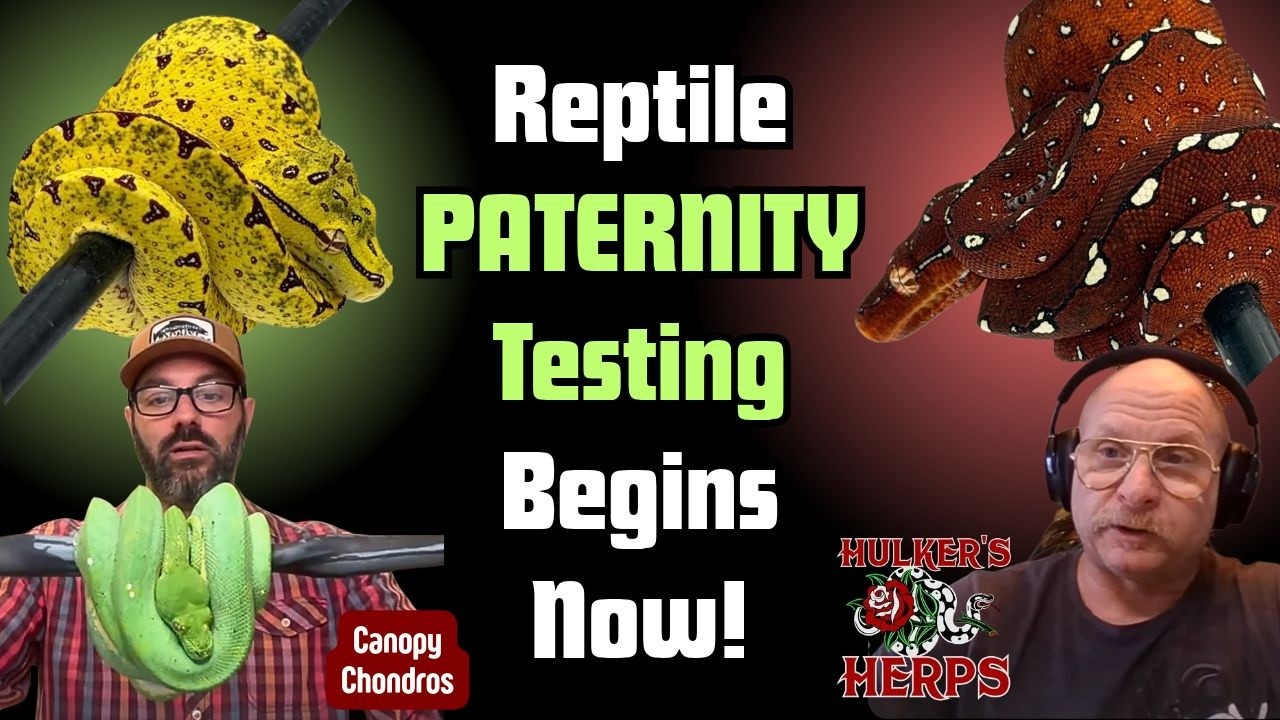
Our First-Ever Parentage Testing For Reptiles! #snake
Keywords
Summary
293 words
Critical Evaluation
Value of the Information & Strength of the Argument
The informational value lies in a concrete, reasonably well narrated case study of applied genetics in a hobby context. The listener gets a clear conceptual account of what a parentage test actually does: anonymous markers that act as an individual fingerprint, inheritance of X- and Y-linked variants, and the resulting asymmetry in which questions can be answered. The strongest element is the explicit statement of what the test cannot do at this stage: sires from the same clutch would be indistinguishable with the current panel, and the four male offspring of Dominic’s clutches cannot be assigned with confidence. That kind of stated limitation is more informative than a clean but unqualified claim would have been. The breeding-side content (fasting, night drops, keeping males small, sperm plugs as a readiness signal, wild body-size data quoted from field work) is presented as personal practice and works as such, but it is entirely anecdotal and never quantified.
The argumentation, however, is conversational rather than demonstrative. Reasoning proceeds by analogy from ball python practice (‘we can tell who the sire is by looking at the morphs’), by plausibility (‘it would be kind of crazy if one sire got all the females and the other got all the males’) and by authority of the laboratory’s own unpublished markers. There is no description of the genotyping protocol, no information on marker number, allele frequencies, exclusion probabilities or error rates, and no statement of how many offspring were typed. The comparison drawn with forensic DNA (‘one in ten to the whatever’) is evocative but substitutes for the missing figures rather than supplying them. The overall claim, that a partial parentage answer was obtained, is credible and internally consistent; the broader implication that this constitutes parentage testing for reptiles in general requires a leap that the single case does not support. The commercial framing — the announcement of a service the company intends to sell — is relevant context for weighing the enthusiasm of the presentation.
Scientific Rigor, Source Quality, Title Accuracy
No scientific reference is cited anywhere in the episode: no article on parentage assignment in squamates, no description of the marker development work, no mention of a preprint or of any validation study. The support offered consists of named breeders, social media handles and the laboratory’s own internal results, which are shown verbally rather than as tables, electropherograms or genotype files. Authority is personal rather than bibliographic: a mentor is credited generously, podcasts are described as the main learning channel, and the historical provenance of specific bloodlines is reconstructed through a 2008 advertisement someone happened to find. The methodological reasoning is sound in its own terms — the investigators did ask the key question about relatedness between candidate sires before attempting the test, and they are upfront about the resolution ceiling of their current panel — but nothing here is independently checkable by a viewer. The title is accurate in spirit and overreaching in scope: it is a first parentage result for this company in one species, obtained with a small panel and only partially resolved to sex-specific offspring, whereas the phrasing suggests a generalised capability. The framing also sits within an explicit commercial roadmap, which is stated honestly but shapes the emphasis of the whole episode.
550 words
Title / Content Match
The title promises the 'first-ever parentage testing for reptiles', and the episode does deliver a genuine first set of parentage assignments in green tree pythons, albeit partial ones limited to female offspring. A substantial share of the running time is nevertheless devoted to general chondro husbandry, cycling and breeding stories rather than to the test itself, and the claim of a 'first' is asserted without any check of prior literature.
Quality & Reliability
5/10
The episode reports results first-hand from the laboratory that produced them and states its limits explicitly (which parentage questions can and cannot be answered with the current X/Y markers). However, no protocol, no genotype data, no marker counts for green tree pythons, no statistical confidence values and no peer-reviewed reference are given; the case rests on a single breeder's two clutches, and the speakers have an obvious commercial interest in the service being announced. Husbandry and breeding claims are entirely anecdotal and drawn from personal practice.
Key Moments
Markers derived by PSI from the transcript: the creator did not define chapters.
- Opening announcement: first-ever parentage test results, framed as a Thanksgiving Eve special edition.
- The hosts situate the test in the company's roadmap, describing it as the start of the 'advanced breeder tools' planned commercially.
- Chad Hulker introduced; he describes moving from ball pythons into green tree pythons and the podcasts and breeders he learned from.
- Dominic DeAure introduced: pet-store upbringing, return to the hobby, purchases from Bushmaster from 2019 onward.
- Husbandry comparison between ball pythons and chondros: room heating, night drops, a two-month fast, feeding males less to keep them small.
- The ball python practice of alternating males is described, and how it prompted the idea of using shed-based sex markers for parentage.
- Presentation of the two candidate sires: a documented designer line male and a melanistic 'mystery' import male.
- Clutch histories reconstructed: the melanistic male placed for under 24 hours after the other male had been in for roughly two months.
- Results presented: melanistic male confirmed as sire of all female offspring in both clutches; male offspring cannot be assigned with the current markers.
- The forthcoming 'archive panel' is explained — identity markers rather than colour genes — with the promise of far more definitive assignments within months.
Cited Sources
- Hulker's Herps (Instagram) — Social media account of guest Chad Hulker, linked in the video description.
- Canopy Chondros (Instagram) — Social media account of guest Dominic DeAure, linked in the video description; used by the hosts to describe his exclusive focus on green tree pythons.
- Rare Genetics, Inc. — Website of the company hosting the episode and offering the sex-determination and parentage tests discussed throughout.
Concurring Sources
- Green tree python (Wikipedia) — General reference on Morelia viridis, the species central to the episode, including its ontogenetic colour change discussed by the guests.
- Microsatellite (Wikipedia) — Background on the type of repetitive genetic marker classically used for individual identification and parentage assignment in animals.
- Single-nucleotide polymorphism (Wikipedia) — Background on the SNP-based panels the hosts describe as the next generation of their parentage testing.
Contribution & Novelties
The genuine novelty is the demonstrated transfer of a sex-determination marker set, developed for single-shed sexing of green tree pythons, into a parentage application. The episode shows the reasoning that makes this possible — Y-linked variants identify paternal lineages, X-linked variants transmitted to daughters identify the dam-side contribution — and applies it to a real ambiguity where two males had access to the same females within a single season. The result is a partial but usable answer: all female offspring in both clutches are attributed to the melanistic male, while the four males remain unassigned. This asymmetry, and the stated impossibility of separating related candidate sires, is the most instructive part of the report. The announced trajectory toward an identity-marker panel derived from a ball python array, with markers deliberately uncoupled from colour and pattern, points to the standard approach used in livestock and wildlife parentage testing.
Further reading:
- Green tree python — Species reference for Morelia viridis, including the ontogenetic colour change discussed at length by the guests.
- Single-nucleotide polymorphism — Background on the marker class underlying the ‘archive panel’ announced as the next step.
- Microsatellite — Classical marker type used for individual identification and parentage assignment in animal breeding and conservation genetics.
- Parentage assignment / exclusion probability in livestock and wildlife genetics — the statistical framework (likelihood of paternity, exclusion probabilities, error rates) that the episode alludes to with its forensic comparison but never states.
- Sperm plugs and pre-breeding condition assessment in snakes — the practical cue Dominic describes as a readiness signal; a concept worth checking against herpetocultural literature rather than accepting from a single testimony.
269 words
Radar Profile
The profile is that of a specialised, mid-density technical conversation: moderate information quantity and technical level, with quality and reliability held back by the absence of any documented protocol or published reference. Strength is concentrated in the transparency about what the current marker set can and cannot resolve, while the anecdotal husbandry content and the commercial framing cap the overall score.