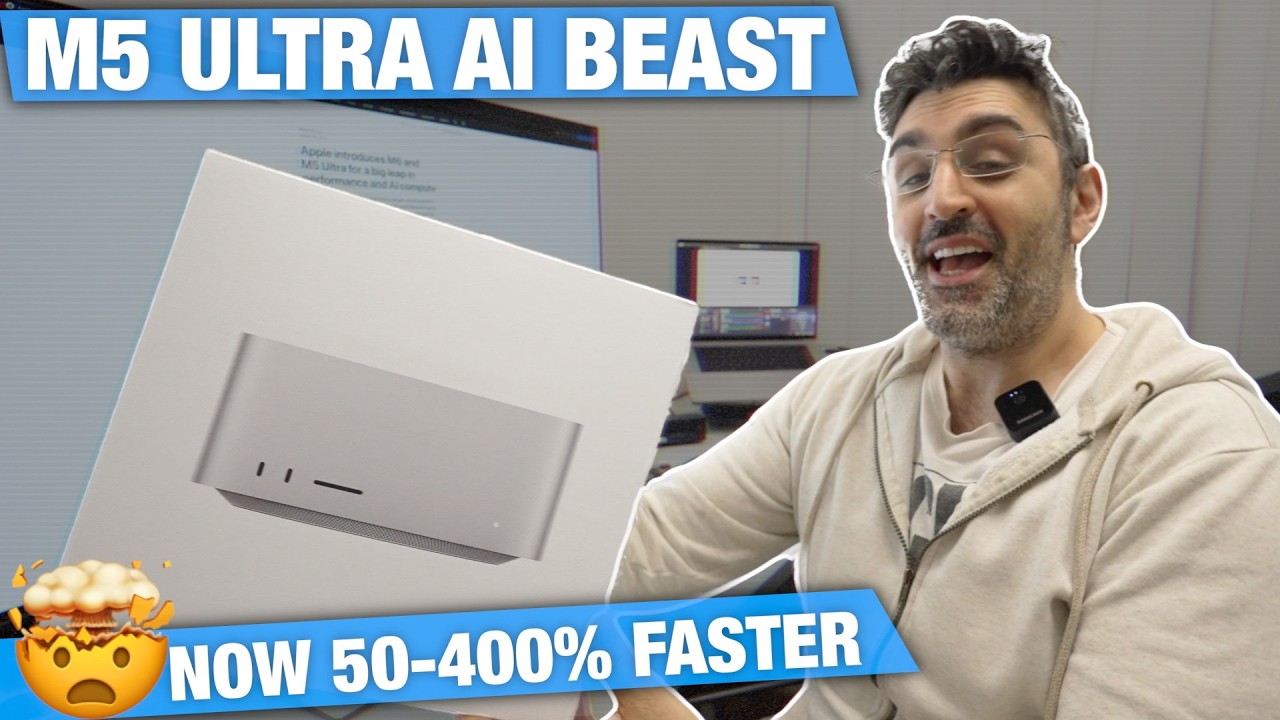
M5 Ultra EXPLAINED - 50% FASTER LLM, 4x LOCAL AI - the King is Back! 🤯
Keywords
Summary
206 words
Critical Evaluation
Value of the Information & Strength of the Argument
The video provides valuable practical insights for anyone considering the M5 Ultra for local AI. The argumentation is solidly grounded in the official specs and the creator’s own testing experience with previous models. He convincingly argues that the memory bandwidth increase is a crucial factor for token generation speed, and he connects this to real-world inference scenarios. The discussion on storage costs and external solutions is particularly useful, as it addresses a common pain point. However, some claims, such as the 50% speedup, are based on Apple’s marketing rather than independent benchmarks, and the creator engages in some speculation about future models. Despite this, the reasoning is logical and the video strikes a good balance between technical depth and accessibility, making a compelling case for the M5 Ultra while acknowledging its limitations.
Scientific Rigor, Source Quality, Title Accuracy
The creator relies primarily on Apple’s official announcement and his own hands-on experience with previous M-series chips. He does not cite external scientific sources, but he references companion videos on recent AI models (Qwen, Kimi, GLM) and mentions an inference app. The title is somewhat sensational but captures the core themes; the content does substantiate the claims of improved speed and local AI capability. However, the lack of independent verification and the focus on Australian pricing may limit its generalizability. The video is consistent with the announcement but does not provide critical scrutiny of Apple’s performance figures, instead taking them at face value and extrapolating from them. Overall, the rigour is moderate; the technical details are accurate, but the analysis is not deeply critical.
271 words
Title / Content Match
The title accurately reflects the content: discusses M5 Ultra claims of 50% faster LLM and 4x faster local AI, though these are based on Apple's marketing rather than independent benchmarks.
Quality & Reliability
6/10
Based on official announcement and personal experience, but includes speculation and focuses heavily on pricing; lacks rigorous verification of claims.
Chapters
- M5 Ultra specs: GPU cores & memory bandwidth
- UltraFusion & CPU core improvements
- Unified memory limits for large models
- New Apple CEO & hardware legacy
- Storage costs: Apple vs. Amazon SSDs
- External storage solutions & RAID options
- Business tax write-offs for hardware
- Using Nvidia vs. Apple silicon for servers
- Mac mini with M6 2nm chips
Cited Sources
- Inferencer App — Mentioned in description as an inference app, potentially relevant for running models.
- Qwen 3.8 video — Companion video about Qwen 3.8, referenced for model discussion.
- Kimi K3 video — Companion video about Kimi K3, discussed in context of large models.
- GLM 5.2 video — Companion video about GLM 5.2, referenced for model discussion.
External References
Contribution & Novelties
The video offers a distinctive perspective by focusing on the practical and financial aspects of adopting the M5 Ultra for local AI, rather than just listing specs. It provides a cost-benefit analysis, including storage strategies and business tax write-offs, which is often overlooked in typical tech reviews. The creator’s personal experience with the M3 Ultra adds credibility, and he effectively translates raw specs into likely user experiences, such as faster token generation and improved handling of large models.
Pour aller plus loin :
- Apple silicon — Overview of Apple’s chip architecture, foundational for understanding M5 Ultra.
- Mac Studio — Details on the Mac Studio product line, contextualizing the hardware.
- Unified memory architecture — Explanation of unified memory, central to the discussion of 512 GB pools.
- Large language model — Background on LLMs, the primary workload discussed in the video.
139 words
Radar Profile
The radar profile shows strong technical level and quantity of information, with moderate quality and lower reliability. This indicates a technically rich but somewhat speculative commentary, suitable for informed enthusiasts but not for those seeking verified performance data.
💬 Very positive. On the 30 comments analyzed, the audience is enthusiastic, with many questions about configurations and pricing debates, but overall optimistic.