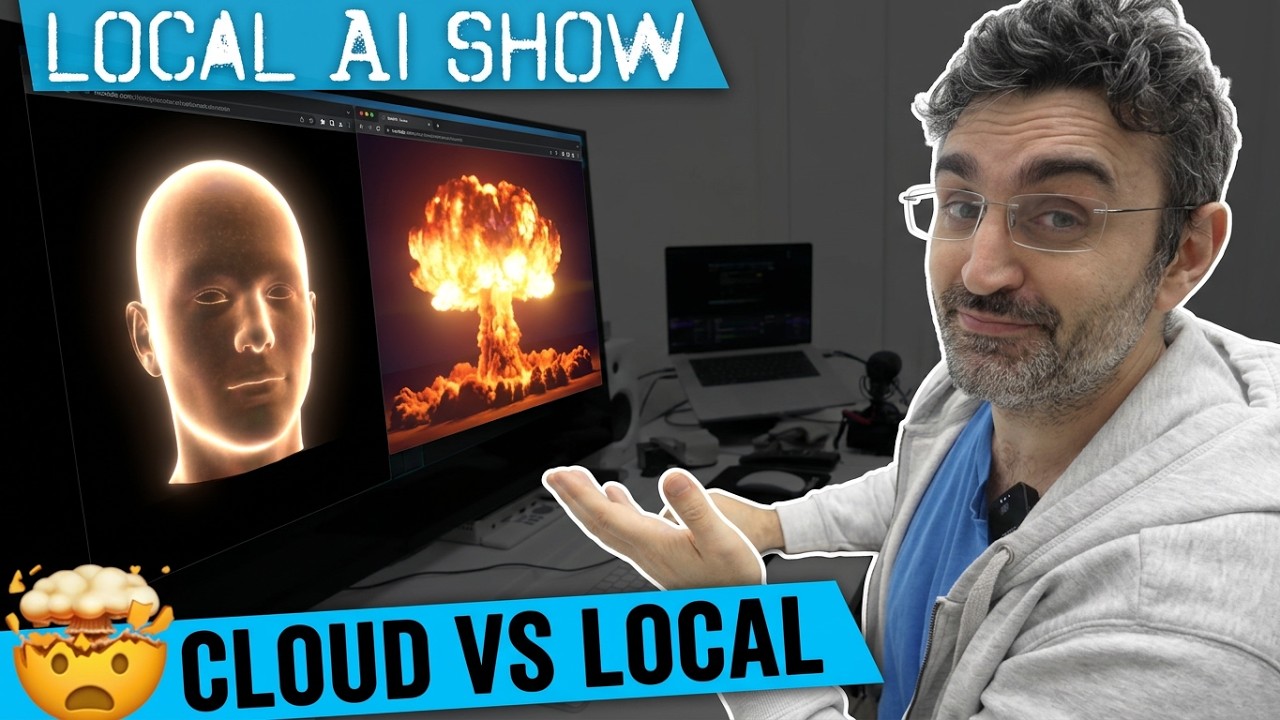
I Tested the #1 FREE Cloud AI against the #1 Local AI... 🤔
Keywords
Summary
157 words
Critical Evaluation
Value of the Information & Strength of the Argument
The value of the information lies in the hands-on comparison of AI coding assistants in a realistic scenario. The creator demonstrates step-by-step setup and iterative debugging, providing concrete token usage and performance metrics. The argumentation is centered on empirical observation rather than statistical proof, which is acceptable for a practical review. The comparison is fair in the sense that both models are given the same tasks and prompts, though the local model is run with maximum thinking and the cloud model with default settings initially, and later both use maximum thinking. The creator transparently acknowledges limitations such as the local model’s screenshot issues and the possibility of differences due to model versions. Overall, the argument is solid, but it lacks a controlled experimental design and only tests two specific scenarios.
Scientific Rigor, Source Quality, Title Accuracy
The title accurately matches the content: the video indeed tests a free cloud AI (Space Bunny Alpha) against a local AI (Qwen). The description includes links to the official pages of OpenCode, Space Bunny Alpha on OpenRouter, Infernucer, and the Qwen model on Hugging Face, providing direct sources for further verification. These links are relevant and appropriately cited. The video also mentions companion videos about other models, which are listed in the description. The content is a practical tutorial rather than a scientific study, so the rigour is appropriate for the genre. The adéquation between title and content is perfect; there is no ambiguity in what is presented.
253 words
Title / Content Match
The title accurately reflects the content: a side-by-side test of a free cloud AI against a local AI.
Quality & Reliability
7/10
The video provides a transparent hands-on comparison with concrete examples and links to sources, but lacks rigorous experimental methodology and statistical validation.
Chapters
Cited Sources
- OpenCode — The tool used to run the AI models and manage the coding tasks.
- Space Bunny Alpha on OpenRouter — The cloud AI model being tested, currently available in stealth mode.
- Inferencer — The local inference server used to run the Qwen model.
- Qwen3.8-Flash-Next-MLX-Q9 on Hugging Face — The local AI model used in the comparison.
- DeepSeek V4.1 video — Companion video mentioned in the description.
- Qwen 4 Exp video — Companion video mentioned in the description.
- Kimi K3 video — Companion video mentioned in the description.
- GLM 5.3 video — Companion video mentioned in the description.
External References
Contribution & Novelties
The video offers a fresh, practical perspective on comparing a free cloud AI with a local AI in a coding environment. It demonstrates real-world usage of OpenCode with both cloud and local models, including setup, token consumption, and iterative debugging. The test scenarios (nuclear explosion and 3D face) are challenging and showcase the models’ capabilities. The original contribution is the direct side-by-side comparison with detailed observations on performance and usability, which is valuable for developers evaluating AI coding assistants.
Pour aller plus loin :
- Large language model — Provides background on how these models work, relevant to understanding the differences between cloud and local inference.
- Three.js — The web framework used for the 3D tests, useful for understanding the coding tasks.
- OpenCode — The tool that integrates both cloud and local models, offering a unified interface for AI-assisted coding.
139 words
Radar Profile
The profile shows high scores in quantitative information and technical level, indicating a content-rich, hands-on tutorial. Quality and reliability are slightly lower, reflecting the empirical nature of the tests without rigorous statistical backing. The overall shape suggests a practical demonstration rather than a deep scientific analysis.