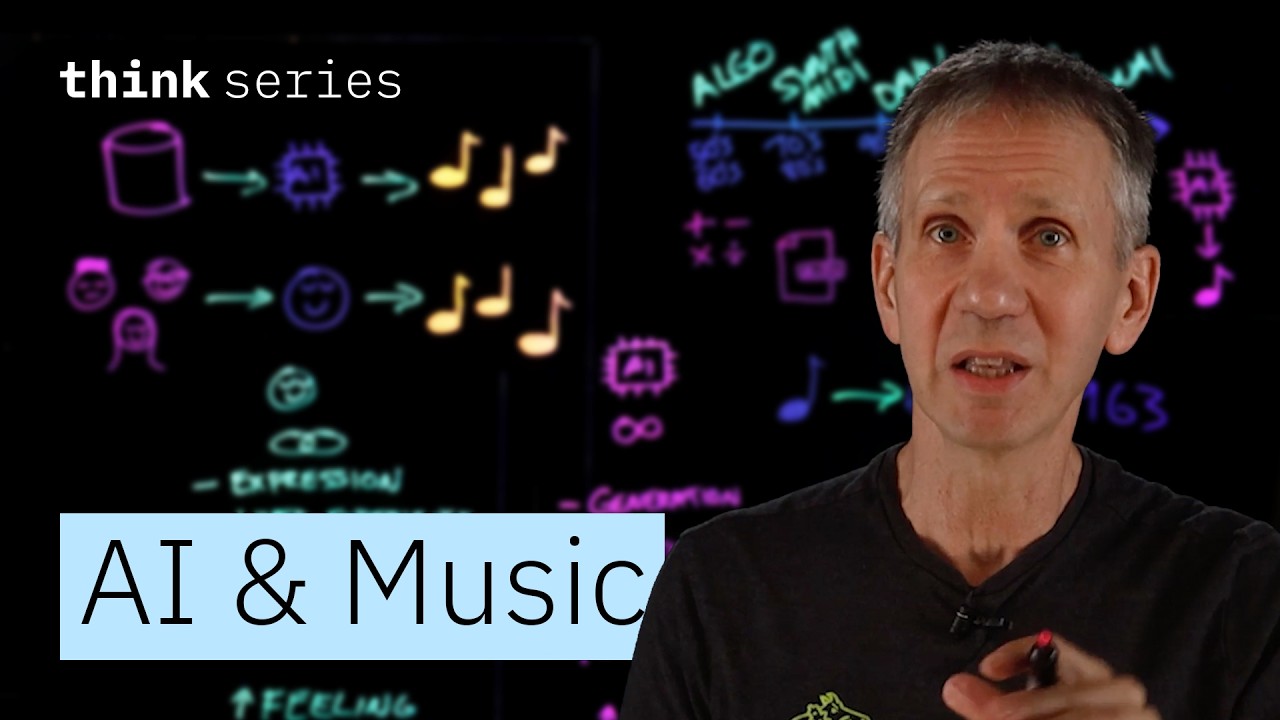
AI & Music: How AI Is Changing Music Creation & Creativity
Keywords
Summary
176 words
Critical Evaluation
Value of the Information & Strength of the Argument
The video provides substantial value by offering a historical context for AI in music, which helps demystify the technology and situate it as a natural progression in music production. The argumentation is coherent and well-supported with practical examples, such as the use of AI for generating variations, cleaning audio, and assisting with performance. Crume effectively argues that AI is not a novel form of recombination, but rather a tool that amplifies human creativity, using analogies like blues and jazz to illustrate that imitation and variation are inherent in music. The discussion of human vs. AI strengths (scale vs. connection) is persuasive and avoids extremes, presenting a balanced view that AI will augment rather than replace musicians. The overall reasoning is logical, accessible, and grounded in realistic applications, though it relies more on personal insight than empirical data.
Scientific Rigor, Source Quality, Title Accuracy
The video demonstrates a good level of scientific rigor by tracing the technological evolution of music and referencing key developments like MIDI and deep learning. However, it does not cite specific academic studies or external sources beyond IBM promotional links. The use of personal anecdotes and hypothetical scenarios adds accessibility but reduces the depth of evidence. The title accurately reflects the content, as the video comprehensively addresses AI’s role in music creation and creativity, from historical foundations to future possibilities. The presentation style is professional and consistent with IBM Technology’s reputation for clear educational content. While no conflicting sources are noted, the video’s own assertions are the primary basis for its claims, making it an opinion-based rather than research-based piece.
272 words
Title / Content Match
The title accurately reflects the content, as the video comprehensively explores AI's impact on music creation and creativity, covering history, technical aspects, and collaboration models.
Quality & Reliability
7/10
The video is presented by IBM Technology's Jeff Crume, an experienced expert, and provides a well-structured overview of AI's role in music creation. While it contains some personal opinions, the technical information is accurate and grounded in the historical evolution of music technology. No formal citations are given beyond IBM resources, but the content aligns with established knowledge in the field.
Key Moments
Markers derived by PSI from the transcript: the creator did not define chapters.
- Introduction: playing a musical idea and questioning its origin (composed, improvised, derivative, or co-created)
- Discussion on originality and recombination in music, referencing blues, folk, and jazz as examples
- Historical evolution: algorithmic composition (1950s), digital synthesis and MIDI (1970s), digital audio workstations (1990s), machine learning (2000s), deep learning and generative AI (2020s)
- Current AI capabilities: composing full songs, generating lyrics, modeling singing voices, audio cleaning, auto-mastering
- AI as collaborative assistant: real-time generation, adaptive music, and the analogy of AI as a brainstorming partner
- Human-AI collaboration matrix: different combinations of human/AI roles in writing, revising, and performing music
- Strengths comparison: AI excels at scale and repetition, while humans excel at connection and feeling; importance of live performance
- Future possibilities: AI-driven instruments, hyper-personalized playlists, real-time adaptive game music, and tools for amateur musicians
- Conclusion: music is subjective, AI did not invent lousy music, and AI should be given an honest hearing as a creative tool
Cited Sources
- Learn more about AI & Music — IBM resource referenced in the video description for additional information on AI and music.
- Monthly AI Newsletter — Sign-up link provided in the description for AI updates from IBM.
Contribution & Novelties
The video’s original contribution lies in its accessible framing of AI as a collaborative partner in music creation, introducing a clear matrix for human and AI roles in writing, revising, and performing. It also emphasizes the historical continuity of technology shaping music, countering the notion that AI is entirely unprecedented. The content synthesizes known concepts into a practical perspective for musicians and enthusiasts.
Pour aller plus loin :
- Generative music — Overview of music generated through algorithms and systems, directly relevant to the AI music techniques discussed.
- Computer music — Historical and technical context of using computers in music composition and performance.
- Music information retrieval — The science of extracting information from music, foundational for training AI models on audio data.
121 words
Radar Profile
The scores indicate a balanced profile: relatively high on information quantity and quality (7/7), moderate on technical depth (5), and strong on reliability (7) given the expert source. This suggests the video is a solid overview rather than a deep technical dive.