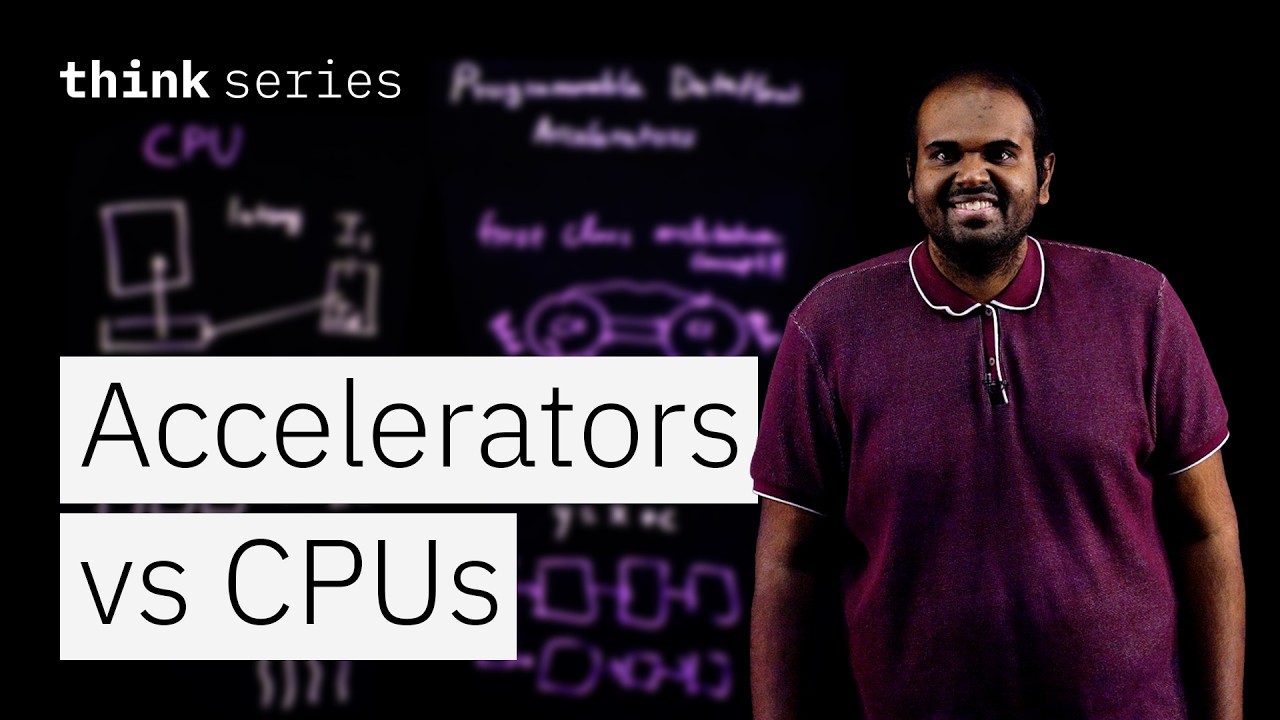
AI Accelerators vs. CPUs: Why They Think Differently
Keywords
Summary
164 words
Critical Evaluation
Value of the Information & Strength of the Argument
The video provides a clear and structured comparison of CPU, GPU, and dataflow accelerator architectures, focusing on scheduling decisions. The explanation uses a concrete example to ground abstract concepts, making the value high for understanding hardware tradeoffs. The argumentation is logical, progressing from latency vs. throughput, then control flow vs. dataflow, and finally illustrating with systolic arrays. The presenter avoids oversimplification, acknowledging limitations of each architecture. The content is well-organized and easy to follow, with strong technical accuracy.
Scientific Rigor, Source Quality, Title Accuracy
The rigor is acceptable: the presenter is from IBM Technology and the content aligns with established computer architecture principles. However, the video does not cite peer-reviewed sources directly; it offers links to IBM resources and a Coursera course. The title accurately reflects the content, which is about different scheduling mechanisms. The information is presented without speculation and appears technically sound. The description mentions AI was used in creating transcript and metadata, which is transparent. No contradictions are found, but the lack of external citations reduces the overall rigor compared to a formal academic source.
187 words
Title / Content Match
The title accurately reflects the content, comparing how CPUs, GPUs, and AI accelerators make scheduling decisions differently.
Quality & Reliability
9/10
The video is produced by IBM Technology, a credible corporate source, and the technical content aligns with well-established computer architecture principles. The explanation is clear, logical, and avoids oversimplification, though it does not cite peer-reviewed literature.
Chapters
- Compare How AI Hardware Decides What Runs Next
- Understand CPUs, GPUs & AI Accelerators
- Compare CPU Latency with GPU Throughput
- See How CPU Control Flow Works
- Understand GPU Parallelism & Warp Scheduling
- Follow Data Through the Memory Hierarchy
- Explore Dataflow AI Accelerators
- Schedule Compute and Data Movement Explicitly
- Understand Systolic Arrays for AI
- Match AI Hardware to the Workload
Cited Sources
- Learn more about AI Accelerators — Provided in description as a resource for AI accelerators.
- Dataflow Execution Models course on Coursera — Linked course for continued education on dataflow execution models.
- AI updates newsletter from IBM — Monthly newsletter for AI updates.
Contribution & Novelties
This video provides a clear pedagogical explanation of the scheduling differences between CPUs, GPUs, and dataflow accelerators. It emphasizes that the same computation is executed with different decision-making mechanisms, which is often conflated in other explanations. The use of a simple arithmetic example effectively demonstrates how each architecture handles control flow and data movement.
Pour aller plus loin :
- Systolic array — A hardware architecture commonly used in AI accelerators for dense matrix operations.
- Graphics processing unit — Overview of GPU architecture and its throughput-oriented design.
- Dataflow architecture — Explores the concept of data-driven computation scheduling.
96 words
Radar Profile
The radar profile is balanced across quantity and quality of information, with high reliability and moderate technical depth. This indicates a solid educational resource that offers accurate but not extremely advanced detail.