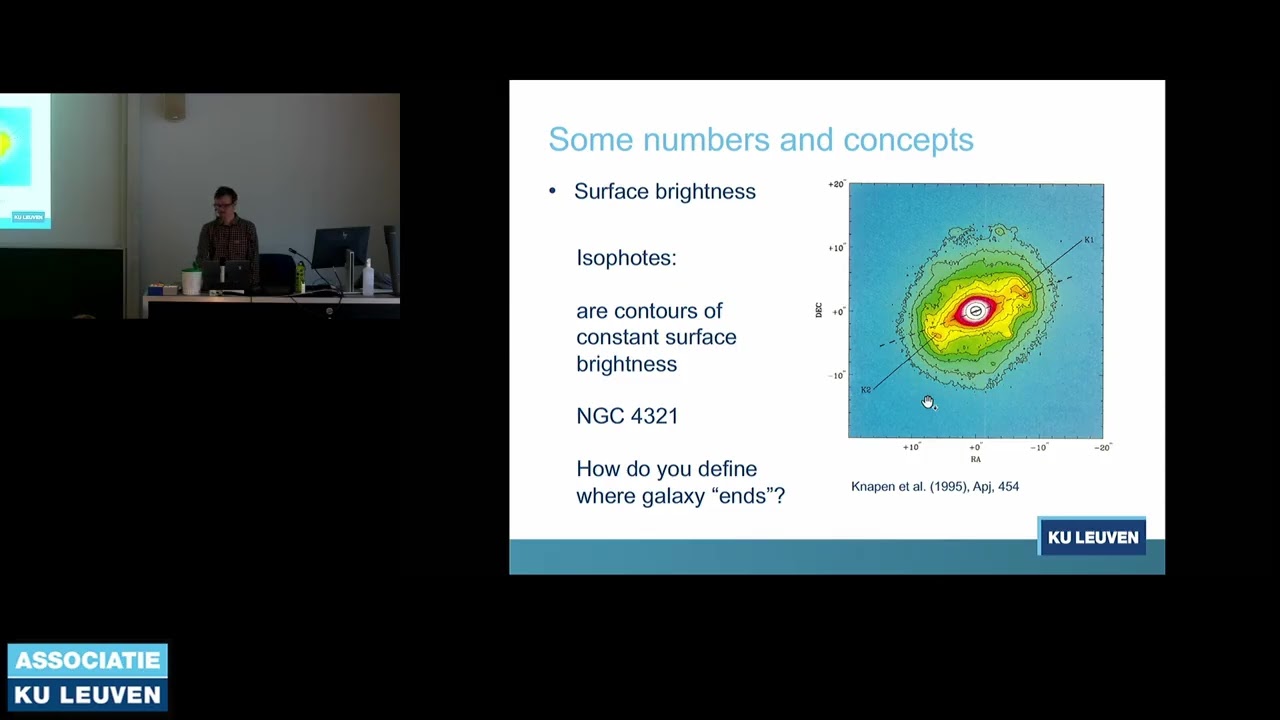
Galaxies and Cosmology: L1c - Surface brightness, luminosity and mass-to-light ratio
Keywords
Summary
379 words
Critical Evaluation
Value of the Information & Strength of the Argument
The informational value lies in the articulation between three levels that are often taught separately: the radiative-transfer definition of a quantity, the empirical photometric laws used to fit real galaxies, and the physical inferences drawn from those fits. The lecturer consistently marks the epistemic status of each element — surface brightness is a measured quantity with a well-defined transformation law, whereas the exponential, de Vaucouleurs and Sérsic profiles are explicitly labelled empirical, and the absence of a general ab-initio model for galaxy surface brightness is stated plainly rather than glossed over. This makes the lecture useful as a map of what is known versus what is merely fitted. The argumentation proceeds by calibrated caveats rather than assertions. The distance-independence of surface brightness is immediately qualified by redshift dimming and by extinction, both Galactic and intergalactic, so that the classical statement is not left standing as an unqualified truth. The scale-length example is worked numerically for the Milky Way, converting an abstract exponential into a concrete statement about the Solar neighbourhood, which is exactly the kind of check that reveals whether a relation has been understood. The mass-to-light discussion is the most argumentatively dense passage: starting from the solar value of unity, moving to 2.5 in the R band, then invoking the luminosity–mass relation (roughly L proportional to M^3) to infer that local light is dominated by stars slightly below solar mass, and finally confronting ratios near 500 in dwarf spheroidals where no stellar population can account for the number. The inference of non-luminous matter is thus built step by step from an observable rather than asserted. Notably, the lecturer voluntarily presents the competing modified-gravity avenue, states the criterion on which he judges it (ability to explain inferences across vastly different scales simultaneously), and explicitly invites correction if his knowledge is outdated. That is a sound argumentative posture, though the treatment of alternatives remains a summary judgement rather than a developed comparison. The main weaknesses are didactic rather than logical: several relations are spoken aloud without their functional form being reconstructible from the audio, numerical values are quoted from memory, and one quiz item is answered by the lecturer himself before students respond, which weakens its diagnostic value.
Scientific Rigor, Source Quality, Title Accuracy
The scientific framework is standard and internally coherent: the definitions of surface brightness, effective radius, Sérsic index and mass-to-light ratio match the conventional extragalactic literature, the band-dependence of mass-to-light ratios is correctly emphasised, and the two limiting forms of the Sérsic profile are stated correctly. The lecture is anchored to a single explicit reference, Peter Schneider’s Extragalactic Astronomy and Cosmology, Chapter 1, with the further indication that figure credits are carried in the lecture slides rather than in the spoken text — a transparent but ultimately unverifiable arrangement for a listener who does not have the slides. One observational dataset is named live (the Sloan Digital Sky Survey) for the Sérsic index versus colour distribution, but the specific paper is not identified in the audio, so the claim cannot be traced from the recording alone. The empirical laws are correctly attributed to empirical status, which is itself a form of source hygiene, and the lecturer distinguishes his own recollection from established results at least once, on modified Newtonian dynamics. On rigour of reasoning, the treatment is careful. The distinction between resolved and unresolved sources is used correctly to explain why surface brightness rather than flux is the meaningful descriptor for galaxies. The discussion of where a galaxy ends is framed as an observational-sensitivity problem rather than a physical boundary, which is the honest formulation, and profile extrapolation is presented as the pragmatic workaround. The weakest point is that numerical values (scale length 3.6 kpc, bulge effective radius 0.7 kpc, mass-to-light ratio 2.5 in R) are delivered without uncertainty ranges or the provenance of the measurement, so a listener cannot assess their precision. Regarding title-content adequacy, the announced triad of surface brightness, luminosity function and mass-to-light ratio is delivered in full and in the announced order, with the closing minutes devoted to a component summary and course logistics. The match is strong; the only drift is that the final portion is administrative rather than scientific.
706 words
Title / Content Match
The title announces surface brightness, luminosity functions and the mass-to-light ratio, and the lecture delivers exactly those three topics in that order before closing with a component summary and course logistics. Very close match, with a small tail of administrative content at the end.
Quality & Reliability
8/10
University lecture delivered by a specialist in a master's programme, grounded in standard extragalactic astrophysics and explicitly tied to a recommended textbook (Schneider 2015). The lecturer flags the empirical, non-ab-initio status of the laws presented, distinguishes observational quantities from theoretical ones, and openly signals his own uncertainty on modified-gravity alternatives. Main limits: no figures, equations or numerical tables are visible in the audio, several definitions are given verbally and approximately, and some statements (e.g. Milky Way scale length, bulge effective radius) are quoted from memory rather than sourced live.
Key Moments
Markers derived by PSI from the transcript: the creator did not define chapters.
- Announcement of the three recurring concepts: surface brightness, luminosity function, mass-to-light ratio.
- Surface brightness identified with specific intensity from radiative transfer; distance independence stated, then qualified by redshift dimming and by interstellar and intergalactic extinction.
- Resolved versus unresolved sources: galaxies allow a surface-brightness measurement, foreground stars only a flux that falls as 1/r^2.
- Exponential disk profile and scale length, worked numerically for the Milky Way (3.6 kpc scale length, Sun at ~8 kpc, giving ~e^-2 of the central surface brightness).
- de Vaucouleurs law for bulges, ellipticals and globular clusters; effective (half-light) radius; mention of the fundamental plane.
- The problem of defining the outer edge of a galaxy when the profile blends into the sky background and the answer depends on telescope sensitivity.
- Generalised Sérsic profile (n = 1 exponential, n = 4 de Vaucouleurs) and SDSS Sérsic index versus colour distributions, with the scatter that complicates morphological classification.
- Schechter luminosity function as an exponentially truncated power law fitted to observed galaxy luminosities, and its tensions at the bright and faint ends.
- Mass-to-light ratio in solar units and per band; value of ~2.5 in R locally and the inference from the luminosity-mass relation about the dominant stellar masses.
- Ratios of ~500 in faint dwarf spheroidals as evidence for non-luminous matter, followed by a fair statement of modified-gravity alternatives and of their current limitations.
Cited Sources
- Peter Schneider, Extragalactic Astronomy and Cosmology: An Introduction (2015), Chapter 1 — The only explicit bibliographic reference given in the description; recommended reading for the concepts presented in this part of the module.
- KU Leuven Institute of Astronomy — Institutional page of the lecturer's institute, linked in the description as the course's home base.
- Galaxies and Cosmology — raw classroom course playlist — Playlist collecting the unedited lecture recordings, of which this video is module 1, part III.
- Galaxies and Cosmology — full edited course playlist — Edited version of the same course, offered in the description as an alternative to the raw recordings.
- Edited version of this class (StarlightWinds channel) — Polished rendering of the same lecture, explicitly cross-referenced in the description.
- Sloan Digital Sky Survey study of Sérsic index versus galaxy colour — Named in the lecture as the source of the Sérsic index/colour contour plot shown on the slides; the precise paper is not identified in the audio, and figure credits are said to be carried in the lecture slides.
Concurring Sources
- Surface brightness — Wikipedia — Confirms the definition and the distance-independence (in the absence of absorption/emission and, in the local Universe, of redshift effects) that the lecture states.
- Sérsic profile — Wikipedia — Confirms the correspondence stated in the lecture: Sérsic index n = 1 corresponds to the exponential disk profile and n = 4 to the de Vaucouleurs profile.
- Luminosity function (astronomy) — Wikipedia — Confirms the Schechter form as an exponentially truncated power law used to fit observed galaxy luminosity distributions.
- Mass-to-light ratio — Wikipedia — Corroborates the definition in solar units, the dependence on photometric band, and the values quoted for stellar populations and for dark-matter-dominated dwarf systems.
- Dark matter — Wikipedia — Provides the broader evidence base the lecturer alludes to (rotation curves, clusters, cosmic microwave background) and the non-baryonic inference he mentions.
Dissenting Sources
- Modified Newtonian dynamics — Wikipedia — The lecture acknowledges this alternative to the dark-matter interpretation and judges that no single MOND model currently reproduces the inferences made across vastly different scales. This source presents the case for the alternative and the attempts to extend it to cluster and cosmological scales, which constitutes the substantive counter-argument the lecturer summarises rather than develops.
Contribution & Novelties
The added value is pedagogical rather than scientific: this is a live master’s lecture, not a research contribution. Its distinctive move is to place three observables side by side and show how they chain together — a photometric measurement (surface brightness), a statistical description of a population (the luminosity function), and a dynamical inference converted into a mass budget (the mass-to-light ratio). The lecture is also unusually candid about the epistemic hierarchy involved: surface brightness has a clean transformation law, the profiles used to describe it are admitted to be empirical fits with no ab-initio derivation available, and the mass-to-light ratio is presented as the operational route by which non-luminous matter is inferred rather than as a direct measurement. The explicit treatment of where a galaxy ends as a sensitivity-dependent question, and the willingness to state the competing modified-gravity position with its evaluation criterion, are the two passages with the most methodological value.
Further reading:
- Surface brightness — Background on the quantity defined at the start of the lecture and its relation to specific intensity.
- Sérsic profile — Formal definition of the generalised profile that the lecturer presents as subsuming the exponential and de Vaucouleurs laws.
- Luminosity function (astronomy) — Context for the Schechter function and for the bright- and faint-end tensions mentioned.
- Mass-to-light ratio — Definitions in solar units, band dependence, and the values discussed for the Solar neighbourhood and dwarf spheroidals.
- Modified Newtonian dynamics — The alternative framework the lecturer cites as unable, in his assessment, to reproduce dark-matter inferences across all scales simultaneously.
- Missing satellite / substructure problem in galaxy formation — The faint-end difficulty of the luminosity function that the lecturer links to this well-known tension; no URL given here to avoid citing an unverified address.
290 words
Radar Profile
The profile is that of a dense, high-level lecture: technical difficulty and information quality are both high, with reliability close behind thanks to explicit textbook anchoring and candid labelling of empirical laws. Information quantity is slightly below the peak because several relations are spoken rather than written, so equations cannot be reconstructed from the recording alone. The comparatively lower score on overall reliability reflects the reliance on quoted-from-memory numbers and on slides the listener cannot see, not any conceptual weakness.