Galaxies and Cosmology: L5c - Active galactic nuclei
Keywords
Summary
326 words
Critical Evaluation
Value of the Information & Strength of the Argument
The informational value is high because the lecture builds a quantitative chain rather than a catalogue of facts. Each observational feature is tied to a physical mechanism: the shape of the disc spectrum follows from the radial temperature profile, the location of the peak follows from the accretion temperature and its inverse dependence on black-hole mass, and the mismatch between that peak and the observed hard X-ray excess is used to motivate the coronal component. The order-of-magnitude diagnostics are particularly instructive: the Einstein A coefficient versus collisional de-excitation ratio is used to convert the presence or absence of forbidden and semi-forbidden lines into density brackets, and the ionisation balance into a temperature range, with the lecturer repeatedly stressing that these are order-of-magnitude constraints of the kind ’not 10^2, not 10^30’, not precision measurements. The argumentation is honest about its own limits. The corona is explicitly labelled a phenomenological toy model with a power-law shape, and the lecturer states that such models are much less developed than accretion-disc models. The nature of the broad-line clouds (clumps versus turbulent density structure, rotating torus versus outflow versus failed wind) is described as unknown. The claim that broad absorption lines, classically quoted in roughly 15 percent of systems, are probably a general feature is presented as a personal assessment with two supporting arguments (Eddington-ratio dependence and viewing-angle projection), which is appropriate hedging rather than assertion. The feedback section is the most argumentative part: the reasoning that radiative cooling alone overproduces star formation and therefore requires reheating is set out as a logical necessity, but the relative role of supernova-driven and AGN-driven feedback, and the difficulty of embedding either in multi-scale galaxy-formation models, is flagged as unresolved. The main weakness is that the transcript preserves only the spoken layer: board derivations are referred to rather than reproduced, several figures are described but not shown, and a few passages are elliptical enough that a reader without the slides may lose the thread.
Scientific Rigor, Source Quality, Title Accuracy
Scientifically the material sits on well-trodden ground: the thin-disc treatment, the multi-blackbody spectral shape, the density diagnostics from critical densities, and reverberation mapping are all textbook results, presented with their standard caveats. The lecturer distinguishes carefully between established results, working phenomenology and open questions, and does not overstate the constraining power of order-of-magnitude estimates. Provenance is, however, lightly documented inside the video: figures and examples are deferred to the lecture slides, and the only recommended reading named in the description is a single graduate textbook (Schneider, Extragalactic Astronomy and Cosmology, 2015, chapters 5 and 2), with specific papers not cited in the spoken text. The links supplied are institutional and pedagogical rather than bibliographic: the KU Leuven Institute of Astronomy page, two YouTube playlists (raw classroom course and edited course) and an edited version of the same class. The transcript also refers to accompanying lecture notes that are not linked, which limits independent verification of the corona toy model and the disc-wind figures. On title and content, the match is essentially perfect: the session is announced as part of a galaxies-and-cosmology sequence on active galactic nuclei and covers precisely the AGN physics promised, with no promotional drift.
538 words
Title / Content Match
The title announces a course lecture on active galactic nuclei, and the content delivers exactly that: accretion-disc spectra, the X-ray corona, the broad-line region, absorption-line outflows and AGN feedback. No gap between promise and delivery.
Quality & Reliability
8/10
University course lecture delivered by a specialist in massive-star winds and radiative processes, grounded in standard accretion-disc theory (Shakura–Sunyaev-type thin disc, multi-blackbody spectrum, density diagnostics from forbidden lines, reverberation mapping). The physics is presented with derivation-level reasoning and explicit statements about what is well established versus still open (corona models, broad-line cloud nature, feedback balance). Weak points for a stand-alone document: unedited classroom format with board work only partly captured in the transcript, figures referenced but not shown, only one textbook recommended (Schneider 2015) and no in-video citation of specific papers.
Key Moments
Markers derived by PSI from the transcript: the creator did not define chapters.
- Recap of the optically thick, geometrically thin accretion disc: Rayleigh–Jeans, multi-blackbody ν^(1/3) and exponential cut-off regimes.
- The 'blue bump': disc peak in the ultraviolet for AGN, contrasted with much hotter stellar-mass accretors due to the inverse mass scaling.
- The hard X-ray excess cannot come from the disc; introduction of the hot-corona phenomenology above the disc.
- Assembling the broadband SED: intrinsic disc, soft X-ray excess, coronal power law, infrared dust torus and host galaxy.
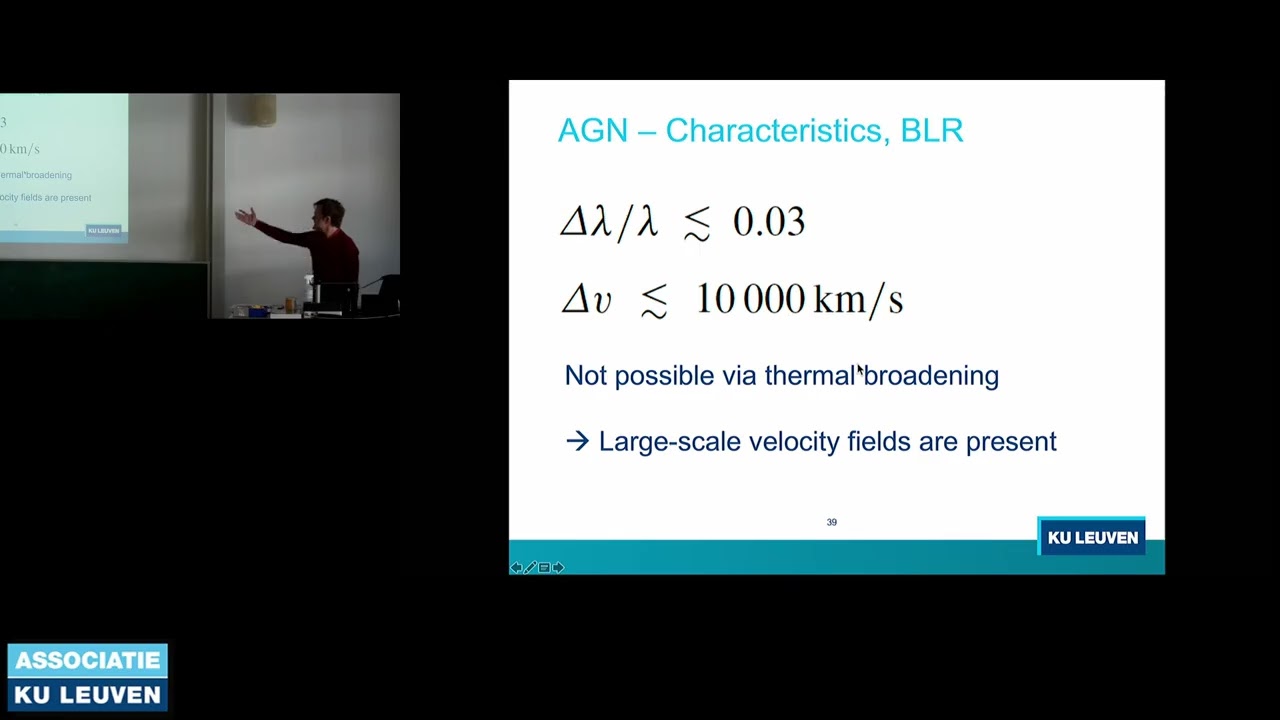
- Broad-line region: thousands of km/s widths exclude thermal broadening; density limits from permitted versus forbidden lines.
- Temperatures of about 20,000–40,000 K from ionisation balance; only roughly 10 percent of ionising photons absorbed by the clouds.
- Reverberation (echo) mapping: continuum–line time lags converted into physical radii of the broad-line region.
- Lyman-alpha forest (external absorbers) versus intrinsic broad absorption lines; blueshifted troughs read as outflows.
- AGN feedback as the remedy for over-efficient radiative cooling and star formation in galaxy-formation models.
- Line-driven disc winds: analogy with hot massive-star winds, bending by the central potential, escaping versus failed winds.
Cited Sources
- KU Leuven Institute of Astronomy — Institutional page of the lecturer's institute, listed in the description as the course's home department.
- Galaxies and Cosmology — raw classroom course (YouTube playlist) — Playlist containing the full unedited lecture series of which this video is module 5, part III.
- The full edited course (YouTube playlist) — Edited version of the same course, referenced in the description as an alternative to the raw recording.
- Edited version of this class on the StarlightWinds channel — Edited cut of the same lecture, useful for recovering the slides and figures that the spoken transcript only refers to.
- Peter Schneider, Extragalactic Astronomy and Cosmology: An Introduction (2015) — The only recommended reading named in the description (chapter 5 and selected material in chapter 2); figures and examples are credited to the lecture slides, not to numbered papers.
Concurring Sources
- Active galactic nucleus — Confirms the standard decomposition into accretion disc, corona, broad- and narrow-line regions, torus and jet described in the lecture.
- Reverberation mapping — Corroborates the continuum–line time-lag method and the resulting radius–luminosity constraints on the broad-line region.
- Lyman-alpha forest — Supports the distinction between intervening absorption along the line of sight and absorption intrinsic to the quasar.
Contribution & Novelties
The originality here is pedagogical rather than observational: it is a complete, derivation-anchored walkthrough of AGN phenomenology as taught in a master’s programme, moving from the thin-disc spectrum to the coronal component, to the broad-line region, to absorption-line outflows and feedback. Two elements stand out. First, the systematic conversion of line inventories into physical conditions — using critical densities to bracket the broad-line region density and ionisation balance to bracket its temperature — is presented as a worked method rather than a result. Second, the explicit bridge between AGN broad-line regions and the line-driven winds of hot massive stars, including the lecturer’s own group’s experiments with line-driven disc-wind models in which the central potential bends the flow into escaping or failed winds, is a research-flavoured perspective that a generic AGN summary would not provide. The lecture is also candid about which pieces are weak: the corona remains a phenomenological power-law add-on, and the cloud nature of the broad-line region is unresolved.
Further reading:
- Active galactic nucleus — Overview of the central-engine picture, unified model and observational classes used throughout the lecture.
- Reverberation mapping — Background on the time-lag technique presented as the key size measurement for the broad-line region.
- Lyman-alpha forest — Context for the ’external’ absorption systems the lecturer distinguishes from intrinsic broad absorption lines.
- Astrophysical jet — The radio-mode feedback channel contrasted with the line-driven disc-wind channel discussed at the end.
- Line-driven stellar wind theory and the Sobolev approximation — The radiative-driving formalism the lecturer says is taught in the radiative-processes and stellar-atmospheres courses; cited by name only.
- Failed / disc winds in AGN — The idea that outflows launched from the disc may fall back under the central gravitational field; cited by name only, as the corresponding figures are in the unlinked lecture notes.
297 words
Radar Profile
The profile is that of a dense, high-level technical lecture: quantity and quality of information and technical depth are all high, reflecting derivation-level content with numbers and physical diagnostics. Reliability is slightly below the technical level because sourcing is deferred to slides and a single textbook rather than to specific papers. The overall shape is a specialist teaching profile rather than a popularisation profile.