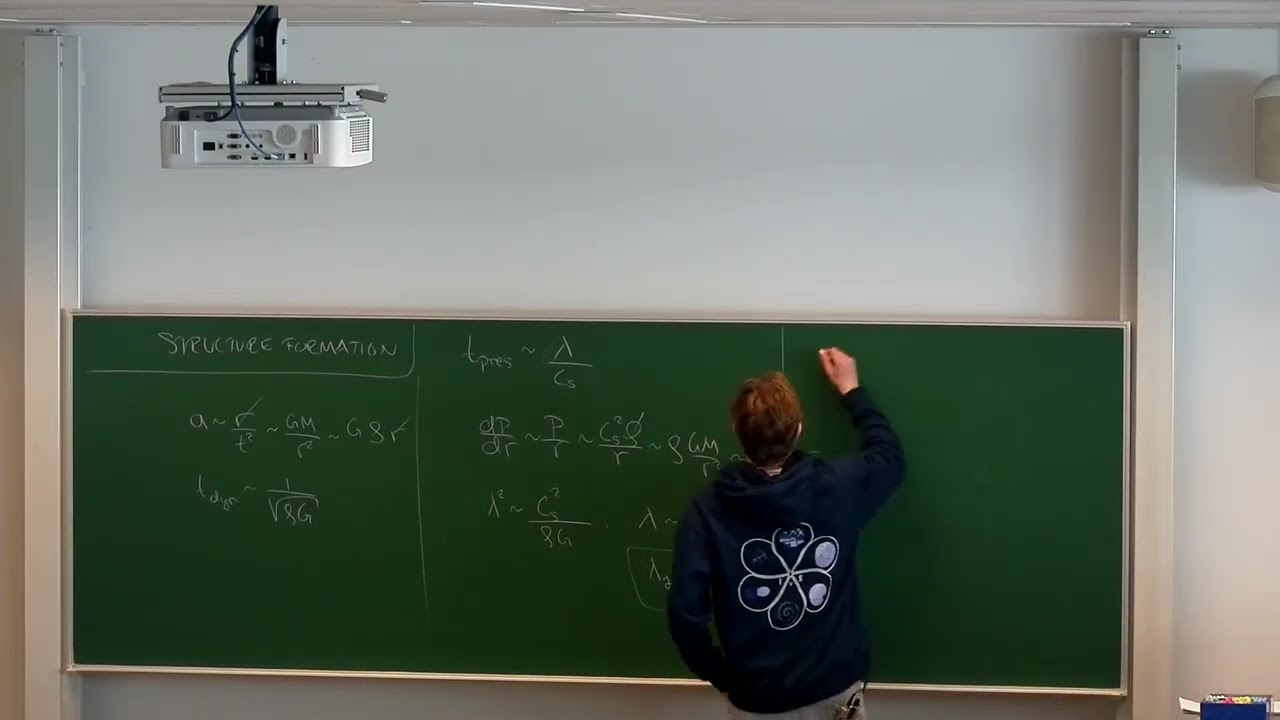
Galaxies and Cosmology: L8a - Structure growth and linear stability
Keywords
Summary
189 words
Critical Evaluation
Value of the Information & Strength of the Argument
The value of the information lies in its coherent construction of the standard linear theory of gravitational instability in an expanding universe. The lecture does not merely state results; it reconstructs the logic from time-scale comparisons to the Jeans criterion, then from the fluid equations to the closed master equation for density perturbations. The argument is solid within its stated Newtonian, sub-horizon approximation: each term is motivated, the linearisation is explicitly defined, and the Hubble expansion is introduced through comoving coordinates rather than added ad hoc. The order-of-magnitude example of the Jeans length in the atmosphere is a useful sanity check that connects the formalism to physical intuition. The live board derivation includes minor algebraic slips and corrections, but these are visible and do not affect the final structure. The main limitation is that the lecture is a pedagogical derivation rather than a critical review of observational evidence or alternative models; it establishes the framework and defers detailed solutions to the following session.
Scientific Rigor, Source Quality, Title Accuracy
The scientific rigour is high for a classroom exposition. The equations are standard, the assumptions are stated—Newtonian gravity, small perturbations, adiabatic pressure, and scales small compared with the horizon—and the derivation proceeds with explicit bookkeeping of background and perturbed quantities. The sources are appropriate for the level: the lecturer refers to the course material and to Peter Schneider’s Extragalactic Astronomy and Cosmology, with selected material in Chapters 7–8, rather than making unsupported empirical claims. The title is well matched to the content: the lecture defines structure growth through gravitational instability and carries out the linear stability analysis promised by L8a. The absence of observational data or literature debate is not a defect in this format, because the aim is to derive the theoretical backbone that later lectures can apply.
307 words
Title / Content Match
The title accurately announces a lecture on structure growth and linear stability, and the content delivers the Jeans analysis, perturbation equations, and the linear master equation.
Quality & Reliability
9/10
University-level lecture by a specialist, based on standard cosmology equations and a recognised textbook; derivations are shown step by step, with occasional board-work corrections made explicitly. The unedited classroom format introduces some disfluency but does not undermine the scientific content.
Key Moments
Markers derived by PSI from the transcript: the creator did not define chapters.
- Recap of homogeneous cosmology and Friedmann equations; transition to the origin of structure.
- Scaling comparison of free-fall time and pressure time, leading to the Jeans length and Jeans mass.
- Order-of-magnitude estimate of the Jeans length for Earth's atmosphere and why the air in the room does not collapse.
- Setup of continuity, Euler, and Poisson equations in comoving coordinates with Hubble expansion.
- Linear perturbation expansion for density, velocity, pressure, and gravitational potential; adiabatic perturbations.
- Derivation of the perturbed continuity and momentum equations, including the Hubble term.
- Combination of perturbed equations into the master equation for the density contrast.
Cited Sources
- KU Leuven Institute of Astronomy — Host institute for the course and lecturer.
- Raw classroom course playlist — Full unedited lecture series to which this video belongs.
- Edited course playlist — Edited version of the full course.
- Edited version of this class — Companion edited video for the same lecture.
- Peter Schneider, Extragalactic Astronomy and Cosmology: An Introduction (2015), Chapters 7–8 — Textbook cited in the description for further reading on the lecture material.
Contribution & Novelties
The original contribution is pedagogical rather than research-level: the lecture assembles a compact, board-level derivation of the standard linear theory of structure growth, explicitly linking the Jeans stability criterion to the expanding-universe perturbation equations. Its distinctive value is the visible reasoning chain—from time-scale estimates to comoving coordinates, linearisation, and the final master equation—which is often skipped in textbook treatments.
Pour aller plus loin :
- Jeans instability — Background for the collapse criterion and the Jeans length/mass used in the first part.
- Cosmological perturbation theory — Broader framework for the linear density-contrast equation derived here.
- Comoving and proper coordinates — Coordinate choice that introduces the Hubble term in the fluid equations.
- Hubble’s law — Expansion context needed to interpret the damping term in the master equation.
- Spherical collapse model — Natural next step beyond linear theory, mentioned here only by implication; no URL given to avoid an uncertain link.
148 words
Radar Profile
The profile is strongly skewed toward technical depth and information density, reflecting a formal derivation-heavy lecture. Reliability and quality are high because the treatment follows standard cosmology and states its approximations, while the main limitation is the absence of observational comparison or literature debate.