Galaxies and Cosmology: L4a - Elliptical galaxies
Keywords
Summary
277 words
Critical Evaluation
Value of the Information & Strength of the Argument
The informational value is high for a lecture format: the session assembles in one place the observational properties of elliptical galaxies (luminosity, diameter, mass, mass-to-light ratio), their photometric description, their dynamical modelling and the physical interpretation of their formation, and it repeatedly connects these to material taught earlier in the course (jeans equation, isothermal sphere, King models, projection effects). The argumentation is essentially pedagogical and cumulative rather than demonstrative: each claim is introduced as a standard result, then qualified. The lecturer is careful about scales and conventions — he explicitly warns about the magnitude scale (more negative means more luminous) and about the difference between the true half-light radius and the projected radius where the surface brightness drops to half its central value. He is equally careful about epistemic status: the de Vaucouleurs law is labelled a purely empirical fit, the Sérsic law is labelled an empirical mathematical model, King models are presented as physically motivated truncations of the isothermal sphere, and the Jaffe model is valued for yielding finite mass and an analytically tractable half-light radius. The strongest argumentative passages concern what cannot be known: the beta degeneracy is not merely stated but derived, with a power-law density example showing that isotropic, tangential and radial orbits give respectively a nominal, a lower and a diverging mass estimate, from which the conclusion follows explicitly that only a lower limit is obtainable without an independent constraint. Similar hedging is applied to X-ray hydrostatic mass estimates (are the systems really in hydrostatic equilibrium, or are hydrodynamic effects present?) and to the physical reality of the dwarf/elliptical split, which the lecturer presents as possibly a convention rather than a clean physical boundary. A slight weakness is the occasional reliance on assertion where the audience would benefit from the underlying evidence — for instance the claim that most ellipticals host faint discs, or the attribution of evacuated cores to binary black-hole scouring, are given as consensus positions without the supporting observational figures being walked through. The transcript itself is auto-generated and badly garbled on technical names (Sérsic rendered as ‘Cersic’, de Vaucouleurs as ‘vocal air’, Jaffe as ‘Jaffa’, Tully-Fisher as ’telefishure’), which does not affect the substance of the reasoning but makes the raw text unreliable for terminology.
Scientific Rigor, Source Quality, Title Accuracy
The scientific level is that of a graduate astronomy course and the content is, as far as it goes, mainstream and standard: the de Vaucouleurs and Sérsic profiles, King and Jaffe models, the rotation-dispersion diagram, the jeans equation with the anisotropy parameter, and the cusp-core problem are all textbook material handled with correct orders of magnitude and correct conventions. Bibliographic sourcing inside the video is nonetheless thin: the only explicit reference is Peter Schneider’s Extragalactic Astronomy and Cosmology (2015), chapter 3, and the lecturer notes that the references for the figures and examples are carried in the lecture slides rather than stated aloud, so a viewer cannot trace individual claims from the recording alone. The description adds institutional context (KU Leuven Institute of Astronomy) and companion playlists for the raw and edited versions of the same course, which are useful for cross-checking but are not scientific sources. On the credit side, the lecture is unusually explicit about uncertainty: it distinguishes empirical fits from physical models, spells out the beta degeneracy as a structural limitation on mass measurement, questions the validity of hydrostatic equilibrium assumptions, and labels the dwarf/elliptical dichotomy as debated among active researchers rather than settled. The presentation also openly acknowledges its own imperfections, inviting viewers to report errors, and the recording retains the lecturer’s self-corrections and a technical hiccup with the projector — signs of an honest rather than polished product. On title/content adequacy: the session does deliver a full treatment of elliptical galaxies, but its own roadmap announces dwarf galaxies and statistical population studies that are deferred to later parts, so the title is accurate yet narrower than the advertised scope of the module.
666 words
Title / Content Match
The title announces elliptical galaxies, and the core of the session — surface-brightness profiles, stellar motions, the fundamental plane, stellar populations — is indeed devoted to them; the opening roadmap nonetheless extends the module to dwarf galaxies and to statistical galaxy-population work, which makes the title narrower than the actual coverage.
Quality & Reliability
8/10
Graduate-level astrophysics lecture delivered by a university professor within a structured Master's course, built on a standard reference textbook (Schneider, Extragalactic Astronomy and Cosmology, ch. 3) and on standard observational results (Sérsic/de Vaucouleurs profiles, King and Jaffe models, jeans-equation mass estimates, the beta degeneracy). The content is internally coherent and openly flags its own uncertainties (mass degeneracies, the dwarf/elliptical dichotomy debate, the cusp-core problem). Weakening factors: no in-video bibliography beyond the textbook, reliance on figures whose references stay in the slides, and an unedited live recording in which the lecturer visibly reasons aloud and corrects himself.
Key Moments
Markers derived by PSI from the transcript: the creator did not define chapters.
- Roadmap of the module: ellipticals, then dwarfs, then the statistical galaxy population in the nearby universe and large surveys such as SDSS.
- Luminosity ranges of normal ellipticals, dwarf ellipticals and cD galaxies; cD galaxies described as cannibals growing at the centre of dense clusters.
- Parameter table (luminosity, mass, diameter D25, mass-to-light ratio) and the question of whether the dwarf/giant elliptical distinction is physical or conventional.
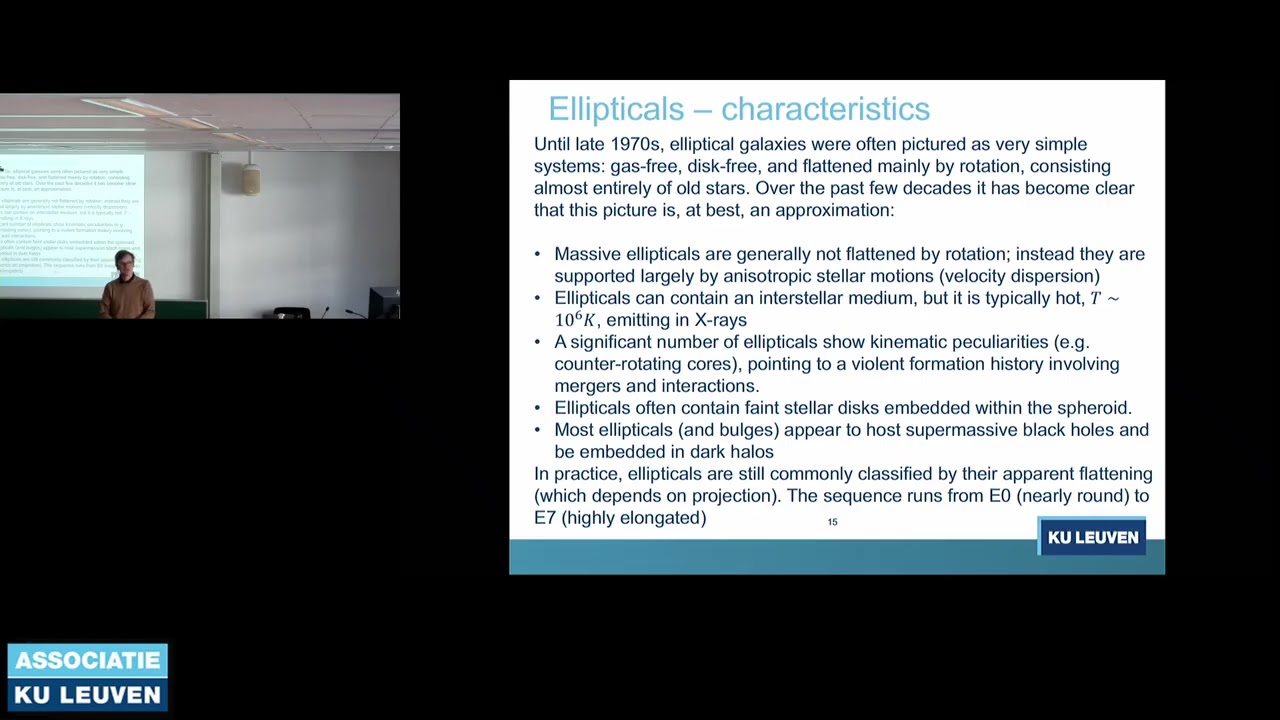
- Revision of the classical picture of ellipticals: gas-free, disc-free, rotationally flattened; replaced by anisotropic velocity dispersion, hot X-ray gas and faint embedded discs.
- Major-merger scenario illustrated by the future Milky Way–Andromeda collision: starburst, disc destruction, settling into a giant elliptical.
- E0–E7 morphological classification by apparent flattening, and the statement that total masses of ellipticals are far more uncertain than those of spirals.
- Surface-brightness fitting: de Vaucouleurs r^(1/4) law, King models from the truncated isothermal sphere, and the analytical Jaffe model with finite mass and half-light radius.
- Sérsic index versus luminosity for ellipticals and dwarfs, and the turnaround of central surface brightness in the most massive systems.
- Evacuated cores in the brightest ellipticals attributed to coalescing supermassive black holes, and the link to the cusp-core problem of cold dark matter haloes.
- Rotation-versus-dispersion diagram, jeans equation with the beta anisotropy parameter, and the derivation of the beta degeneracy limiting mass estimates.
Cited Sources
- Peter Schneider, Extragalactic Astronomy and Cosmology: An Introduction (2015), Chapter 3 — The only explicit bibliographic reference given in the lecture; the lecturer states that figure references are carried in the accompanying slides.
- KU Leuven Institute of Astronomy — Institutional home of the course and of the lecturer, cited in the video description.
- Edited version of this class (StarlightWinds channel) — Companion edited recording of the same lecture, useful for checking passages obscured by the live format.
- Raw classroom course playlist — Galaxies and Cosmology — Full sequence of unedited lectures, allowing the earlier modules referenced repeatedly in this session (stellar dynamics, jeans equation, isothermal sphere) to be consulted.
- Full edited course playlist — Edited counterpart of the course, cited in the description.
Concurring Sources
- Elliptical galaxy — Wikipedia — Confirms the standard properties described in the lecture: cD galaxies in cluster cores, wide luminosity range, hot X-ray gas, faint discs and anisotropic velocity dispersion in massive systems.
- Sérsic profile — Wikipedia — Corroborates the use of the Sérsic index as a continuous parameter interpolating between exponential and de Vaucouleurs profiles.
- Fundamental plane (elliptical galaxies) — Wikipedia — Supports the lecture's framing of the fundamental plane as the elliptical analogue, with differences, of the Tully-Fisher relation for spirals.
Contribution & Novelties
No new research is presented; this is a didactic synthesis whose value lies in the way it reorganises standard extragalactic material into a single coherent narrative. Its most useful contribution is the explicit linkage between photometry and dynamics: the session shows how the same galaxy is described first by an empirical surface-brightness law (de Vaucouleurs, Sérsic), then by physically motivated dynamical models (King, Jaffe) derived from the truncated isothermal sphere, and finally by jeans-equation mass estimates whose non-uniqueness is demonstrated numerically rather than merely asserted. The treatment of the Sérsic index as a continuous function of luminosity, rather than as the marker of a dwarf/elliptical dichotomy, and the corresponding reading of the central surface-brightness turnaround in the brightest systems, give a compact state-of-the-field summary of a live methodological debate. The connection drawn between evacuated cores, binary black-hole scouring and the cusp-core problem is a further point of articulation that is often left implicit in textbook treatments.
Further reading:
- Elliptical galaxy — Overview of morphological classes, scaling relations and formation channels discussed throughout the lecture.
- Sérsic profile — Mathematical definition of the generalised profile used by the lecturer to unify the exponential (disc) and r^(1/4) (elliptical) cases.
- Fundamental plane (elliptical galaxies) — The scaling relation explicitly announced at the start of the session as the elliptical counterpart of the Tully-Fisher relation.
- Dark matter halo — Background for the cusp-core problem and for the NFW-type density profiles invoked when comparing predictions with observed cores.
- Sloan Digital Sky Survey — The survey named by the lecturer as the data source for the statistical galaxy-population part of the module.
- Peter Schneider, Extragalactic Astronomy and Cosmology: An Introduction (2015), ch. 3 — The course textbook cited in the description; cited by name only, as no verified link is available here.
- Jaffe (1983) and King (1966) stellar-dynamical models — Cited by the lecturer as the analytical models behind the surface-brightness fits; referred to by name without a link.
322 words
Radar Profile
The profile is dominated by technical depth and information density, typical of a graduate lecture that assumes fluency with the jeans equation and dynamical modelling. Reliability and information quality sit high but slightly below the technical ceiling, reflecting the absence of an in-video bibliography and the unedited, self-correcting delivery rather than any substantive error. The relatively lower score on popular accessibility is structural and does not reflect a deficiency of the content itself.