Galaxies and Cosmology: Course organisation and exams (2025–2026)
Keywords
Summary
307 words
Critical Evaluation
Value of the Information & Strength of the Argument
The informational value is real but narrowly scoped: it is a complete, unambiguous specification of how a Master-level astronomy course is run and graded. Every operational question a student could have — when classes take place, how many modules there are, what each module covers, what must be handed in, what happens if one component is missing, what the retake looks like, which book to buy or not buy, how exercises are released — is answered explicitly and in sequence. This is high-value information for its intended recipients and near-zero value for anyone else, since none of it is transferable knowledge about galaxies or cosmology; the module titles are listed but never developed, so the astrophysical substance is announced rather than delivered. The argumentation is not demonstrative but procedural: the lecturer justifies choices rather than claims (why a background textbook is needed before touching JWST results, why exercises should be attempted rather than merely read, why the reference book should be used as a hub rather than read linearly). These justifications are sensible and coherent with the stated course level, and the lecturer openly flags uncertainty where it exists — the schedule depends on enrolment and on how group assignments are allocated, and some lectures may be replaced by pre-recorded material. The main weakness is the absence of any supporting evidence for the pedagogical claims: assertions such as ‘it does you well to follow along because I drop hints’ or ‘you need to do exercises yourself’ are presented as experience-based statements without any reference to research on learning. Several passages are also visibly improvised and self-corrected (‘I did not explain myself very clearly there’), which lowers density without adding error. Overall, the discourse is honest, well structured and free of overstatement, but it argues about logistics, not about the world.
Scientific Rigor, Source Quality, Title Accuracy
Scientific rigour in the strict sense is barely at stake here, since no empirical claim about galaxies or cosmology is made or defended; the only technical content is a list of module topics, all of which are standard, uncontroversial elements of an introductory extragalactic course (galactic dynamics, galaxy morphology, active galactic nuclei, clusters, cosmological world models, structure growth, galaxy formation). Where the lecturer does touch on substance, he is careful: he insists that the latest James Webb Space Telescope results must be placed in the context of basic material before being tackled, which is a methodologically sound position. Source quality is appropriate for the genre: one clearly identified main textbook (Schneider, ‘Extragalactic Astronomy and Cosmology’), explicitly described as a background reference the course is inspired by rather than followed, plus a set of further readings whose level is honestly characterised (one with more emphasis on background physics, two more advanced volumes used by active researchers, and a general classic). The provenance and access conditions of the main book are specified, and the lecturer warns against reading an encyclopaedic reference cover to cover, which is good guidance. What is missing is any formal referencing of the specific results alluded to in passing (recent telescope findings, cosmic microwave background fluctuations), but that is deferred to the lectures themselves. On title/content fit: the title announces course organisation and exams, and that is precisely what is delivered — the fit is excellent, with the module preview being a bonus rather than a departure.
564 words
Title / Content Match
The title is fully accurate: the video is exactly a course-organisation and exam-format briefing, with no astrophysics content beyond a list of module titles. A viewer expecting a lecture on galaxies would be disappointed, but nothing is over-promised.
Quality & Reliability
6/10
First-hand, authoritative information given by the course lecturer himself about his own course: module list, assessment rules, deadlines and reading material are stated directly by the person who sets them, which makes them highly reliable as institutional/pedagogical information. Reliability as *scientific content* is however limited: almost no physics is discussed, no data or literature is analysed, and the only cited reference is a textbook used as background. The talk is also explicitly provisional in places (schedules 'to be confirmed', possible replacement of lectures by pre-recorded material), so a few details may change during the semester.
Key Moments
Markers derived by PSI from the transcript: the creator did not define chapters.
- Opening: timetable (Wednesday 9–12), long-format sessions with breaks, and the announcement that the course is organised differently from the autumn course.
- Structure of the course: nine content volumes plus a group-assignment module, an exercise module and a review/exam-preparation module; default live streaming and recording, with no guarantee.
- Typical class routine: recap, Q&A and exercises at the start, preparation for the following week at the end; course material on the university platform (Toledo).
- Assessment overview: oral exam, group assignment and individual take-home exam must all be submitted to pass; consequences of a missing component and rules for the retake.
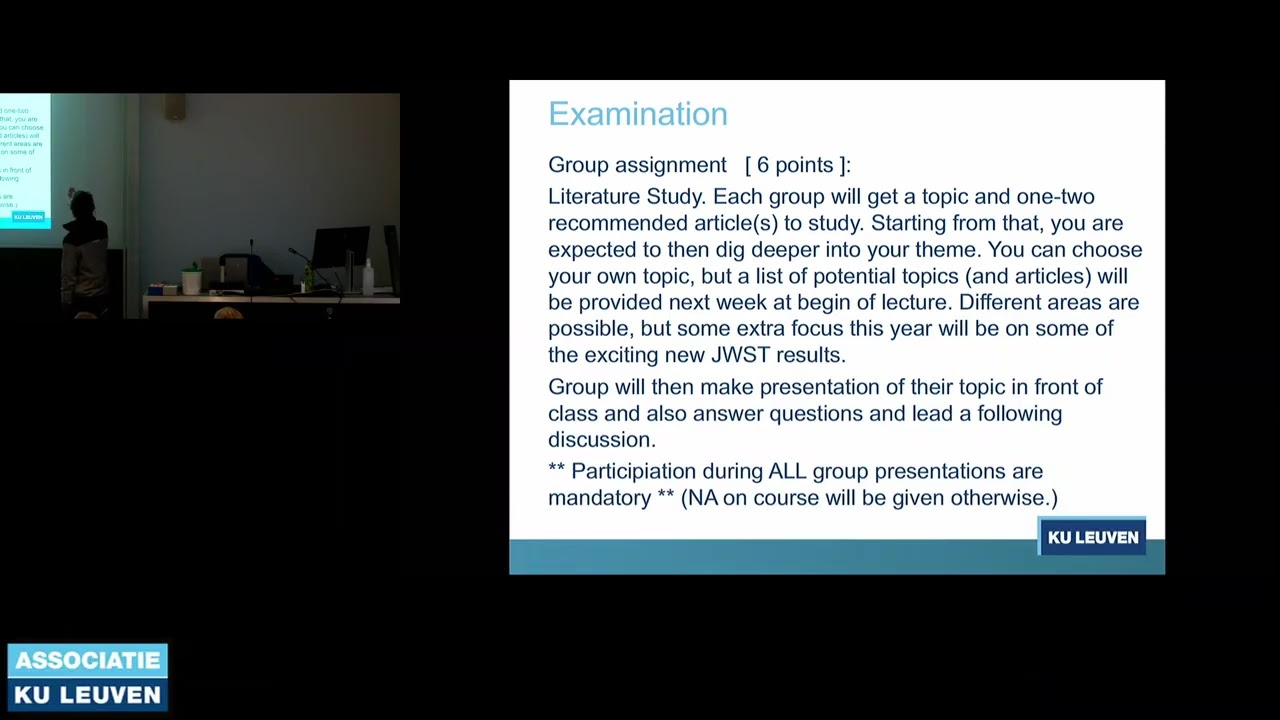
- Group assignment described as a literature study: one to three recommended articles per group, free choice of topic subject to approval, extra focus this year on recent JWST results, mandatory in-class presentation and discussion in May.
- Take-home exam: individual written report, exercises released two to three weeks before the exam-period deadline, with detailed instructions.
- Oral exam format: 15–20 minute open-book discussion, any material allowed, with a caution that looking up basic definitions consumes the available time.
- Walkthrough of the nine content modules: dynamics fundamentals, the Milky Way and galaxy classes, the galaxy population and the Sloan Digital Sky Survey exercise, active galaxies, clusters, cosmology, structure growth, galaxy formation and the early universe.
- Reading material: Schneider's 'Extragalactic Astronomy and Cosmology' as main background reference, freely available via the university library and posted on the course platform, plus further recommended textbooks characterised by depth and level.
- Study strategy: use lectures, slides, study questions and exercises as the core path, and the reference book as an overarching entry point for deeper reading rather than cover-to-cover; short break announced.
Cited Sources
- Institute of Astronomy, KU Leuven — Institutional page of the hosting institute, given in the description as the reference point for the course and its staff.
- Galaxies and Cosmology — edited course playlist (StarlightWinds / Jon Sundqvist) — Playlist of the edited lectures of the same course, linked in the description for viewers wanting the produced version with more physics.
- Peter Schneider, 'Extragalactic Astronomy and Cosmology' — Main background reference book of the course, described as broad and extensive rather than deep on background physics; available to students through the university online library.
- Linda Sparke, 'Galaxies in the Universe' — Cited among the further recommended textbooks as a good general classic on galaxies.
- Sloan Digital Sky Survey (SDSS) — Database explicitly named as the basis of one hands-on exercise in the galaxy-population module.
- James Webb Space Telescope results — Recent telescope results announced as a new emphasis of this year's group assignments, to be embedded in the basic material.
Concurring Sources
- Institute of Astronomy, KU Leuven — Institutional source matching the course, programme and lecturer described in the video.
Contribution & Novelties
There is essentially no scientific novelty: the video announces topics and logistics, it does not produce or discuss results. Its genuine contribution is documentary — it captures how a specific Master-level astronomy course is designed in 2025–2026, including the weighting given to a literature-study group project, the choice of an open-book oral discussion as the exam format, and the deliberate decision to reserve the newest telescope results for student projects rather than for the lecture core because the audience needs fundamentals first. It also documents a hybrid teaching arrangement in which live streaming is the default but attendance is the only guarantee, a detail of some interest for anyone studying contemporary university practice.
Pour aller plus loin :
- Sloan Digital Sky Survey — The survey database used for the hands-on exercise in the galaxy-population module.
- James Webb Space Telescope — Background on the recent results the lecturer wants to bring into the group assignments.
- Cosmic microwave background — The ‘very tiny fluctuations’ referred to as the starting point of structure growth in the cosmology modules.
- Lambda-CDM model — The standard cosmological framework underlying the ‘world models’ and structure-growth lectures.
- Galaxy formation and evolution — Subject of the final content module of the course.
- Active galactic nuclei and supermassive black holes — Central topic of one module; treated here only by name, without development.
223 words
Radar Profile
The profile is deliberately lopsided: very low technical level and modest information quantity, since the session is administrative, but comparatively good information quality and reliability because the statements come from the person who actually sets the rules. The gap between reliability and technical depth is the signature of a legitimate but non-substantive document — trustworthy about procedures, silent about science.