IvS Seminar: Orsola De Marco (19/11/2026)
Title history
- IvS Seminar: Orsola De Marco (19/11/2026) — observed on 20261119-1709 UTC (YouTube)
Keywords
Summary
183 words
Critical Evaluation
Value of the Information & Strength of the Argument
The value of the information is high, as it synthesizes recent observational and theoretical work on binary stellar evolution, particularly post-AGB binaries. The argumentation is based on detailed simulations and comparisons with observations. The speaker carefully discusses uncertainties, such as numerical effects and equation of state choices. She also acknowledges limitations and open questions. The argumentation is logical, starting from known facts and building to new insights, and she provides quantitative evidence from simulations.
Scientific Rigor, Source Quality, Title Accuracy
The scientific rigor is appropriate for a seminar talk, with clear methodology and discussion of systematic effects. However, no explicit references are given in the video or description, so the provenance of specific claims isn’t verifiable directly. The title of the video is generic, but the description provides a descriptive title that matches content. The talk is a synthesis of the speaker’s own research and that of her students, which is credible but lacks external citations.
165 words
Title / Content Match
The video title is generic, but the description clearly specifies the topic of mass transfer and stellar evolution, which matches the content.
Quality & Reliability
8/10
The speaker is a professor with extensive expertise in stellar astrophysics; the talk presents original research and reviews current understanding, though no external sources are cited within the video itself.
Key Moments
Markers derived by PSI from the transcript: the creator did not define chapters.
- Introduction and speaker bio; initial remarks on academic career.
- Detailed explanation of common envelope phases: Roche-lobe overflow, inspiral, and ejection.
- Showing a smoothed-particle hydrodynamics simulation movie of a common envelope event.
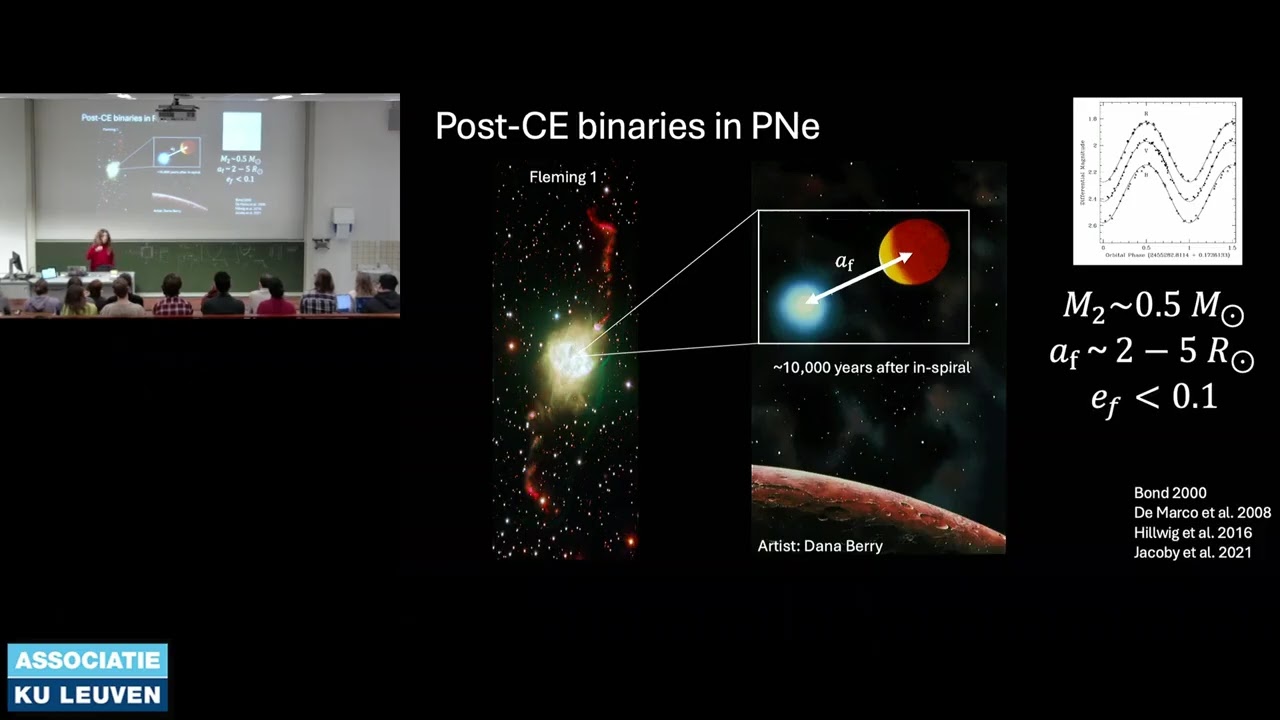
- Introduction to post-AGB binaries and their characteristics, including circumbinary disks and jets.
- Period-eccentricity diagram illustrating challenges to common envelope predictions.
- Discussion of companion mass distribution and its impact on stabilizing mass transfer.
- Presentation of simulations with varying companion mass and the effect of the equation of state.
- Introduction of Scala's project: triggering common envelope when the envelope is light, with quantifications of penetration.
Contribution & Novelties
The talk offers original insights into the role of massive companions in delaying but not fully preventing common envelope evolution, and highlights the importance of equation-of-state choices in simulations. It also emphasizes the utility of post-AGB binaries as probes of binary interaction history.
Pour aller plus loin :
- Common envelope — A key concept in close binary evolution, explaining the inspiral and ejection processes discussed.
- Post-AGB star — The evolutionary phase central to the talk, with links to binary interactions and disks.
- Smoothed-particle hydrodynamics — The numerical method used in the phantom simulations presented, crucial for understanding the computational results.
100 words
Radar Profile
The profile shows a high technical level and solid information quality, with slightly lower completeness and novelty, reflecting a focused but deep seminar presentation.