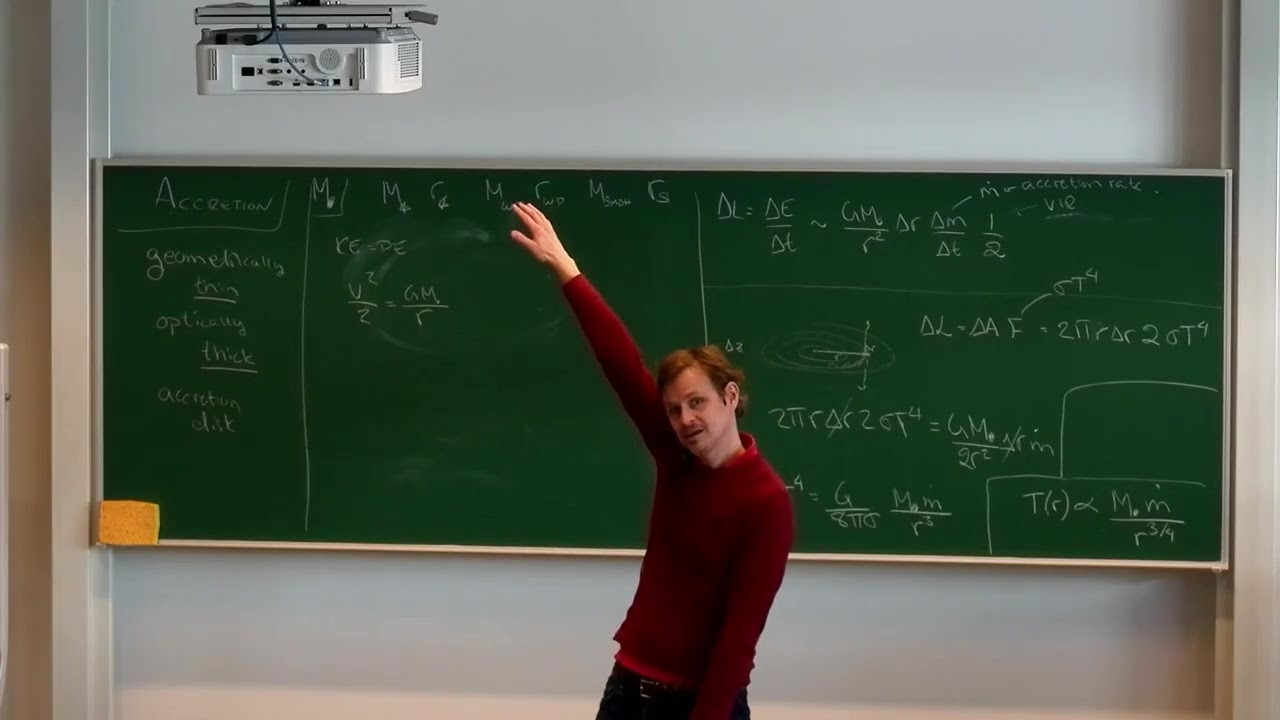
Galaxies and Cosmology: L5b - Accretion onto compact objects
Keywords
Summary
290 words
Critical Evaluation
Value of the Information & Strength of the Argument
The informational value is high for anyone seeking a compact, self-contained derivation of the standard thin-disc model. Every step is built from a small number of primitives that the audience already owns: Newtonian potential energy, the virial theorem, blackbody radiation and dimensional scaling. This makes the reasoning fully auditable, since the listener can redo each line and see exactly where the factor of two, the two radiating faces or the 1/2 in the virial theorem enters. The lecturer repeatedly signposts what is being neglected and why, for instance that the detailed conversion of gravitational energy into heat is genuinely difficult and would require a dedicated course, and that angular momentum and the innermost stable circular orbit are absorbed into a phenomenological correction factor rather than derived. That honesty strengthens the argument considerably: the model is presented as an order-of-magnitude framework whose predictions can be tested, not as an exact solution. The argumentative chain is linear and cumulative, from potential energy to luminosity, to surface flux, to temperature profile, to spectrum, each result feeding the next, and the numerical scaling relation (temperature in kelvin as a function of accretion rate, black hole mass and radius in Schwarzschild units) is then used to discriminate between two observed classes of object. The pedagogical device of contrasting a spherical star with a flat disc, and a single-temperature blackbody with an integrated multi-temperature disc, is what carries the conceptual payload: it explains why the spectrum is not Planckian and why the ν^(1/3) segment is a signature of the model. Weaknesses are those of the format rather than of the reasoning: the board work is occasionally hesitant, notation shifts between capital and lower-case r, a factor of 1/4 is initially omitted and only caught later, and the treatment stays at the level of proportionalities with numerical coefficients dropped in the spectral integration. A listener without a radiative-processes background will find the Rayleigh–Jeans and Wien limits asserted rather than re-derived here.
Scientific Rigor, Source Quality, Title Accuracy
Scientific rigour is solid and appropriate to a graduate lecture. The results quoted are the standard ones, the derivation of the Schwarzschild radius from setting the escape velocity to the speed of light is correctly flagged as a Newtonian shortcut rather than a general-relativistic result, and the temperature scaling with the inverse square root of the black hole mass is presented as an order-of-magnitude estimate valid at a given radius in Schwarzschild units, not as a precise prediction. The self-correction of a dropped 1/4 factor mid-derivation is a concrete indicator of care. Sourcing is light but explicit: the description points to Peter Schneider’s Extragalactic Astronomy and Cosmology (2015), chapters 5 and 2, as the accompanying reading, states that figure and example references are given in the lecture slides, and links the institutional page of the KU Leuven Institute of Astronomy together with the raw and edited versions of the course. No primary research papers are cited in the spoken content, which is normal for a didactic exposition but means the listener is not directed to the original literature on accretion disc theory. The title-content match is exact, with no rhetorical inflation and no promise beyond what the blackboard delivers.
538 words
Title / Content Match
The title is fully consistent with the content: the entire session is devoted to accretion onto compact objects, deriving the accretion luminosity, the disc temperature profile and the resulting spectral energy distribution. No discrepancy between announced and delivered material.
Quality & Reliability
8/10
Live blackboard derivation by a university lecturer for a Master's course in astronomy and astrophysics. The physics is standard and internally consistent (gravitational energy release, virial theorem factor, thin optically thick disc, multi-temperature blackbody spectrum), and the lecturer corrects a missing 1/4 factor in real time in front of the camera, which is a good sign of intellectual honesty. The treatment is deliberately order-of-magnitude: angular momentum transport, the detailed dissipation mechanism and relativistic corrections are explicitly deferred, and the innermost-stable-circular-orbit correction is introduced only as a phenomenological f(r) factor. No external claims are made that would require fact-checking.
Key Moments
Markers derived by PSI from the transcript: the creator did not define chapters.
- Framing of the lecture: accretion is a broad astrophysical process, but the target today is AGN and the standard geometrically thin, optically thick accretion disc.
- Gravitational potential energy difference between r and r + Δr, expansion for Δr much smaller than r, giving GM Δm Δr / r², then conversion into luminosity with the virial-theorem factor of one half and definition of the mass accretion rate.
- Disc modelled as an annulus: area 2πr Δr times two radiating faces, blackbody flux σT⁴ equated to the accretion power, yielding T ∝ (M Ṁ / r³)^(1/4).
- Characteristic scales for a stellar surface, a white dwarf and a black hole; Schwarzschild radius re-derived by setting the escape velocity to c, with an outreach illustration of why a black hole appears black.
- Temperature expressed in units of the Schwarzschild radius; numerical scaling around 8.7×10⁵ K, introduction of a correction factor f(r) and of the innermost stable circular orbit at roughly six gravitational radii.
- Observational consequence: accreting stellar binaries reach about 10⁷ K and shine in X-rays, while AGN discs sit near 10⁵ K and produce the blue bump; discussion of the dependence on accretion rate, mass and radius.
- Transition from a single-temperature blackbody to a disc: because the source is spatially unresolved, the observed spectrum is the integral of B_ν(T(r)) over all disc radii.
- Rayleigh–Jeans and Wien limits of the integrated spectrum: the ν² tail constrains the minimum disc temperature, the exponential cutoff constrains the maximum one.
- Intermediate regime handled by a change of variable, showing that the summed spectrum follows L_ν ∝ ν^(1/3) instead of a Planck shape.
- Schematic log L_ν versus log ν with its three characteristic regions, cross-referenced to the numerical integration shown in the accompanying lecture notes.
Cited Sources
- Peter Schneider, Extragalactic Astronomy and Cosmology: An Introduction (2015) — Recommended reading cited in the description, chapters 5 and selected material in chapter 2; figure and example references are given in the lecture slides.
- Institute of Astronomy, KU Leuven — Institutional page of the host institute, linked in the description.
- Galaxies and Cosmology — raw classroom course (playlist) — Full unedited lecture series to which this recording belongs.
- Edited version of this class — StarlightWinds — Edited counterpart of the same lecture, referenced in the description.
- Full edited course (playlist) — Complete edited version of the course, linked in the description.
Concurring Sources
- Accretion disc (Wikipedia) — Confirms the standard thin-disc temperature profile T ∝ (M Ṁ / r³)^(1/4) and the multi-temperature spectrum with its ν^(1/3) segment.
- Schwarzschild radius (Wikipedia) — Matches the derivation of r_s = 2GM/c² from the escape-velocity argument, including its limitations as a Newtonian shortcut.
- Active galactic nucleus (Wikipedia) — Supports the identification of the ultraviolet blue bump with thermal emission from an accretion disc at around 10⁵ K.
- X-ray binary (Wikipedia) — Corroborates the link between stellar-mass compact objects, disc temperatures near 10⁷ K and dominant X-ray emission.
Contribution & Novelties
There is no new scientific result here, and none is claimed: this is a didactic exposition of textbook accretion physics. Its value lies in the reconstruction of the reasoning chain in real time, from a gravitational potential-energy difference to the shape of an AGN spectrum, including the intermediate steps that polished reviews usually skip. Two elements stand out. First, the explicit demonstration that, once the radius is measured in Schwarzschild units, the disc temperature scales as the inverse square root of the black hole mass, which directly explains why stellar-mass accretors are X-ray sources while supermassive accretors radiate in the ultraviolet. Second, the derivation of the ν^(1/3) spectral segment as the unavoidable consequence of summing blackbodies over a T ∝ r^(-3/4) profile, presented alongside the diagnostic use of the Rayleigh–Jeans and Wien ends as constraints on the minimum and maximum disc temperatures. The visible correction of a dropped factor also gives an unusually candid view of the derivation as a working process.
Pour aller plus loin :
- Accretion disc — General overview of disc physics, the thin-disc regime and its variants; useful complement to the blackboard derivation.
- Schwarzschild radius — Formalises the escape-velocity shortcut used in the lecture and its general-relativistic justification.
- Active galactic nucleus — Context for the blue bump and the AGN energy budget discussed here.
- X-ray binary — Observational counterpart of the stellar-mass accretion case, where disc temperatures near 10⁷ K produce X-ray emission.
- Shakura & Sunyaev (1973), “Black holes in binary systems: observational appearance” — The founding paper of the geometrically thin, optically thick disc model used throughout the lecture; cited here by name only, as no stable public link is asserted.
- Innermost stable circular orbit — The concept behind the f(r) correction factor introduced near the end; cited by name only.
296 words
Radar Profile
The profile is that of a dense, high-level but narrowly scoped lecture: information quantity, information quality and technical level are all high and closely matched, since the density comes from a continuous derivation rather than from a survey of results. Overall reliability is slightly below those peaks only because the treatment deliberately stops at order-of-magnitude estimates and proportionalities, leaving the microphysics of angular momentum transport and relativistic effects out of scope.