Galaxies and Cosmology: L9a - Dark matter halos and baryonic infall
Keywords
Summary
300 words
Critical Evaluation
Value of the Information & Strength of the Argument
The informational value is high and densely packed: in half an hour the lecture chains cosmological initial conditions, the Jeans-mass argument, the necessity of collisionless dark matter, the phenomenology of halo substructure, the standard analytic halo models, and the thermodynamical sequence from shock heating to radiative cooling. Each step is justified rather than asserted, typically by a short derivation at the board (equating centrifugal and gravitational terms for the circular velocity, setting the ideal-gas thermal energy against the virial potential to obtain the virial temperature, dimensional reasoning to recover the scaling of the spin parameter). The pedagogical scaffolding is explicit: the lecturer repeatedly points back to earlier modules (module 2 for gas dynamics and the isothermal sphere, module 3 for rotation curves, module 4 for anisotropic velocity dispersion in ellipticals, module 6 for cooling flows in clusters, module 7 for the critical density), which makes the argument cumulative rather than a string of facts. The reasoning is also honest about its own limits: the simple cooling picture is immediately confronted with the observed persistence of star formation, and runaway cooling is named as the failure mode that requires feedback, without pretending the feedback implementation is settled. Numerical orders of magnitude (10^12 solar masses and 200 kpc for a Milky Way halo versus a 10 kpc disc, 10^6 K versus 10^7 K virial temperatures) are given to anchor the scaling relations, and the distinction between the physical picture and its numerical realisation is maintained. Weaknesses are those inherent to an unedited oral delivery: occasional self-corrections, slips in naming (the NFW acronym is spelled out imperfectly, the Millennium Simulation authors are referred to loosely by their institute), and a somewhat abrupt transition into the problem list, which is recapitulated rather than re-derived. The argumentative thread nonetheless remains clear from start to finish, and the final synthesis, that galaxy formation hinges on whether hot halo gas can radiate away its thermal energy and on whether feedback prevents that radiation from being catastrophic, is a defensible and well-motivated conclusion.
Scientific Rigor, Source Quality, Title Accuracy
Scientifically, the content conforms to the standard Lambda-CDM framework: the definitions of R200 and of the virial mass, the isothermal-sphere and NFW profiles, the spin-parameter values (about 0.4 for a naive isothermal halo versus about 0.05 in simulated halos), and the virial-temperature scaling are all stated correctly and are consistent with the textbook cited in the description (Schneider, Extragalactic Astronomy and Cosmology, chapters 7-10). The lecturer also correctly flags the three classical tensions of the model, the missing-satellite problem, too-big-to-fail and the cuspy-core problem, and presents them as open issues rather than resolved details, which is the appropriate posture. On sourcing, however, the lecture is a synthesis rather than a documented argument: no specific paper is named, and the references it does invoke (Millennium and Aquarius simulations, the GADGET code, the NFW profile) are identified by group or acronym rather than by a citable reference, with the pointers deferred to slides not visible in the recording. Traceability therefore depends on the viewer following the description’s further-reading link to the textbook. The only external links supplied are institutional and course-playlist links (KU Leuven Institute of Astronomy, the raw and edited course playlists), which document the provenance of the lecture but not the individual claims. On the fit between title and content, the match is direct and the title is informative rather than promotional: the two announced topics, dark matter halos and baryonic infall, occupy the analytical core of the session, and the surrounding material on structure growth and on the problems of the Cold Dark Matter model functions as the necessary frame.
611 words
Title / Content Match
The title announces dark matter halos and baryonic infall, and the lecture delivers exactly that: halo definitions and profiles, then the shock-heating and radiative-cooling sequence that governs whether infalling gas can turn into a galaxy. The opening framing on galaxy formation and structure growth is broader than the title but serves as necessary context rather than digression.
Quality & Reliability
8/10
University lecture delivered by a specialist (Prof. Jon Sundqvist, KU Leuven Institute of Astronomy) within a structured Master's course, building explicitly on previous modules and on a recognised textbook (Schneider 2015, ch. 7-10). The physics presented (Jeans mass, virial temperature, R200 definition, isothermal sphere, NFW profile, spin parameter, radiative cooling) is standard, internally consistent and correctly derived on the board. The framing is that of a classroom synthesis rather than a primary publication; no individual papers are cited verbally, only named simulation programmes (Millennium, Aquarius, GADGET) and a textbook, so traceability of specific claims is partial. The lecturer explicitly invites corrections from viewers, which is a good-faith signal but not a formal peer-review mechanism.
Key Moments
Markers derived by PSI from the transcript: the creator did not define chapters.
- Opening of module 9: the lecture is framed as galaxy formation and evolution, and a simulation of a galaxy in the making is introduced as the thread for the session.
- Recap of structure growth: the Jeans mass before recombination, why photon pressure blocked collapse below the horizon scale, and why a collisionless non-baryonic component was needed to accelerate growth.
- The lecturer displays a simplified galaxy-formation flowchart and maps the session onto it: initial conditions, gravitational instability, halo formation, then the critical branching on radiative cooling.
- Playback of the Millennium Simulation showing nonlinear growth of the cosmic web, with filaments, voids and dense halos identified as the sites of galaxy formation.
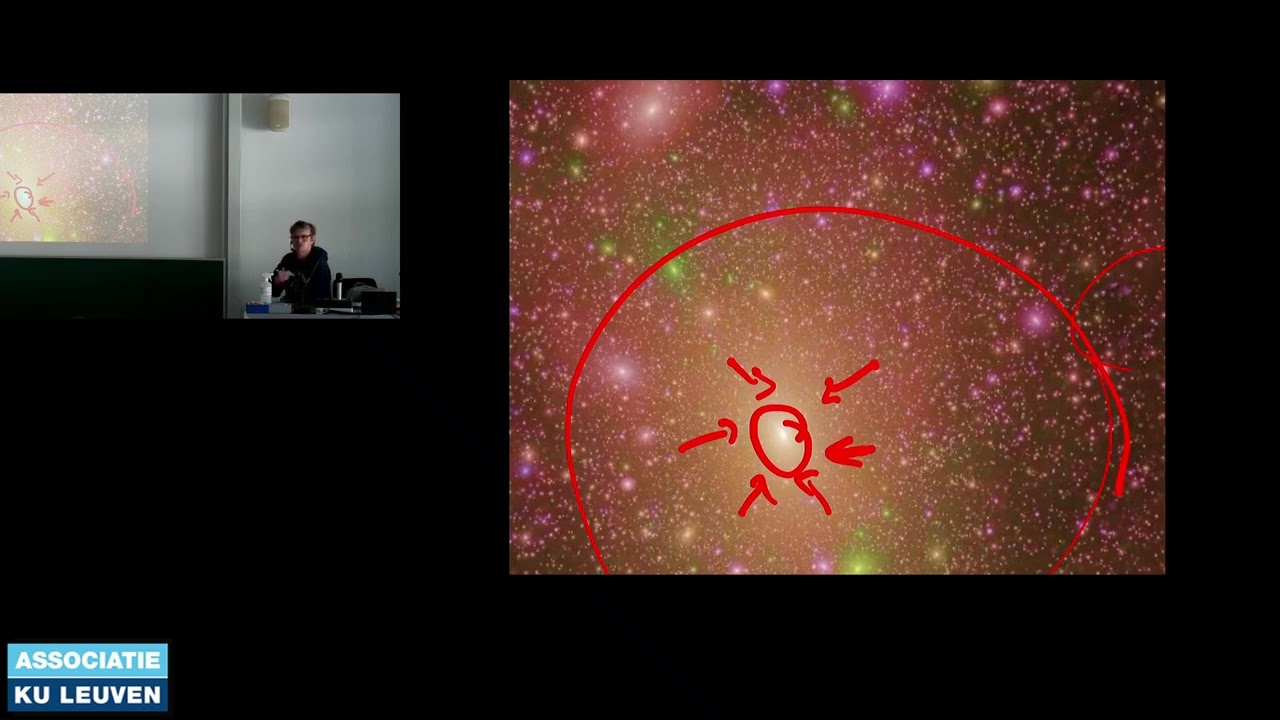
- The Aquarius simulation zooms toward a single halo; the visible substructure is used to introduce the missing-satellite problem and the too-big-to-fail issue.
- Formal halo definitions: R200 as two hundred times the critical density at the relevant redshift, the enclosed virial mass, and the circular velocity obtained by balancing centrifugal and gravitational terms.
- The singular isothermal sphere and its flat rotation curves as the classical dark-matter evidence, followed by the dimensionless spin parameter and the gap between the naive expectation and simulated values.
- The NFW profile as a better analytic fit, with the outer 1/r^3 falloff curing the infinite-mass problem of the isothermal sphere, and the cuspy-core discrepancy with observed low-surface-brightness galaxies.
- Baryonic infall: collisional gas falls into the pre-existing potential wells, shocks develop, and the virial temperature is derived, giving about 10^6 K for a Milky Way halo and 10^7 K for a cluster.
- Radiative cooling as the decisive switch, the runaway-cooling problem it creates, and the need for supernova, wind, ionising and AGN feedback, linked back to the cooling flows seen in clusters.
Cited Sources
- Institute of Astronomy, KU Leuven — Institutional page of the host institute; identifies the academic setting of the lecture and the Master of Astronomy and Astrophysics programme.
- Galaxies and Cosmology - raw classroom course (playlist) — Unedited classroom recordings of the course, of which this video is module 9, part I.
- Edited version of this class - StarlightWinds — Edited edition of the same lecture, offered in the description as an alternative viewing format.
- Full edited course (playlist) — Complete edited version of the course for viewers wanting the sequenced presentation.
- Peter Schneider, Extragalactic Astronomy and Cosmology: An Introduction (2015), chapters 7-10 — Further reading explicitly recommended in the description; the lecture notes that references for figures and examples are given in the slides where used.
- Millennium Simulation and Aquarius Simulation (Springel and collaborators, MPA Garching) — Numerical Lambda-CDM simulations whose visualisations are shown and discussed; the GADGET code used to render them is mentioned as open source.
Concurring Sources
- Dark matter halo (Wikipedia) — Confirms the standard R200 and virial-mass definitions and the NFW parameterisation presented in the lecture.
- Galaxy formation and evolution (Wikipedia) — Corroborates the overall sequence of gas infall, shock heating, cooling and feedback described here.
- Millennium Simulation (Wikipedia) — Documents the Lambda-CDM simulation shown as a visualisation and its role in mapping the cosmic web.
Dissenting Sources
- Modified Newtonian dynamics (Wikipedia) — Presents the main non-dark-matter alternative for explaining flat rotation curves; the lecture adopts the Lambda-CDM interpretation without discussing modified-gravity proposals, which is a legitimate scope choice for a course module but leaves that debate unaddressed.
- Cuspy halo problem (Wikipedia) — Details the observational side of the core-versus-cusp tension. It does not contradict the lecture, which explicitly names the problem, but it documents how persistent the discrepancy has been and how contested its resolution remains.
Contribution & Novelties
This is not a vehicle for new results: it is a pedagogical synthesis of established Lambda-CDM galaxy-formation physics, and its originality lies in the way the pieces are ordered and motivated. The most valuable contribution is the explicit framing of radiative cooling as a branching point in the galaxy-formation flowchart, together with the immediate statement of why that branch, taken naively, fails: efficient cooling produces runaway starbursts and leaves dead galaxies, so feedback must be invoked. The lecture also usefully reconnects two topics usually taught apart, the cooling-flow problem in cluster cores and the cooling problem of individual halo gas, presenting them as the same physics at two mass scales. The concentric series of recaps, pointing back to six earlier modules for each ingredient, makes the causal chain from recombination to a star-forming disc unusually legible for a single session.
Pour aller plus loin :
- Dark matter halo — Overview of halo definitions, mass profiles and the R200 convention used throughout the lecture.
- Navarro-Frenk-White profile — The analytic profile fitted to simulated halos, with its inner cusp and outer 1/r^3 falloff.
- Galaxy formation and evolution — Broader context for the baryonic-infall and cooling sequence outlined here.
- Cuspy halo problem — The core-versus-cusp discrepancy between Cold Dark Matter simulations and observations of low-surface-brightness galaxies.
- Dwarf galaxy problem — The missing-satellite and too-big-to-fail tensions raised when the Aquarius substructure is shown.
- Cooling flows and feedback in galaxy clusters — the same radiative-cooling argument applied at cluster scales, already treated in module 6 of this course; no stable canonical URL cited here to avoid pointing to an approximate address.
- Jeans instability and the virial theorem — the two analytical tools on which the derivations of this session rest; consult the corresponding Wikipedia entries rather than any specific address quoted from memory.
298 words
Radar Profile
The profile is dominated by a high technical level and a high density of information, typical of a formal Master's lecture built on derivations rather than on narrative. Information quality and global reliability sit close behind, supported by a coherent internal logic and standard textbook physics, while the slightly lower reliability mark reflects the absence of citable primary references in the spoken content. The resulting shape is that of a dense but trustworthy specialist exposition rather than a broad or speculative one.