Galaxies and Cosmology: L6b - Galaxy clusters and dark matter
Keywords
Summary
239 words
Critical Evaluation
Value of the Information & Strength of the Argument
The informational value is high because the lecture organizes a broad observational problem around three independent mass-estimation routes: cluster dynamics, X-ray hydrostatic equilibrium and gravitational lensing. Each route is presented with its direct observables, its scaling relations and its main model dependencies, so the audience can see why the dark-matter inference is not tied to a single measurement. The argument is cumulative rather than rhetorical: dynamical mass is compared with optical luminosity, the hot-gas mass is inferred from X-ray emission, and the total gravitational mass is then confronted with the visible components. The numerical mass budget and the order-of-magnitude density comparison make the scale of the discrepancy concrete. The reasoning is generally solid, but the lecture format means that several derivations are delegated to earlier classes and that approximations such as spherical symmetry, isotropy, isothermality or hydrostatic equilibrium are stated rather than fully tested. The lecturer explicitly acknowledges some of these limitations and corrects the satellite attribution, which strengthens the argumentative honesty. Overall, the segment offers a coherent pedagogical synthesis rather than new evidence, and its conclusions are presented with appropriate caveats about model dependence.
Scientific Rigor, Source Quality, Title Accuracy
Scientific rigor is high for a course lecture: standard equations are used, observables and model assumptions are distinguished, and the lecturer flags complications such as velocity anisotropy, deprojection, hydrodynamical corrections and simplified density profiles. The description identifies Peter Schneider’s Extragalactic Astronomy and Cosmology: An Introduction (2015), Chapter 6, as further reading, and the lecturer refers to earlier course notes and a radiative-processes course. The linked material is institutional or pedagogical—KU Leuven’s Institute of Astronomy and the raw and edited course playlists—rather than primary research papers, and the slides said to contain figure references are not linked in the description. The title/content fit is strong: the lecture delivers cluster mass measurements and dark-matter evidence through dynamics, X-ray gas and lensing, with the subtitle accurately delimiting the module.
326 words
Title / Content Match
The title matches the content: the lecture is about galaxy-cluster mass measurements and the evidence for dark matter. The broader 'Galaxies and Cosmology' label is appropriate for the course, while the specific subtitle accurately describes this segment.
Quality & Reliability
9/10
Specialist university lecturer presenting standard astrophysical material with explicit assumptions and self-corrections; however, this is an unedited classroom recording and the transcript contains no primary citations.
Key Moments
Markers derived by PSI from the transcript: the creator did not define chapters.
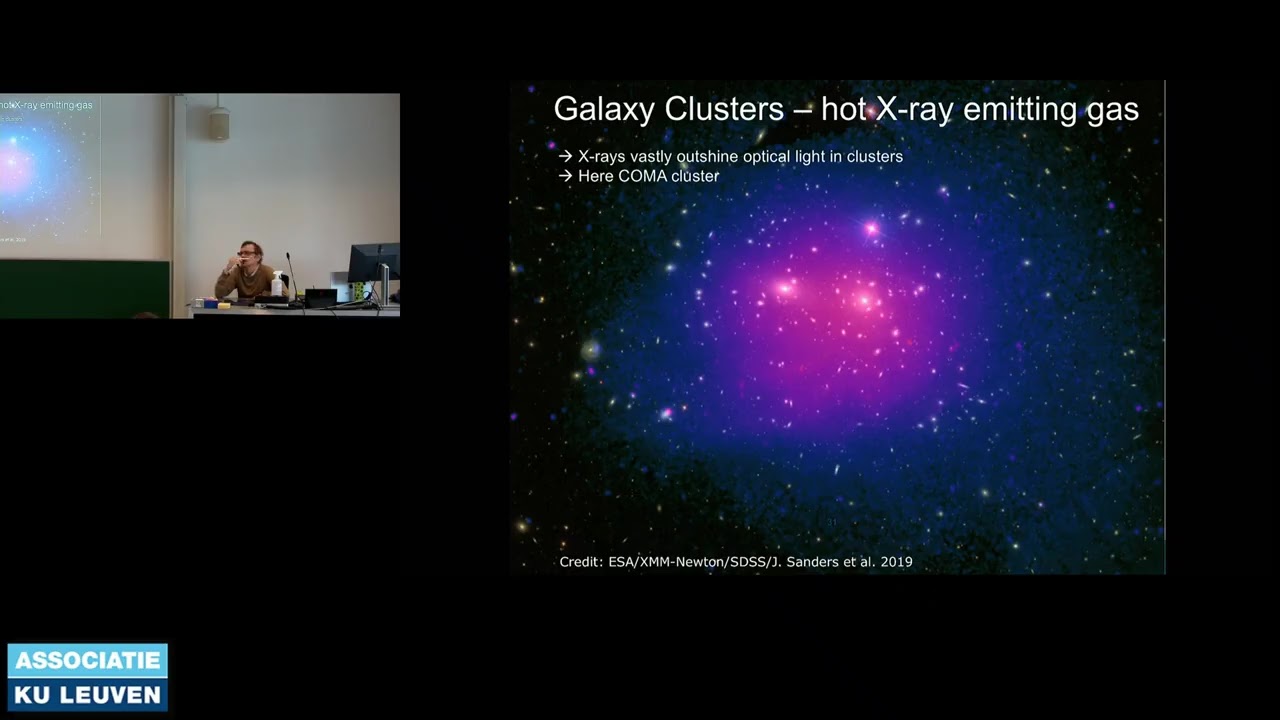
- Opening question and composite optical/X-ray image of the Coma Cluster; plan to measure total cluster mass and separate its components.
- Dynamical mass from the virial theorem; line-of-sight velocity dispersion and projected separations; rich-cluster scale near 10^15 solar masses.
- Optical luminosity and mass-to-light ratio of several hundred; visible stars contribute less than about 5% of cluster mass, the first dark-matter evidence.
- Hot intracluster gas and X-ray emission; thermal bremsstrahlung; temperatures of tens of millions of kelvin and inefficient cooling.
- X-ray luminosity and emission measure; density-squared dependence; spectral cutoff and line diagnostics as temperature indicators.
- Hydrostatic equilibrium; total mass from temperature and density profiles; beta-model and isothermal approximations discussed.
- Mass budget: roughly 3% stars, 15% hot gas and 80% dark matter; second independent dark-matter line of evidence.
- Gravitational lensing introduced through arcs, an Einstein ring, the Abell Cluster and the twin quasar as a third mass probe.
Cited Sources
- KU Leuven Institute of Astronomy — Institutional homepage listed in the video description; host of the course and lecturer.
- Galaxies and Cosmology — raw classroom course playlist — Playlist for the unedited lecture series, linked in the description.
- Galaxies and Cosmology — full edited course playlist — Edited course playlist linked in the description.
- Edited version of this class — StarlightWinds — Edited version of the same class, explicitly linked in the description.
- Peter Schneider, Extragalactic Astronomy and Cosmology: An Introduction (2015), Chapter 6 — Further reading listed in the description; the lecturer says figures and examples are referenced in the slides.
Concurring Sources
- Coma Cluster — Wikipedia — Reference overview of the cluster used as the lecture's main example.
- Intracluster medium — Wikipedia — Background on the hot X-ray-emitting gas discussed as a major cluster mass component.
- Gravitational lens — Wikipedia — Background on arcs and Einstein rings used as the third mass probe.
- Dark matter — Wikipedia — General context for the mass-discrepancy evidence presented in the lecture.
Dissenting Sources
- Modified Newtonian dynamics — Wikipedia — Alternative framework that attempts to explain galaxy and cluster dynamics without particle dark matter; it does not directly contradict the observed mass discrepancies but offers a different interpretation.
Contribution & Novelties
The lecture’s value is pedagogical synthesis rather than new research: it connects dynamical, X-ray hydrostatic and gravitational-lensing mass estimates around a single observational problem, and it makes the dark-matter inference concrete with an explicit mass budget and order-of-magnitude density comparisons. It also flags model dependencies and systematic complications, which is useful for understanding why cluster masses are robust in broad terms but uncertain in detail.
For further reading:
- Galaxy cluster — Overview of cluster structure and the mass components discussed.
- Intracluster medium — Background on the hot X-ray gas and its role in cluster mass estimates.
- Gravitational lens — Context for arcs, Einstein rings and lensing-based mass measurements.
- Dark matter — General framework for the mass-discrepancy evidence presented.
118 words
Radar Profile
The radar profile is high and balanced: information density, technical level and reliability all sit near the top of the scale, while the accessibility/edited dimension is lower because this is an unedited classroom recording. The shape reflects a dense, equation-driven lecture rather than a broad-audience explainer.