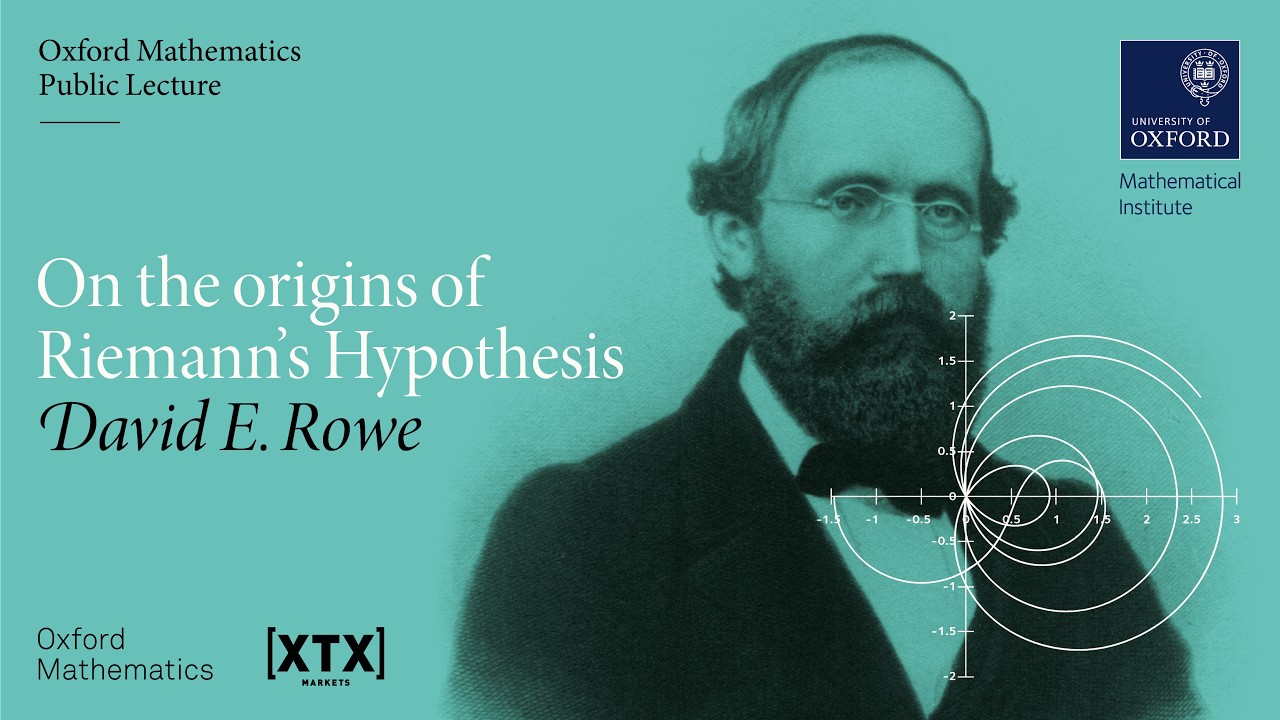
On the origins of Riemann’s Hypothesis - David E Rowe
Title history
- On the origins of Riemann’s Hypothesis - David E Rowe — observed on 20261118-1753 UTC (YouTube)
Keywords
Summary
224 words
Critical Evaluation
Value of the Information & Strength of the Argument
The lecture provides valuable historical insight by unearthing the Gauss–Encke letter as a key influence, thereby challenging the common narrative that Riemann’s work was purely self-motivated. Rowe’s argumentation is solid: he supports each claim with quotes from primary sources, such as the dean’s letter and Gauss’s report on Riemann’s dissertation, and carefully distinguishes verified facts from plausible inferences. The use of archival documents (like the factorization tables and the letter’s handwriting) adds concrete evidence. However, some connections remain speculative, especially the exact timing of Riemann’s knowledge of the letter, which Rowe acknowledges and illustrates with his own corrected guess. Overall, the talk is intellectually rigorous and offers a fresh perspective on a well-known episode in mathematics history.
Scientific Rigor, Source Quality, Title Accuracy
The speaker demonstrates high scholarly rigor by relying on published and unpublished primary sources, including the Gauss-Encke letter (published in Gauss’s collected works and later by Yuri Shinko), and by situating Riemann’s work within the scientific practices of the era, such as geomagnetic observations and computational tables. He openly discusses uncertainties (e.g., the dating of a note) and corrects his own earlier misconceptions, which enhances credibility. The title is appropriate, as the entire lecture is devoted to the historical origins of the hypothesis, without delving into modern proofs. The lecture is well-structured, moving smoothly from general context to specific evidence, and the visual aids (slides of letters and tables) are effectively used. No audience comments were provided to analyze; however, the high like-to-view ratio and the speaker’s authority indicate a favorable reception.
264 words
Title / Content Match
The title precisely matches the content: a historical exploration of how Riemann's hypothesis came to be, focusing on his 1859 paper and its context.
Quality & Reliability
9/10
The speaker is a professor emeritus of history of mathematics, basing his talk on primary sources such as the Gauss-Encke letter and archival documents. The presentation is meticulous and well-referenced.
Key Moments
Markers derived by PSI from the transcript: the creator did not define chapters.
- Introduction and outline of the talk; aim is to explain Riemann's motivation in his 1859 paper.
- Who coined 'Riemann hypothesis' – Hardy and Littlewood; mention of Hilbert’s 8th problem.
- Presentation of the 1859 paper to the Berlin Academy; the paper's structure and its role in the history of mathematics.
- Background on Riemann's education: Göttingen under Gauss and Weber, then Berlin with Dirichlet and Jacobi; influence of geomagnetism and Weber's experiments.
- The Gauss–Encke letter of December 1849: Gauss's earlier work on prime distribution and the logarithmic integral, including his empirical counting up to 3 million.
- Riemann's acquisition of the letter only in 1859; the role of Eduard Kummer and the copy made by Riemann.
- Detailed examination of Gauss's factorization tables and how they were used to count primes; comparison of formulas.
- Euler's product formula for the zeta function; Riemann's extension to complex numbers via the functional equation.
- Riemann's original statement of the hypothesis and his remark that it was not essential for his main goal.
- Conclusion: reception after Riemann, including Hardy's theorem, and the ongoing significance of the hypothesis.
Cited Sources
- Riemann's 1859 paper (On the Number of Prime Numbers less than a Given Quantity) — The focus of the lecture, described as a short 8-page paper presented to the Berlin Academy.
- Letter from Gauss to Encke, December 1849 — Key primary source revealing Gauss's earlier work on prime distribution; published in Gauss's collected works.
- Gauss's Collected Works — Where the Gauss-Encke letter was first published in 1863.
- Hilbert's 1900 Paris Address — Mentioned as including the Riemann hypothesis as problem 8.
- Factorization tables used by Gauss (e.g., Burckhardt's tables) — Mentioned as sources for counting primes up to 3 million.
Contribution & Novelties
The lecture’s main original contribution is the detailed reconstruction of Gauss’s earlier work on prime distribution via the 1849 letter to Encke, and the demonstration that Riemann only learned of this letter shortly before writing his own paper. This challenges simplistic narratives and highlights the importance of primary archival research. The speaker also corrects his own earlier misinterpretation of the letter’s influence on Riemann.
Pour aller plus loin :
- Riemann hypothesis — Context on the modern status and significance of the conjecture.
- Riemann zeta function — Mathematical background for the function and its functional equation.
- Carl Friedrich Gauss — Biographical details of Gauss’s contributions to number theory and prime counting.
110 words
Radar Profile
The radar profile is balanced, with high scores for information quantity and quality, reflecting the speaker's expertise and rich historical detail. The technical level is moderate, indicating accessibility to a general audience, while the global reliability remains high due to the use of primary sources.