MESSIDORE | Schizophrénie : les avancées de la génomique au service du diagnostic
MESSIDORE | Schizophrenia: genomic advances serving diagnosis
Keywords
Summary
196 words
Critical Evaluation
Value of the Information & Strength of the Argument
The value of the information lies in its presentation of original data from an ongoing research program, with clear statistics on diagnostic yields across different clinical sets. The argumentation is solid: the speaker builds on established genetic principles, explains the limitations of polygenic scores, and justifies the focus on rare variants by citing international society recommendations. He provides a balanced view, acknowledging both successes and uncertainties (e.g., variants of unknown significance). However, the talk is essentially a progress report, and some numbers (e.g., 22% yield) rely on unpublished data, so the audience cannot fully verify the claims. The reasoning for broadening criteria is logical and supported by incremental results, making the narrative persuasive.
Scientific Rigor, Source Quality, Title Accuracy
The speaker references the Psychiatric Genomics Consortium, mentions the French genomic medicine plan, and briefly notes a meta-analysis on rare variants in schizophrenia. No formal citations are given during the talk, but the description provides a link to the MESSIDORE event. The title accurately reflects the content, which centers on genomics and schizophrenia diagnosis. The talk is scientifically rigorous in its reliance on current international guidelines and its transparent description of methodology and limitations. There is no obvious discrepancy between title and content. The speaker’s dual role as clinician and researcher adds credibility.
221 words
Title / Content Match
The title accurately reflects the content, which focuses on genomics advances applied to schizophrenia diagnosis through rare variant identification.
Quality & Reliability
8/10
The presentation is given by a clinician-researcher directly involved in the MESSIDORE project, with concrete data from unpublished studies. The methodology is transparent and aligns with international recommendations in psychiatric genetics. Claims are supported by references to consortium work and meta-analyses, though some figures are not contextualized to specific publications.
Key Moments
Markers derived by PSI from the transcript: the creator did not define chapters.
- Introduction to genetics of psychiatric disorders, heritability via twin studies.
- Explanation of common vs rare variants, polygenic scores and their limitations.
- Description of rare variants (CNVs, point mutations) and their impact.
- Overview of the French genomic medicine plan and trio sequencing.
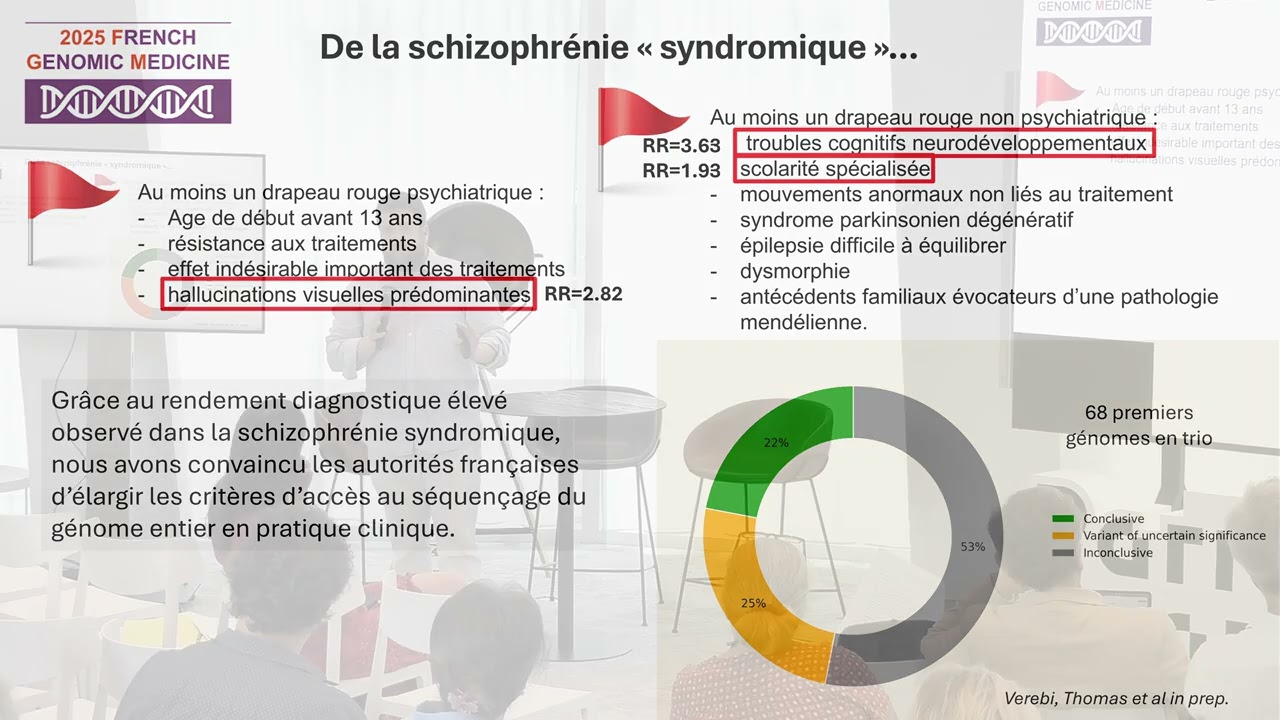
- Presentation of first results: 22% diagnostic yield in 68 stringent trios.
- Broadened criteria and inclusion of bipolar disorder; 18% yield in 254 cases.
- Data from at-risk and first-episode psychosis cohorts, ~13% variant rate.
- Outlook: training prescribers, benefits for stigma and genetic counseling, ongoing FrenchMine cohort.
Cited Sources
- MESSIDORE day: 4 years of research and innovation — Link from video description, providing context on the project and conference.
Concurring Sources
- Genomic findings in schizophrenia and their implications — Recent review supporting the role of rare variants in schizophrenia, concordant with the speaker's claims.
- Meta-analysis of penetrance of schizophrenia risk variants — Provides meta-analytic estimates for rare variant effects, indirectly supporting the 6% overall yield.
Dissenting Sources
- Polygenic risk scores in psychiatry – cautionary perspectives — While the speaker dismisses polygenic scores as not clinically useful, some researchers argue they may have future clinical value in risk prediction, representing a partial disagreement on their potential.
Contribution & Novelties
The MESSIDORE project provides French-specific data on the yield of trio genome sequencing in psychiatric disorders, showing that stringent selection criteria (atypical symptoms with neurodevelopmental red flags) achieve a 22% diagnostic success, which remains high even when broadening eligibility. This is original because prior data were mainly from international cohorts without ad hoc criteria. The presentation also documents the process of expanding national access to genomic testing in schizophrenia and bipolar disorder, which has policy implications.
Pour aller plus loin :
- Psychiatric Genomics Consortium — The consortium behind large-scale GWAS in psychiatric disorders, relevant for common variant findings.
- Schizophrenia Working Group of the Psychiatric Genomics Consortium — Landmark study identifying 108 loci for schizophrenia.
- Copy number variation in schizophrenia — Review of CNVs in schizophrenia risk.
- France Médecine Génomique 2025 — Official description of the French plan for genomic medicine.
140 words
Radar Profile
The profile shows high scores in information quantity and quality, with a slightly lower technical level, indicating the talk balances technical depth with accessibility. Reliability is high due to the researcher's expertise and transparent methodology.