Documenting Decision-Making Capacity, Oral Advance Directives, and Health Care Agents
Keywords
Summary
230 words
Critical Evaluation
Value of the Information & Strength of the Argument
The video offers substantial value to clinicians by translating ethical and legal principles into concrete documentation practices. The case-based format allows for practical application of the four capacity criteria and the surrogate hierarchy, making abstract concepts actionable. The argumentation is solid, grounded in institutional policies, Maryland state law, and accepted medical ethics. Each scenario is examined from multiple disciplinary perspectives—clinical, social work, and risk management—which enriches the discussion and highlights potential pitfalls, such as misunderstandings about domestic partner status or the distinction between a surrogate and a health care agent. The panel also addresses real-world questions from the audience, including patient refusal of emergency treatment and handling of cultural family dynamics, providing reasoned responses based on legal and ethical standards. The emphasis on documentation as a safeguard for both patient autonomy and clinician liability is well-argued and supported by the experts’ combined experience.
Scientific Rigor, Source Quality, Title Accuracy
The session is rigorous in its reliance on established ethical frameworks, legal statutes (notably the Maryland Health Care Decisions Act, implicitly referenced), and the institutional policies of Johns Hopkins Hospital. While no external citations or linked references are provided, the content reflects current clinical and legal standards, presumably drawn from peer-reviewed guidelines and regulatory requirements. The expertise of the panelists—a bioethicist physician, a social worker overseeing guardianship, and a risk manager with malpractice litigation background—lends credibility. The title precisely matches the content, as the entire session is devoted to documenting decision-making capacity, oral advance directives, and health care agents. No public comments were provided for analysis, so no audience feedback trends can be inferred.
272 words
Title / Content Match
The title accurately reflects the content: the session focuses on documenting decision-making capacity, oral advance directives, and health care agents through case-based discussion.
Quality & Reliability
9/10
Panel of expert clinicians and a risk manager discuss clinical scenarios and documentation practices based on institutional policies and legal frameworks at Johns Hopkins, providing practical, high-quality guidance.
Key Moments
Markers derived by PSI from the transcript: the creator did not define chapters.
- Introduction and objectives of the Ethics for Lunch session, sponsored by the Johns Hopkins ethics committee and CME.
- Panelist introductions: Mark Davies (MD, bioethics), Molly Sullmanoff (clinical social worker, guardianship program), and Amy Shane (risk manager, medical malpractice background).
- Explanation of the four components of decision-making capacity: comprehension, appreciation, reasoning, and communication of a choice.
- Scenario 1: 82-year-old unconscious female with intracranial hemorrhage needs emergency surgery; documentation of incapacity and emergency exception in ACP activity.
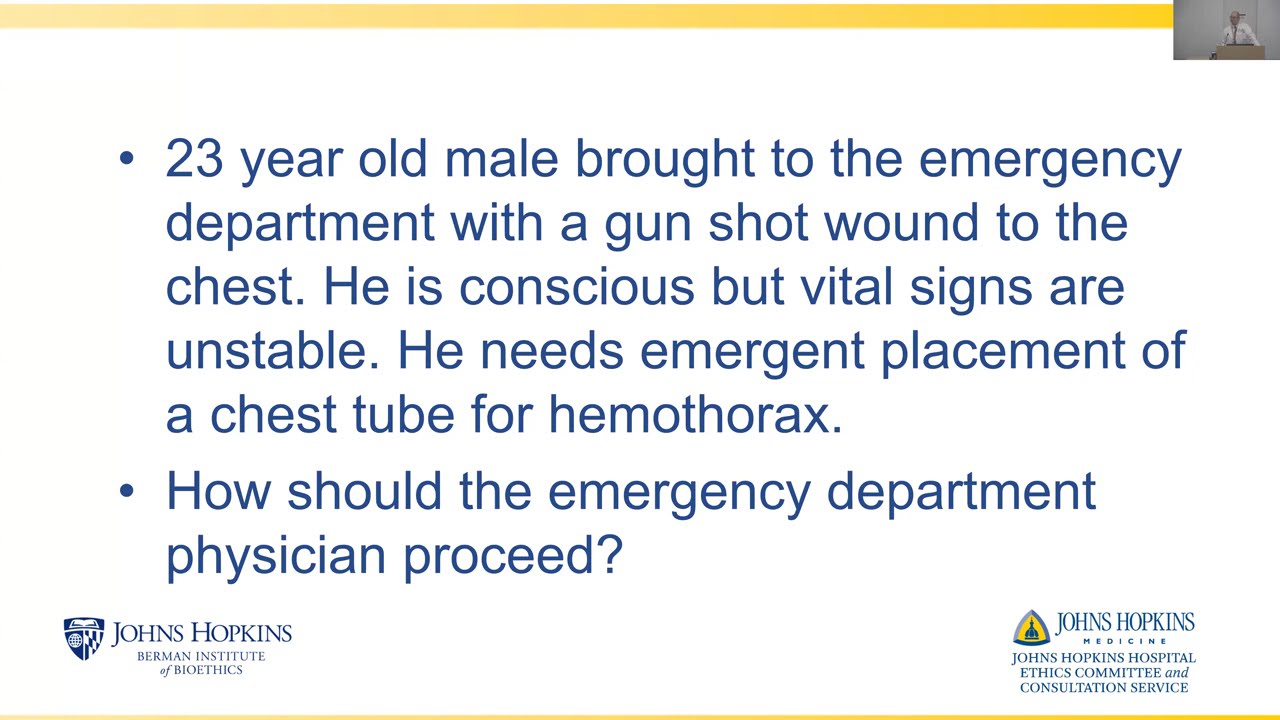
- Scenario 2: 23-year-old conscious but unstable male with gunshot wound; discussion of verbal consent, capacity to refuse, and emergency exception documentation.
- Detailed review of surrogate decision-maker hierarchy in Maryland: legal guardian, spouse/domestic partner, adult children, parents, siblings, friends; includes cultural and legal nuances.
- Scenario 3: 56-year-old ICU patient with GI bleed; capacity assessment using the four criteria and activation of legally authorized health care decision maker (LAHD) in the EMR.
- Overview of new note types in ACP activity, including incapacitated emergency, unconscious/communicative, and incapacitated non-emergency; final audience Q&A.
Contribution & Novelties
The video provides a practical, case-based walkthrough of documenting decision-making capacity and oral advance directives within a specific electronic medical record system (Epic), integrated with Maryland law and institutional policy. It clarifies the nuanced hierarchy of surrogates and addresses common documentation errors, offering clinicians a ready reference for complex situations. The inclusion of multiple professional perspectives—physician, social worker, risk manager—gives a comprehensive view that is often missing in purely clinical or legal resources.
Pour aller plus loin :
- Informed consent — Foundational concept underlying the capacity assessment and emergency exception discussed.
- Advance healthcare directive — Explains types of advance directives, including oral directives and naming a health care agent.
- Health care proxy — Addresses the role of a designated agent, as referenced in the video.
- Surrogate decision-making — Discusses standards for incapacity and substituted judgment, relevant to the hierarchy presented.
140 words
Radar Profile
The radar profile shows high scores across all four dimensions—quantity, quality, technical level, and reliability—indicating a well-rounded, authoritative educational resource. The strongest points are information quantity (9) and reliability (9), reflecting its thorough treatment of the subject and institutional credibility, while still maintaining solid quality (8) and technical depth (8).