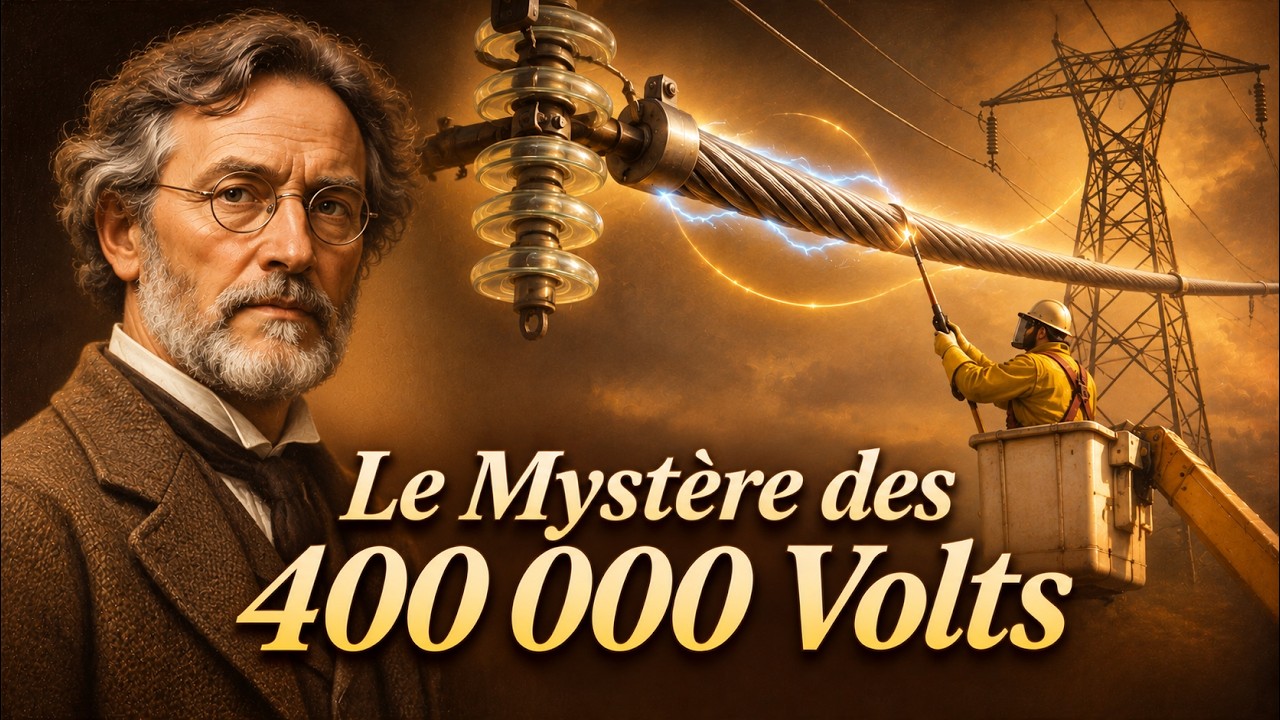
Que transporte vraiment une ligne électrique à 400 000 volts ?
What does a 400,000-volt power line really carry?
Title history
- Que transporte vraiment une ligne électrique à 400 000 volts ? — observed on 20261118-1155 UTC (YouTube)
Keywords
Summary
192 words
Critical Evaluation
Value of the Information & Strength of the Argument
The video offers substantial educational value by demystifying common misconceptions about electricity transmission. Its argumentation is logically structured, starting from the physical necessity of high voltage, progressing through the mechanisms of transformers and AC/DC trade-offs, and culminating in the counterintuitive explanation of energy flow via electromagnetic fields. Real case studies, such as the Flamanville reactor and the record-setting Changji-Guquan line, anchor the discussion in tangible reality. The historical digressions, like the war of currents and the origins of live-line work, enrich the narrative without overshadowing the physics. Each concept builds on the previous one, ensuring a coherent and persuasive narrative that addresses both ‘how’ and ‘why’.
Scientific Rigor, Source Quality, Title Accuracy
The video demonstrates strong scientific rigor in its explanations, referencing established engineering facts and dates, such as the 1969 765 kV line in the US and the 1985 Soviet 1.15 MV line. It correctly attributes the invention of bare-hand work to Harold Rodden in 1960. The description of energy flow around conductors aligns with the Poynting vector concept, though it is not explicitly named. While no formal citations are provided, the content is consistent with standard electrical engineering knowledge. The title is highly accurate and provocative, promising an answer to a common yet subtle question. The video is well-chaptered, and each segment delivers on its promise, making the title-content alignment excellent.
232 words
Title / Content Match
The title perfectly matches the content, which explores the surprising reality of what travels along high-voltage lines.
Quality & Reliability
8/10
The video provides accurate and well-explained physics about electricity transmission, with concrete examples and historical facts. No major errors or unsupported claims found.
Chapters
Contribution & Novelties
The video uniquely combines practical safety advice with advanced physics, explaining that energy propagates in the space around conductors, a fact often overlooked in popular explanations. It also highlights the step voltage hazard and correct evacuation procedures, which are rarely addressed in such detail.
Pour aller plus loin :
- Poynting vector — Explains the mathematical description of energy flow in electromagnetic fields, directly relevant to the section on energy traveling around cables.
- Faraday cage — The principle behind the conductive suit worn by linemen, showing how external fields are excluded from the interior.
- High-voltage direct current — Discusses the use of DC for long-distance transmission, providing background to the Changji-Guquan line mentioned in the video.
115 words
Radar Profile
The radar profile shows high scores in information quality and reliability, with a slightly lower but still strong quantity of information and technical level. This indicates a well-balanced, accurate, and comprehensive educational resource, suitable for a general audience seeking a rigorous explanation of high-voltage electricity.