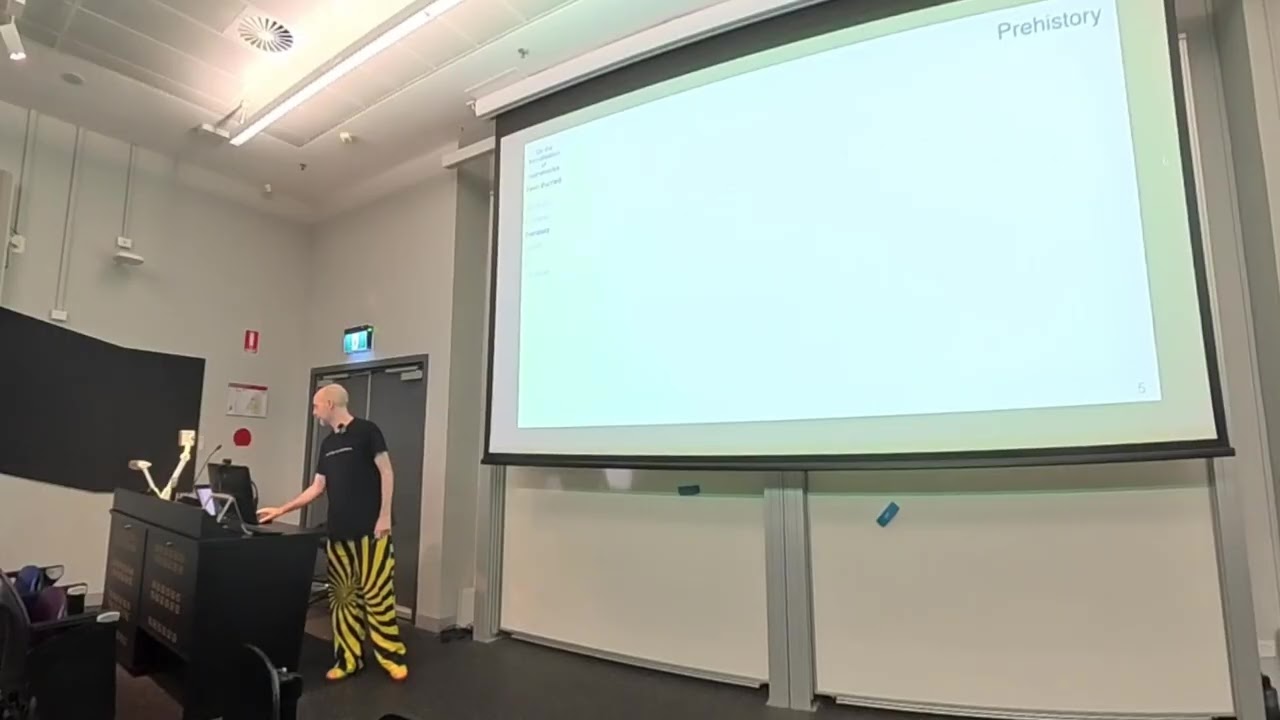
Kevin Buzzard - SMRI Colloquium: Formalisation, AI and mathematics 12th November 2026
Keywords
Summary
356 words
Critical Evaluation
Value of the Information & Strength of the Argument
The informational value lies less in systematic exposition than in the density of concrete, checkable material. The opening Lean sessions are the strongest part: rather than claiming that formalisation is difficult, Buzzard demonstrates the three failure modes that matter — the confusion between a statement and its proof, the mismatch between informal conventions and total functions (natural numbers starting at zero, division by zero returning a value, differentiation of a non-differentiable function returning something) — and each demonstration is visible, falsifiable and immediately understandable. The historical sequence that follows is a compact chronology of the field with names, institutions and rough dates attached (prime number theorem and four colour theorem around 2004, odd order theorem in 2012, Flyspeck completed in 2014, mathlib founded in 2017, research-level formalisations from 2019 onward), and the recurring diagnosis — that verifying results everybody already accepts persuades no mathematician — is a genuine analytical point rather than a talking point.
The argumentation, however, is narrative and autobiographical rather than demonstrative. The central claim, that a deliberate sequence of ‘publicity stunts’ (perfectoid spaces, then Scholze’s theorem) shifted the field’s trajectory, is asserted through anecdote and cannot be tested against the evidence presented: no user numbers, no growth curves, no comparison with the parallel Coq, Isabelle or Metamath ecosystems, which are mentioned only as a list. Several explanatory causal statements are stated flatly without support — that computer scientists ‘dominated the field’, and that this is why they ‘weren’t doing the things that mathematicians were getting excited by’ — and the quantitative claims (90 person-years, 22 people over 12 years, 12,000 lines, six months) are recalled from memory with hedging words such as ‘around’ and ‘roughly’. The speaker is also commendably candid about the limits of his own demonstrations, repeatedly noting that the perfectoid-space work proved essentially nothing and that the cap set formalisation was possible only because the prerequisites were already in the library. The overall reasoning is coherent, internally consistent and honestly bounded, but it is the reasoning of a witness and an advocate, not of a systematic review: it tells the listener what happened in one community and why it felt important, and it should be read as expert testimony rather than as an assessment of the field.
Scientific Rigor, Source Quality, Title Accuracy
No bibliography, no slide references and no links in the description: every source is invoked orally, by author and result — Gonthier on the four colour theorem and on the odd order theorem, Hales and Ferguson on Kepler, Hales’s Formal Abstracts proposal, mathlib, Housel and Lewis on the cap set problem, Buzzard–Commelin–Massot on perfectoid spaces, Scholze on the liquid tensor experiment — with Lean, Coq, Isabelle, Metamath and Agda given as a bare enumeration. These are real and correctly attributed works, and the attributions match the public record as far as the named results go; but the listener is given no means of checking anything, and the dating is approximate by the speaker’s own admission (‘around 2004’, ‘roughly twelve years’). A few details are stated loosely for effect, notably the framing of the 2004 four colour theorem verification as teaching mathematics nothing, which conflates the mathematical content with the trust gained in the proof. The most visible rigour issue is chronological: the video is labelled 12 November 2026 and published 25 November 2026, while the narrative stops at Scholze’s 2021 liquid tensor experiment blog post and treats it as the present, so the framing of what is ‘recent’ is frozen several years before the stated date. On adequacy, the title is honest about what the talk is — a colloquium on formalisation and mathematics — and the delivered material matches it closely for the part transcribed; the ‘AI’ component announced in the description (autoformalisation, speculation about the future) is not present in the transcript segment supplied and cannot be assessed.
649 words
Title / Content Match
The title announces formalisation, AI and mathematics; the transcript supplied covers formalisation and mathematics thoroughly (definitions, Lean demo, history, mathlib, research-level case studies), but the AI/autoformalisation material promised by the description does not appear in the transcript segment available, so the match can only be judged on the portion observed, where it is faithful.
Quality & Reliability
8/10
First-hand account by a central actor of the field (a maintainer of mathlib), technically accurate on what a proof assistant does and does not do, and illustrated by live, checkable Lean sessions rather than assertions. Reliability is limited by the genre: a spoken colloquium with no bibliography, no slides reproduced in the transcript, figures and dates recalled from memory (90 person-years, 12 years, 22 people, 12,000 lines), and a narrative that is openly promotional in places ('publicity stunt'). No links are provided in the description to back any of the named works.
Key Moments
Markers derived by PSI from the transcript: the creator did not define chapters.
- Definition of an interactive theorem prover as a language that knows only the axioms and the rules of logic; Lean compared to a chess program that checks legality but never suggests a move.
- Live Lean session in Visual Studio Code: compiling 2 + 2 = 4, reading error messages, and the first distinction between stating a proposition and proving it.
- A statement labelled 'Fermat's last theorem' is disproved, because Lean's natural numbers start at zero — a concrete demonstration of the gap between informal and formal convention.
- The division-by-zero trap: Lean proves that there exists a real x with 1/x = 0, and will happily differentiate a function that was never assumed differentiable. The moral: formalise carefully.
- Brief history: late-1960s prototypes, the need for automation to make trivial goals bearable, the prime number theorem and the four colour theorem formalised around 2004.
- The odd order theorem (2012): 90 person-years to translate 300 pages, and the marketing problem that verifying what everyone already believes teaches mathematicians nothing.
- The Kepler conjecture: 70,000 non-linear inequalities, seven years in refereeing, then the Flyspeck formal verification completed in 2014 by 22 people over about twelve years.
- Hales's Formal Abstracts proposal, and the state of the field in 2017: very few users in mathematics departments, libraries limited to computer-science-flavoured material, missing class field theory.
- Birth of mathlib in 2017: free and open source, maintainer-run, built by undergraduates typing in their own lectures — 'digitising mathematics' the way music was digitised.
- Research-level milestones: Housel and Lewis on the cap set problem, the 12,000-line definition of perfectoid spaces, and Scholze's challenge of a hard theorem about hard objects.
Cited Sources
- Gonthier — formal verification of the Four Colour Theorem (2004) — Cited as the moment the field tried to sell itself to mathematicians by checking a contentious result; Buzzard notes the argument fell flat because the original proof was also computer-assisted.
- Gonthier et al. — formalisation of the Feit–Thompson odd order theorem (2012) — Presented as the technical milestone proving that a 300-page group theory proof could be handled, while illustrating the marketing failure: the result was already universally accepted.
- Hales and Ferguson — proof of the Kepler conjecture (1998) and the Flyspeck formal verification (2014) — Used as the paradigm case of computer-assisted proof that referees could not check, and of the decade-long effort needed to make it formally verifiable.
- Hales — Formal Abstracts project — Proposal to attach a formal statement of the main theorem, with all hypotheses, to every published paper; described as an idea that came too early.
- mathlib — Lean's mathematical library (founded 2017) — The free, open-source library at the centre of the second half of the talk, described as maintainer-run and largely built by undergraduates.
- Housel and Lewis — formalisation of the cap set bound — Cited as the first recent Annals-level paper formalised essentially for free because its prerequisites were already in the library.
- Buzzard, Commelin and Massot — formal definition of perfectoid spaces (2019) — Some 12,000 lines of code for a definition from which only the empty set could be shown to be an instance; used to signal that the field had moved beyond undergraduate material.
- Scholze — Liquid Tensor Experiment — Scholze's proposal of a hard theorem about hard objects, formalised from an eight-page preprint in about six months; presented as the proof that research-level formalisation is feasible in real time.
- Lean, Coq, Isabelle, Metamath, Agda — Listed as the family of interactive theorem provers, with Lean singled out for its association with AI despite not being AI itself.
Concurring Sources
- Lean mathematical library (mathlib) — community documentation — Confirms the free, open-source, community-maintained character of the library and the scale of contribution described in the second half of the talk.
- Proof assistant — Wikipedia — Independently corroborates the definition given at the start (a system encoding axioms and inference rules that checks proofs without producing them) and the list of competing systems.
- Kepler conjecture — Wikipedia — Corroborates the chronology of the Hales–Ferguson proof, the role of extensive computer checking, and the completion of the Flyspeck formal verification.
- Four color theorem — Wikipedia — Corroborates Gonthier's 2004 Coq formalisation and the surrounding debate on computer-assisted proof.
Contribution & Novelties
The originality of the talk is not technical novelty but testimony and framing. Buzzard speaks as a protagonist and gives an insider’s account of a strategic shift: instead of trying to persuade mathematicians by checking famous hard theorems, the community built a broad library of ordinary undergraduate mathematics and then produced a series of deliberately chosen ‘publicity stunts’ — a definition of perfectoid spaces, then Scholze’s own theorem — designed to demonstrate capability rather than to establish truth. That distinction, between formalisation as error elimination and formalisation as infrastructure, is the conceptual core of the talk, and the taxonomy he sketches (hard theorems about easy things, easy theorems about hard things, then a hard theorem about hard objects) is a useful lens for reading the field’s progress. The live Lean sessions add a second original element: the failure modes are shown rather than described, which makes the epistemological point that informal mathematics is riddled with tacit hypotheses far more convincing than an abstract argument would be. The talk also contains a candid negative result — a 12,000-line definition from which no non-trivial example could be produced — that is rarely stated so plainly in promotional accounts.
Pour aller plus loin :
- Proof assistant — Wikipedia — Situates Lean among Coq, Isabelle, Metamath and Agda, the enumeration given orally in the talk.
- Lean (proof assistant) — Wikipedia — Background on the system and on mathlib, including the distinction between the kernel and its tactic language that Buzzard deliberately skips.
- Four color theorem — Wikipedia — The 2004 Coq verification discussed, and the debate over what computer-assisted proofs establish.
- Kepler conjecture — Wikipedia — The Hales–Ferguson proof and the Flyspeck project, the case study used to explain why referees could not check the result.
- Perfectoid space — Wikipedia — The object whose formal definition took 12,000 lines, and the context of Scholze’s Fields Medal citation.
- Feit–Thompson odd order theorem — cited by name only, as the 300-page proof formalised in 2012; no address given here because the exact spelling of the article title is uncertain.
343 words
Radar Profile
The profile is that of an expert colloquium rather than a documentary: high reliability and information quality, carried by first-hand authority and concrete demonstration, with a technical level that is demanding in its references (perfectoid spaces, class field theory, homological algebra) although no Lean expertise is assumed. Quantity of information is solid but conversational, and the scores are pulled down only by the absence of any citable apparatus in the transcript.