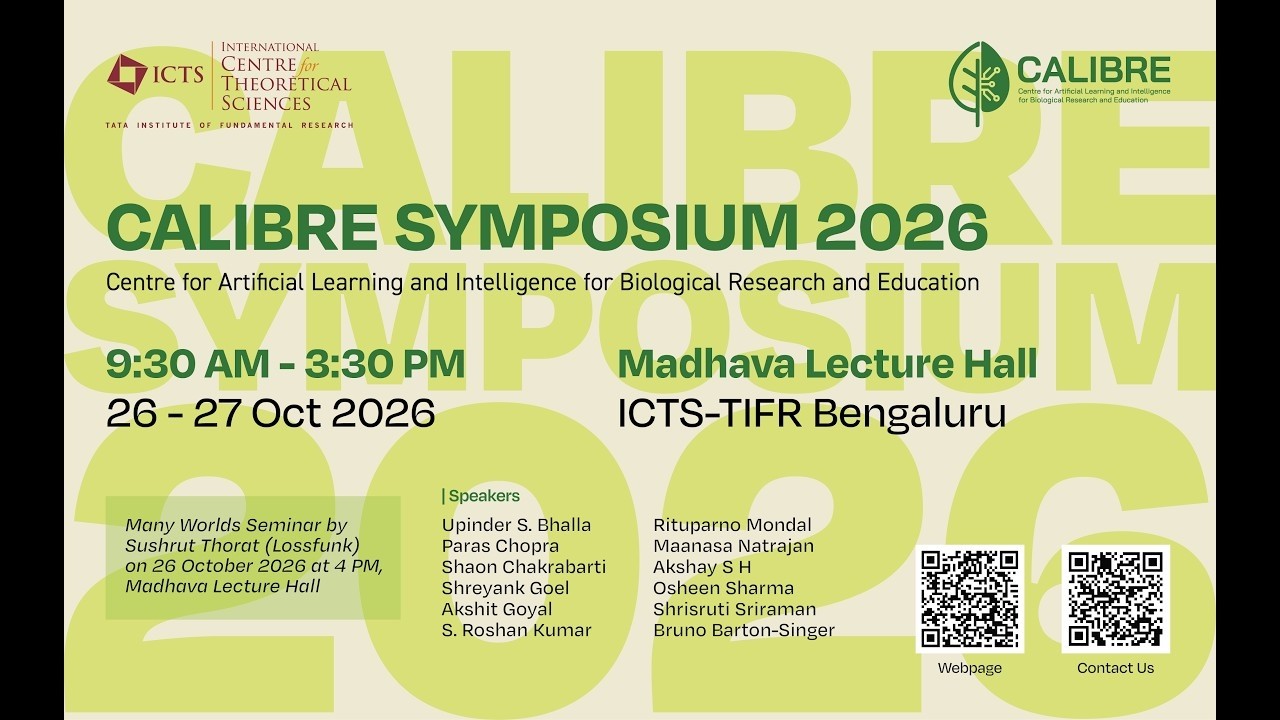
Learning to Learn: What the zebrafish larva can teach AI by S Roshan Kumar
Keywords
Summary
301 words
Critical Evaluation
Value of the Information & Strength of the Argument
The informational value here lies less in established facts than in a well-posed question and a coherent research design. The speaker builds a readable argument chain: an empirical asymmetry between symbolic/textual tasks and embodied control; the scaling explanation drawn from Sutton’s ‘Bitter Lesson’ and from compute/data/model scaling laws; the observation that biological agents cannot pay the scaling bill; the diagnosis that supervised learning’s clean X-to-Y mapping does not generalise to reinforcement settings where the action space is enormous and the data distribution depends on the agent’s own competence (the chess example); and the conclusion that structured, developmentally ordered learning is the plausible alternative. On that basis he proposes to read the developmental trajectory of an animal as a ready-made curriculum, and to use innate rather than learned behaviours as the substrate, which usefully removes the confound of explicit learning during the recording window. The argument is strengthened by the choice of zebrafish, justified on concrete practical grounds (external development, transparency, clutch size, fast maturation, genetic and optogenetic tools), and by the explicit ambition of a closed loop in which rules extracted from the animal are used to train an artificial system and the resulting predictions are then tested back in the animal. It is weakened by several gaps. The causal claim that the observed developmental sequence is the reason for biological data efficiency is asserted rather than demonstrated, and no alternative account (evolutionary priors, morphological computation, closed-loop sensorimotor coupling) is seriously weighed. The energy-constraint premise, central to the whole argument, is never quantified. ‘Curriculum learning’ and hierarchical reinforcement learning have substantial literatures, including work on automatic difficulty ordering and subgoal discovery, that are not engaged, so it is unclear what the biological data would add beyond what is already known. The sub-task decomposition problem is acknowledged but then deferred to the animal without saying what would count as evidence that the extracted hierarchy is the right one. Finally, the transfer step — training a simulated fish from behavioural motifs and claiming this validates something about intelligence — has no stated metric, baseline or falsification condition, which makes the programme hard to evaluate prospectively.
Scientific Rigor, Source Quality, Title Accuracy
Sourcing is informal throughout: references are given by author and rough date (Moravec in the 1980s, Sutton’s 2019 essay, an OpenAI 2020 scaling-law paper, Tinbergen’s ethology, plus unnamed Drosophila and C. elegans studies and a digital-fly neuromechanical model), with no slides of references legible in the transcript and no links in the description beyond the symposium programme page. The attributions themselves are broadly correct at the level of ideas, and the speaker is careful to hedge (‘we don’t know if they still hold true’), to flag that his own proposal is speculation, and to volunteer the strongest recent counter-example to connectome-copying, namely the demonstration that a C. elegans connectome can be wired to drive a fly body — a commendable display of epistemic hygiene that partly compensates for the absence of formal citation. Some technical phrasing is loose (references to ’essays’ and ‘hurdles’ where ‘architectures’ and ‘models’ are meant), and figures for the scaling-law paper are not given, but no claim is misattributed in a way that would mislead a specialist. On adequacy between title and content, the framing of ’learning to learn’ via larval development is faithful to what is actually discussed; the only mismatch is that the title could suggest empirical findings whereas the talk is a plan. Public comments were not supplied, so no audience trend is assessed.
589 words
Title / Content Match
The title matches the content closely: the talk is explicitly about a learning-to-learn/curriculum strategy inspired by zebrafish larval development and aimed at artificial systems. The only nuance is that it delivers a project plan, not findings.
Quality & Reliability
6/10
The talk is an honest, self-critical presentation of a research programme rather than a report of results: the speaker states up front that no data will be shown. The conceptual scaffolding is sound and correctly attributed in broad strokes (Moravec's paradox, Sutton's scaling argument, empirical scaling laws, Tinbergen's hierarchical organisation of innate behaviour), and the speaker explicitly names a counter-example that undermines a naive connectome-copying strategy. Credibility is limited, however, by the absence of any quantitative detail, of explicit citations, of pilot data, and by the fact that key claims (energy constraints, hierarchical emergence of behaviour, transfer of motifs to a simulated fish) remain hypotheses without an operationalised protocol or success criterion.
Key Moments
Markers derived by PSI from the transcript: the creator did not define chapters.
- Framing of the project: understanding the difference between biological and artificial intelligence; explicit statement that no data will be presented, only the idea.
- Moravec's paradox introduced: tasks humans find hard are comparatively easy for machines, and 'easy' sensorimotor tasks are hard.
- Scaling as the dominant driver of recent AI progress, following Sutton's 'Bitter Lesson'; mention of empirical scaling laws relating compute, data and model size.
- Supervised versus reinforcement learning, and the specific costs of embodied tasks: expensive data, hard real-time local computation, and the impossibility of hallucinating.
- The central hypothesis: curriculum learning, in the form of capacity constraints or difficulty orderings, as the biological answer to data and energy scarcity.
- Why zebrafish: external development, transparency, large clutches, fast brain maturation, and genetic and optogenetic tools that allow predictions to be tested in the animal.
- The developmental transition from uncoordinated to coordinated swimming, explained by spinal circuits maturing in stages while the animal must remain able to escape at all times.
- Prior work as methodological templates: low-dimensional behavioural embedding and transition-based clustering in Drosophila versus dictionary compression in C. elegans.
- Digital-twin approach and deep reinforcement learning of a simulated fish, plus the explicit warning taken from a study where a worm connectome successfully drove a fly body.
- Whole-brain imaging at single-cell resolution, estimation of inter-regional connectivity, and the plan to link connectivity changes to emerging behavioural sequences.
Cited Sources
- CALIBRE Symposium 2026 — programme page (ICTS-TIFR) — Only link provided in the video description; gives the symposium programme in which this talk was delivered.
- Hans Moravec — Moravec's paradox (1980s) — Invoked to explain why reasoning tasks are easy for machines while sensorimotor tasks are hard.
- Richard Sutton, 'The Bitter Lesson' (2019) — Cited as the canonical statement that general methods open to scaling outperform approaches that bake in domain knowledge.
- Kaplan et al., 'Scaling Laws for Neural Language Models' (OpenAI, 2020) — Referred to as the 2020 paper showing scaling laws with respect to compute, data size and model size.
- Niko Tinbergen — hierarchical organisation of innate behaviour (ethology) — Used to support the claim that innate response sequences are organised hierarchically, with drives, fixed action patterns and sub-acts.
- Drosophila whole-body behavioural embedding study (low-dimensional embedding with transition-based clustering) — Presented as the closest methodological template: long recordings, low-dimensional embedding, clustering in which transition statistics are preserved, yielding a physically interpretable hierarchy.
- C. elegans behavioural dictionary-compression study — Presented as a contrasting approach (recursive compression of repeating motifs) that did not recover a strongly hierarchical structure.
- Neuromechanical 'digital fly' model built from anatomy and connectome data — Cited as proof of principle that a detailed biomechanical model can reproduce behaviours of the real animal.
- Study wiring a C. elegans connectome into a fly body model — Raised as the cautionary result motivating the project's decision not to aim at exact connectome replication.
Concurring Sources
- Moravec's paradox (Wikipedia entry) — Corroborates the framing that high-level reasoning is comparatively cheap to automate while perception and motor control are not.
- Richard Sutton, 'The Bitter Lesson' — Supports the claim that general, scalable methods have historically overtaken knowledge-heavy approaches.
- Kaplan et al., 'Scaling Laws for Neural Language Models' — Supports the statement that loss scales predictably with compute, data and parameters over a wide range.
- Tinbergen's four questions (Wikipedia entry) — Supports the ethological background on hierarchical organisation of innate behaviour.
Dissenting Sources
- Connectome-transfer critique (C. elegans connectome driving a fly body) — The speaker himself cites this result as evidence that detailed biological replication can produce behaviour without explaining it. It cuts against strong claims that copying biological structure yields understanding, and by extension presses the project to justify why a behavioural hierarchy, rather than a wiring diagram, is the causally relevant thing to transfer.
- Scaling-first accounts of embodied AI progress — A substantial body of recent robotics work attributes slow progress in embodied tasks to insufficient data, simulation fidelity and evaluation rather than to the absence of curriculum structure, which is an alternative explanation the talk does not address.
Contribution & Novelties
The originality is not in any single ingredient — curriculum learning, hierarchical reinforcement learning, behavioural embedding in Drosophila and C. elegans, and neuromechanical digital twins all pre-exist — but in the proposed coupling: treat the developmental timeline of an animal as a ready-made curriculum, discover its structure inductively from unsupervised analysis of long behavioural recordings rather than imposing a task decomposition by hand, and then reuse that discovered sequence as the training schedule for a controller of a simulated body. Two design choices sharpen this: restricting the target to innate responses removes the confound of learning during the observation window, and the explicit refusal to reproduce the connectome (justified by the counter-example in which a worm connectome drives a fly body) reframes the goal as capturing a sequence of behavioural transitions rather than a wiring diagram. The closed loop — extract rules from the fish, train an artificial controller, return to the fish to test predictions with genetic and optogenetic perturbations — is the most substantive methodological contribution, since it gives the comparative programme a falsifiable endpoint that purely computational accounts of biological intelligence usually lack.
Pour aller plus loin :
- Moravec’s paradox — Background on the asymmetry between reasoning and sensorimotor competence that motivates the whole talk.
- The Bitter Lesson (Richard Sutton, 2019) — The scaling argument the speaker uses to explain recent AI progress, and whose implications for inductive bias he partly pushes against.
- Scaling Laws for Neural Language Models (Kaplan et al., 2020) — The empirical scaling results referred to when discussing compute, data and model size.
- Tinbergen’s four questions — Framework behind the claim that innate behaviour is hierarchically organised; useful for reading the ethological part of the argument.
- Zebrafish — Natural history and laboratory background for the model organism chosen, including transparency and external development.
- Curriculum learning and hierarchical reinforcement learning literature (difficulty ordering, subgoal discovery, option frameworks) — the relevant body of work the talk invokes conceptually but does not engage in detail; worth consulting to judge what biological data would add.
- NeuroMechFly and other neuromechanical insect models — biomechanics-plus-neural-controller simulations of the kind the talk proposes to build for the fish.
- Whole-brain calcium imaging in larval zebrafish — the recording technology underlying the proposed link between connectivity changes and behavioural transitions.
378 words
Radar Profile
The profile is characteristic of a speculative research proposal: modest-to-moderate information quantity and technical depth, since no data or quantitative protocol is presented, offset by a coherent conceptual structure and a well-chosen experimental system. Reliability sits in the middle because the biological grounding is sound and the speaker flags his own uncertainties, while the central causal claim remains untested. Overall this is a navigable idea talk rather than a source of established findings.