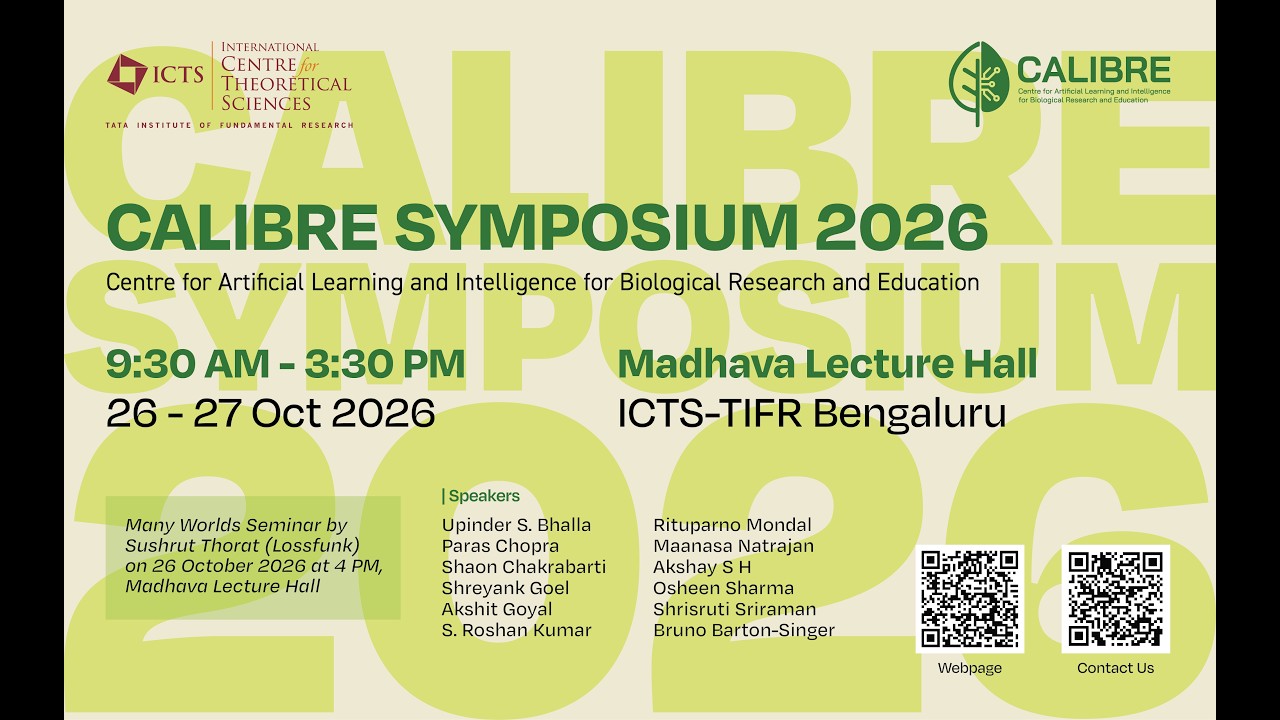
Emergence in magnets, zebrafish and fruit flies by Bruno Barton-Singer
Keywords
Summary
309 words
Critical Evaluation
Value of the Information & Strength of the Argument
The informational value is that of a compact, honest tour of a specialised subfield delivered by someone who has actually worked on it. The audience leaves with a working picture of what a skyrmion is, why it is topologically protected, why its position is a low-energy degree of freedom, and where the particle description stops being adequate. The most valuable passages are the ones that connect levels of description: the enumeration of scales from lattice spins to continuum field to effective particles to skyrmion crystals is a clean, transferable model of what emergence means in practice, and the explicit statement of where the particle picture fails is a methodological point that generalises far beyond magnetism. The applied passages are treated with visible scepticism by the speaker himself, who says plainly that the main driver is theoretical interest and that applications are still being searched for, which is a useful corrective to the more promotional register often found around this topic. On argumentation, the reasoning is structured and self-aware: definitions are given before claims, the difference between topological solitons and topological defects is drawn carefully rather than glossed over, and the historical order (theory first, then experimental search) is used correctly to explain why the community cared. The weak points are matters of scope rather than of logic. Several claims are qualitative and programmatic, particularly the biological and machine-learning bridges, which are presented as loose inspirations and future projects rather than as arguments. The mathematical presentation is condensed to the point where the constraint that the order parameter has fixed length, and the way the chiral term selects a preferred twist angle, are asserted rather than derived, so a listener cannot check them from the talk alone. The digressions, the slide malfunction and the long self-introduction cost time that the final part of the argument, the relaxation of exact solutions to realistic parameters, would have deserved. The handling of questions is a strength: the answers on mobility, on annihilation and topological charge, on skyrmion number and on the spacing of the lattice are precise, and the exchange over the damping term is resolved by reference to energy dissipation rather than by assertion.
Scientific Rigor, Source Quality, Title Accuracy
Methodologically the talk behaves like a seminar rather than a review: no bibliography is displayed, no paper is named, one phase diagram is shown with an explicit admission that it is not the speaker’s and without a citation, and the standard model used is referred to generically as a Landau-Lifshitz equation with a chiral single-derivative term rather than tied to a named reference. The formalism itself is the accepted one in micromagnetics, and the speaker signals the limits of the model, noting that the continuum equation reproduces much of the experimental phenomenology while leaving out many interactions. The original contribution discussed, the family of exact solutions obtained with Ben Schroers, is attributed to the collaborator by name, which is the minimum expected, though the resulting publication is never identified, so the listener cannot go and check it. Numerical and experimental results are presented as illustrative screenshots without acquisition details, contrast calibration or sample parameters. The level of rigour is therefore appropriate to an oral research overview but below what a written account would require. On title and content, the advertised scope is broader than what is delivered in this recording: the magnetic part occupies the overwhelming majority of the time, the zebrafish and fruit-fly material appears as loose asides and as an announcement of newly started projects, and the AI dimension is largely absent, the speaker stating explicitly that the talk will contain little of either. The title is thus best read as a description of the speaker’s trajectory across domains rather than of the argument actually developed.
634 words
Title / Content Match
The title promises a cross-domain account of emergence in magnets, zebrafish and fruit flies, but the delivered content is almost entirely about magnetic skyrmions, with the biological side reduced to brief asides and forward-looking announcements about projects starting in a biology lab. The mismatch is real but limited to the framing of the last part of the talk.
Quality & Reliability
6/10
The speaker is a working researcher (PhD and postdoc on magnetic skyrmions, now CALIBRE postdoc) presenting his own peer-reviewable results and the standard formalism of the field (Landau-Lifshitz dynamics, micromagnetic energy with a chiral term, phase diagrams). The physics is stated with appropriate hedging and the audience's objections on mobility, damping and lattice spacing are answered on the spot. However, the talk cites no references, no paper titles or DOIs are given, one phase diagram is shown without attribution, and the framing elements (zebrafish, fruit flies, AI) are barely substantiated in the available recording. Hence a solid but not verifiable-in-detail reliability score.
Key Moments
Markers derived by PSI from the transcript: the creator did not define chapters.
- Opening: the speaker presents himself as a newly arrived CALIBRE postdoc at NCBS-TIFR and announces the three-part plan of the talk.
- Definition of a magnetic skyrmion: a localised, smoothly varying magnetisation texture in a thin quasi-two-dimensional magnet, mobile like a wave or a bump in a carpet.
- Topological protection explained: no half-skyrmion, no continuous shrinking to zero, and the position of the skyrmion is a near-zero-energy mode.
- Comparison with nematic defects: the distinction between a topological soliton on a smooth field and a genuine defect where the order parameter breaks down.
- Experimental evidence: magnetic force microscopy images showing dark spots that shrink as the external field is increased and that form clusters.
- Question from the audience on skyrmion spacing; answer distinguishes lattice-driven ordering from emergent repulsion between skyrmions that costs negative energy to create.
- The emergence ladder: lattice spins, then continuum field theory, then particle-like objects with effective forces and masses, then skyrmion gases and crystals.
- Applications discussed with caution: mobile data storage in racetrack geometry and neuromorphic or reservoir-computing schemes using a skyrmion assembly as physical substrate.
- Formal core: the Landau-Lifshitz equation with precessional and damping terms, the micromagnetic energy functional, and the chiral single-derivative term that favours a fixed twist angle.
- Own results: at a special point of parameter space, on the boundary between phases, an unexpectedly large family of exact solutions exists and many survive numerical relaxation to realistic parameters.
Cited Sources
- CALIBRE Symposium 2026 — programme page (ICTS-TIFR) — The only link supplied in the description; it documents the symposium within which this talk was given (CALIBRE, ICTS-TIFR, 26-27 October 2026) and the interdisciplinary framing announced there.
- Collaboration with Ben Schroers on exact skyrmion solutions — Named by the speaker as his PhD collaborator on the derivation of the large family of exact solutions; no publication reference or link is given in the talk, so the underlying paper cannot be identified from the recording alone.
Concurring Sources
- Skyrmion (Wikipedia) — Confirms the standard definition of magnetic skyrmions as topological, localised magnetisation textures stabilised by a chiral interaction, and their classification as topological solitons.
- Soliton (Wikipedia) — Supports the speaker's distinction between stable localised solutions of a field equation and singular topological defects.
- Reservoir computing (Wikipedia) — Corroborates the description of fixed nonlinear reservoirs with trained readouts, matching the neuromorphic-computing application sketched in the talk.
Contribution & Novelties
The original element is the presentation of the speaker’s own analytical result, obtained with Ben Schroers: at a finely tuned point of the applied-field/anisotropy parameter space, on the boundary between magnetic phases, the standard micromagnetic energy admits an unexpectedly large family of exact solutions, a situation usually met in highly symmetric abstract field theories rather than in a physically motivated model. The genuinely useful move is what he does with that result: treating the exact solutions as starting points and relaxing them numerically reveals that many remain stable away from the fine-tuned point, which converts a mathematical curiosity into a set of candidate realistic configurations. The talk is otherwise a synthesis rather than a discovery, but the explicit multi-level picture of emergence, and the insistence on where the particle description of skyrmions ceases to hold, are pedagogically valuable. A secondary interest is the candid account of why the field is pursued, with fundamental motivation placed ahead of applications.
Pour aller plus loin :
- Skyrmion — Overview of skyrmions across particle physics, condensed matter and magnetic materials; useful entry point to the objects discussed here.
- Soliton — Background on topological solitons, the category to which magnetic skyrmions belong and the distinction the speaker draws with topological defects.
- Landau–Lifshitz–Gilbert equation — The magnetisation dynamics used throughout the talk, including the precessional and damping terms debated in the question session.
- Reservoir computing — Framework behind the neuromorphic computing proposals mentioned as a possible use of skyrmion assemblies.
- Topological defect in nematic liquid crystals, by name — the comparison case used to separate solitons on smooth fields from true singularities; active nematics are cited as the biological counterpart.
- Electron–monopole duality in certain quantum field theories, by name — the deeper motivation invoked for why topological objects matter conceptually.
294 words
Radar Profile
The profile is strongly skewed towards technical depth and information quality while remaining moderate on raw quantity and on overall reliability, which reflects a dense but deliberately informal seminar rather than a structured review. The gap between technical level and reliability stems from the absence of any cited literature or publication identifiers, not from any weakness in the physics presented.