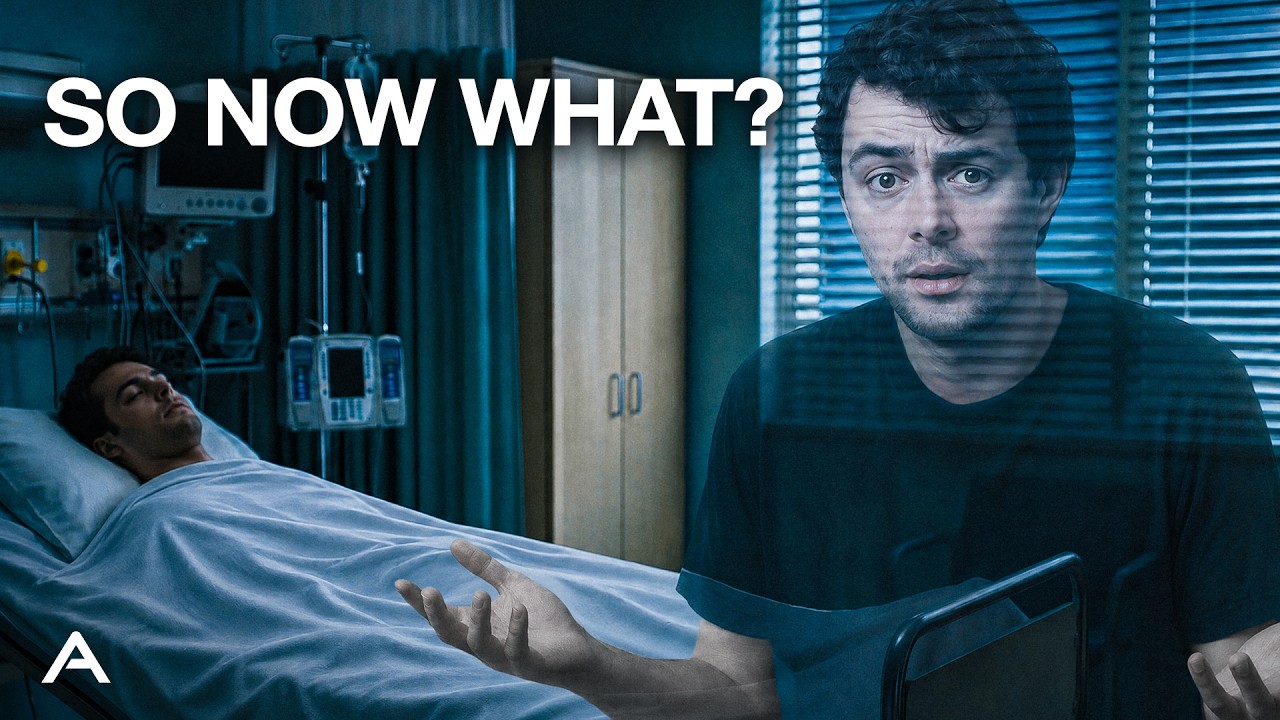
The Strangest Theories About What Happens After You Die
Keywords
Summary
267 words
Critical Evaluation
Value of the Information & Strength of the Argument
The video’s informational value lies in its broad synthesis: it connects anesthesia, coma, cardiac arrest, EEG signatures, near-death reports, quantum-collapse theories and information conservation in a single narrative. It offers useful conceptual distinctions, especially between memory and experience, between clinical death and irreversible death, and between information being preserved and information being readable. Its argumentation is strongest when it states a claim, names a relevant experiment, and then notes the limits of that experiment. It is weakest when it moves from laboratory findings in isolated proteins or model systems to claims about consciousness surviving bodily death. The central quantum-soul argument depends on a chain of analogies: microtubules as scaffolding, quantum collapse as a coin settling, and information dispersal as milk stirred into coffee. These metaphors are pedagogically effective but do not establish the metaphysical conclusion. The video does acknowledge major objections, including decoherence and the Gran Sasso null result, but it often keeps the speculative frame alive after the empirical support has narrowed. The result is an engaging and information-rich presentation whose argumentative solidity decreases sharply as it moves from neuroscience to afterlife speculation.
Scientific Rigor, Source Quality, Title Accuracy
Scientific rigor is uneven. The video refers to real lines of research, including cardiac-arrest gamma surges, AWARE-II, microtubule stabilization under isoflurane, superradiance in microtubule networks, anesthetic effects on quantum optical signals, and the Gran Sasso test of the Diósi–Penrose model. However, it provides no citations, no on-screen references and no direct links to papers; the description contains only social and sponsorship links. Several researcher and institution names appear misrendered or approximate, such as ‘Bourjugan,’ ‘Welsley Cottage,’ ‘Calra’ and ‘Donady,’ which weakens traceability. Some numerical claims, such as the 39% AWARE-II figure, are presented without methodological context. On the positive side, the video does include counterevidence, especially decoherence objections and the null result from Gran Sasso, and it notes that the simplest collapse model was ruled out. Title/content adequacy is acceptable: the title announces strange theories about death, and the video delivers speculative quantum, anesthetic and immortality themes. The title is therefore broadly faithful, though it may suggest more definitive answers than the content can support.
364 words
Title / Content Match
The title promises strange theories about death, and the video delivers speculative quantum, anesthetic and immortality ideas. It is broadly accurate, though the framing sometimes implies stronger answers than the evidence supports.
Quality & Reliability
4/10
The video names real experiments and debates, but it mixes empirical neuroscience with speculative quantum-consciousness claims, gives no citations, and uses imprecise names and strong narrative leaps. The inclusion of decoherence objections and the Gran Sasso null result improves balance, yet the core afterlife interpretation remains unsupported.
Key Moments
Markers derived by PSI from the transcript: the creator did not define chapters.
- Opening: anesthesia is used as a reversible model for the absence of consciousness, framing the question of what happens at death.
- The video presents death as a descending ladder and explains the roughly ten-second oxygen window before consciousness is lost.
- Sedation versus anesthesia: memory formation can be blocked while responsiveness remains, complicating claims about awareness.
- Coma and cognitive motor dissociation are discussed, including the tennis/home imagery test for covert awareness.
- CPR and defibrillation make clinical death potentially reversible, opening the way to survivor accounts.
- Chapter transition to the quantum immortality theory, as listed in the video description.
- Dying-brain gamma surges and AWARE-II cardiac-arrest survivor reports are presented as possible near-death correlates.
- Terminal spreading depolarization and the Penrose–Hameroff Orch OR hypothesis are introduced, with microtubules as the proposed quantum substrate.
- Chapter transition to the argument that endless immortality would produce boredom and psychological stagnation.
- Final advertised chapter on 'the man who fought death and won'.
Cited Sources
- 2013 rat cardiac-arrest gamma-surge study (Borjigin, Wang and Mashour) — Cited for a coherent gamma surge in the first 30 seconds after cardiac arrest before EEG flattening.
- 2023 four comatose-patient gamma-surge study — Two of four patients reportedly showed organized gamma activity after ventilator withdrawal; none survived.
- AWARE-II cardiac-arrest awareness study (Sam Parnia and colleagues) — Reported that about 39% of interviewed survivors recalled memories or perceptions suggesting awareness.
- 2024 microtubule-stabilization and isoflurane study described as 'Welsley Cottage' — Rats with stabilized microtubules reportedly took longer to lose consciousness under anesthetic.
- Superradiance in tryptophan networks inside microtubules (Babcock, Kurian et al.) — Presented as evidence that quantum optical effects can persist at body temperature.
- Anesthetic suppression of quantum optical effects in microtubules (the 'Calra' group named in the video) — Cited as separate support for microtubule involvement in anesthetic action.
- 2024 Physical Review E model of myelin sheath as entangled-photon source (Leochen et al.) — A theoretical model, not an experiment, linking myelin to entangled photon pairs.
- 2021 Gran Sasso test of the Diósi–Penrose model (Donadi et al., Nature Physics) — Null result that ruled out the simplest gravity-driven collapse version relevant to Orch OR.
- Orchestrated objective reduction (Orch OR) theory (Penrose and Hameroff) — Core speculative framework linking quantum collapse in microtubules to consciousness and a possible soul.
- No-hiding theorem — Used to explain that information is not destroyed but dispersed and becomes practically unreadable.
Concurring Sources
- Orchestrated objective reduction — Background on the Penrose–Hameroff hypothesis discussed in the video.
- Near-death experience — General context for the AWARE-II and survivor-account discussion.
- Black hole information paradox — Context for the no-hiding theorem and information-preservation argument.
- Anesthesia — Background for the video's use of reversible unconsciousness.
Dissenting Sources
- Tegmark (2000), 'Importance of quantum decoherence in brain processes' — Argues neural quantum states decohere far too fast for Orch OR; this supports the video's decoherence objection but contradicts its quantum-soul extension.
- Donadi et al. (2021), Gran Sasso test of the Diósi–Penrose model — The null result rules out the simplest gravity-driven collapse model cited as a basis for Orch OR; the video acknowledges this but still presents the broader quantum-consciousness narrative.
Contribution & Novelties
The video’s original contribution is pedagogical synthesis rather than new data: it stitches anesthesia, coma, cardiac arrest, EEG signatures, Orch OR and information theory into one continuous narrative. It is most valuable when it separates memory from experience, clinical death from irreversible death, and information preservation from retrievability. Its novelty is also rhetorical: it keeps counterevidence inside the story, especially decoherence and the Gran Sasso null result, instead of presenting only supportive claims.
Pour aller plus loin :
- Orchestrated objective reduction — Background on the Penrose–Hameroff hypothesis discussed in the video.
- Quantum immortality — Context for the chapter advertised in the description.
- Black hole information paradox — Context for the no-hiding theorem and the information-preservation argument.
- Near-death experience — General context for the AWARE-II and survivor-account discussion.
127 words
Radar Profile
The profile is high in information quantity and moderate in technical level, reflecting a long synthesis with many named experiments. Quality and global reliability are lower because empirical findings are repeatedly stretched into metaphysical conclusions. The radar therefore shows an engaging but uneven science-communication profile rather than a rigorous review.