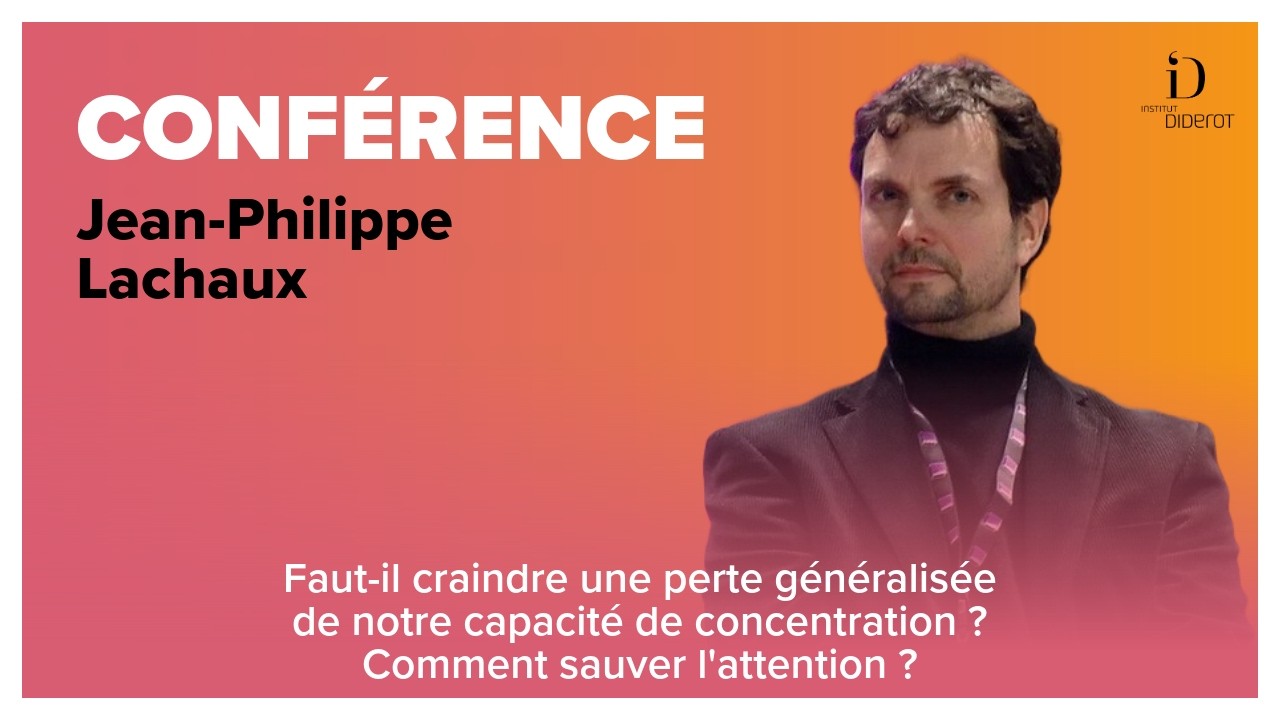
Faut-il craindre une perte généralisée de notre capacité de concentration ? Jean-Philippe Lachaux
Should we fear a widespread loss of our ability to concentrate? Jean-Philippe Lachaux
Keywords
Summary
312 words
Critical Evaluation
Value of the Information & Strength of the Argument
The informational value is high on the conceptual side: the talk offers a clean, operational account of what attention does rather than a vague plea for ‘paying attention’. The strongest passage is the reading experiment, which converts an abstract notion into a measurable contrast — identical early visual processing, divergent late frontal engagement — and gives the audience a concrete criterion for distinguishing genuine concentration from mere exposure to content. The exploration/exploitation framing is also productive: it turns ‘we are all scattered’ into a rational adaptive response to an environment with many channels, which shifts the diagnosis from individual failing to environmental design. The reward-circuit section provides the causal bridge between that environment and behaviour, and the notion of a common neural currency is a useful simplification, clearly flagged as an analogy drawn largely from animal work. Argumentation is linear and pedagogically controlled, with explicit signposting and repeated returns to the guiding question. Its limits are equally clear: the central neural claim is exhibited rather than quantified, no alternative interpretation of the data is discussed (effort, task difficulty or motivation could equally explain the frontal difference), and the jump from ‘reward circuit is stimulated’ to ‘attention is captured against our will’ is asserted rather than tested against the literature on attentional control and mind-wandering, which emphasizes internal as well as external sources of distraction. The treatment of addiction is the most honest part methodologically, since the speaker openly states what non-invasive human methods cannot prove and downgrades the claim accordingly; but that caution is not carried over into the headline conclusion, delivered as a flat ‘yes’ while the reviewed mechanisms support ‘plausible and predictable’ rather than ‘demonstrated’. The passion-versus-addiction distinction is raised with the right nuance but left without criteria that would make it usable. Overall a well-constructed expert argument whose strength lies in mechanistic explanation and whose weakness lies in the asymmetry between the caution of the middle section and the assertiveness of the conclusion.
Scientific Rigor, Source Quality, Title Accuracy
Scientific rigour is that of a specialist lecturing from his own research programme: the intracranial dataset presented comes from his laboratory and is described with its actual resolution limits (millimetre, millisecond), which is a mark of technical honesty, and the reward-circuit model is presented as phylogenetically conserved and largely derived from animal work, with the transposition to humans flagged. No formal bibliography is given in speech, and the design-taxonomy and addiction literature is referred to by pointing at projected references rather than by naming articles, so a listener cannot reconstruct the evidential chain; the historical anchor is nonetheless precise (William James, 1890) and correctly characterised as the founding definition of the field. The main rigour gap is argumentative rather than factual: alternative explanations for the reading data are not examined, and the addiction framing is explicitly described as a contested debate among experts, which is accurate, before the closing answer adopts a firmer tone than that discussion licenses. Sources actually mobilised in the talk are the founding text of cognitive psychology, the speaker’s own imaging work, standard neuroeconomic models of exploration and exploitation, and the literature on persuasive design and behavioural addictions. On title-content fit, the announced question is the question actually treated and the answer is stated explicitly, so there is no mismatch or inflation; the lecture delivers what the title promises, including the nuance that the ‘yes’ rests on mechanism-based prediction more than on demonstrated decline.
579 words
Title / Content Match
The title's question is explicitly posed and answered in the talk, and the whole argument is built around the risk of attentional dispersion; the fit is direct and honest, though the answer given is more assertive than the evidence discussed strictly allows.
Quality & Reliability
7/10
The speaker is a recognised specialist in cognitive neuroscience of attention (Inserm researcher, author of several books on the topic) and grounds his talk in his own intracranial recording work and in well-established findings on the brain's reward system. However, the lecture format gives no formal reference apparatus: the design-taxonomy and addiction literature is invoked by pointing at slides rather than by citing precise papers, several claims (the 'yes, we are losing concentration' conclusion, the addiction analogy for screens) are stated as expert judgement rather than demonstrated, and the central empirical illustration is shown without effect sizes or published citation. Reliable as expert synthesis, weaker as a sourced review.
Key Moments
Markers derived by PSI from the transcript: the creator did not define chapters.
- Introduction by the host: the paradox of unprecedented access to information combined with a persistent feeling of being interrupted and dispersed; framing of the three questions (are we losing concentration, is our brain adapted to permanent solicitation, how to regain control). Timestamps in this list are approximate, as the video has no creator-defined chapters.
- Presentation of the speaker and his trajectory (engineering training followed by a fundamental biology thesis), and the remark that attention had no social visibility thirty-five years ago, unlike memory and Alzheimer's disease.
- William James's 1890 definition of attention as the mind taking possession of one object among several, and the corollary that attention determines the content of mental life — the speaker's justification for studying it 'in the first person'.
- Intracranial recording data from his laboratory comparing engaged versus distracted reading: identical early visual activation, then an all-or-nothing late frontal engagement supporting meaning and memory only in the concentrated condition.
- Emergence of the attention economy: any actor with something to sell must cross the attentional gate to reach decision-making circuits, hence competition and the multiplication of capture strategies.
- The exploration/exploitation dilemma illustrated by the gold-panner and the library of ten thousand books: fixation on one option costs the others, making temporal dispersion across channels a rational response to a rich environment.
- The reward circuit as a common neural currency (water when thirsty, conversation, music, but also drugs), its role in learning reward predictors, and its tight coupling with attentional orienting.
- Design features engineered to maximally stimulate the reward circuit (likes, kittens, celebrity content), their densification when many actors use the same levers, and the resulting difficulty of self-directed attention.
- The digital addiction debate: why human non-invasive methods cannot replicate the fine dopaminergic mechanisms demonstrated in animal models, and the shift to a purely behavioural level of questioning.
- Behavioural warning signs derived from addiction models: motivational narrowing, loss of interest in natural rewards, reduced cognitive-emotional regulation and tolerance of low-stimulation tasks, and difficulty pursuing long-term goals.
- The fine line between addiction and passion, discussed through intensive guitar practice and multi-day video-game sessions, with the criterion of what the activity contributes to the person over the long term.
- Explicit answer to the title question — yes, a generalised loss of concentration is to be feared — justified by the reward system acting as a permanent force of attentional dispersion.
Cited Sources
- William James, The Principles of Psychology (1890) — definition of attention — Explicitly quoted as the founding definition: attention as the taking possession by the mind of one object among several, with selection and the determination of mental content.
- Intracranial recordings of engaged versus distracted reading (speaker's laboratory data) — The core empirical illustration of the talk, presented with millimetre and millisecond resolution; no publication reference is given in the spoken text.
- Jean-Philippe Lachaux, Les Petites Bulles de l'attention (graphic novel on attention) — Mentioned by the host during the introduction as one of the speaker's books on attention, written and drawn by him.
- Jean-Philippe Lachaux, Le Cerveau funambule — Cited by the host among the speaker's books; offered to the audience alongside Le Cerveau attentif.
- Jean-Philippe Lachaux, Le Cerveau attentif — Presented by the host as the book given to attendees at the event.
Concurring Sources
- Attention economy — Confirms the framework in which attention becomes a scarce resource competed for by economic actors, as described in the talk.
- Reward system — Supports the account of a phylogenetically conserved reward circuitry sensitive to both natural and pharmacological rewards, and its coupling with motivation and approach behaviour.
- Persuasive technology — Corroborates the existence of a systematic body of design knowledge aimed at capturing and holding user attention.
- Digital media use and mental health — Consistent with the speaker's cautious position: associations are documented, causal mechanisms in humans remain debated.
Dissenting Sources
- Video game addiction — The literature recorded here is more divided than the talk suggests: nosological status (ICD-11 gaming disorder versus DSM-5 'condition for further study'), prevalence estimates and the boundary with high engagement remain contested, which echoes but sharpens the speaker's own passion/addiction caveat.
- Contested construct of smartphone/'digital' addiction — A significant body of critical work argues that 'smartphone addiction' scales are often measuring heavy but functional use and suffer from overlapping items and weak clinical validation; the talk's behavioural sign list inherits this problem, since no thresholds are given to distinguish problem use from intensive but non-pathological use.
- Evidence on attentional decline at population level — Claims of a generalised decline in concentration are typically supported by proxies (self-report, task-switching in lab settings, media-multitasking correlations) whose ecological validity and effect sizes are debated; the talk's affirmative conclusion is stronger than this evidence base strictly supports.
Contribution & Novelties
The talk’s genuine contribution is not a new finding but an explanatory articulation: it connects three usually separate literatures — the neurophysiology of attentional engagement, the economics of exploration versus exploitation, and the neurobiology of reward — into a single causal story about why a high-channel environment produces dispersion without requiring any individual weakness. Two elements stand out as more than standard popularisation. First, the reading data used as a criterion for what attention actually adds: not more sensory processing, but a late, all-or-nothing engagement of meaning-related regions, which gives a testable operational marker for ‘real’ versus ‘superficial’ exposure to content. Second, the methodological honesty about behavioural addictions: the speaker states plainly that the fine-grained dopaminergic mechanism cannot currently be demonstrated in humans with non-invasive tools, and converts that limitation into a practical list of observable warning signs rather than into a diagnostic claim. The discussion of the fine line between addiction and passion is also more nuanced than the usual alarmist framing, even if it stops short of operational criteria. What is not new: the attention-economy narrative, the persuasive-design taxonomy and the reward-circuit account are all well-established in the literature and are rehearsed here in accessible form.
Pour aller plus loin :
- Attention economy — Background on the framework the speaker uses to explain competition for attentional capture.
- Reward system — The ‘common currency’ circuitry, its conservation across species and its links to dopaminergic prediction-error learning.
- Multi-armed bandit — Formal counterpart of the exploration/exploitation dilemma illustrated by the gold-panner and the library of ten thousand books.
- Persuasive technology — The design tradition behind the capture techniques described (Fogg’s captology and its descendants).
- William James — The 1890 definition of attention quoted at the start, and its place in the founding of cognitive psychology.
- Flow (psychology) — Useful counterpoint to the passion/addiction distinction: sustained deep engagement as an attentional state rather than a pathology.
- ATOLE programme (Lachaux’s school-based attention-training programme) — Direct application of the framework, cited by name only as no reliable address is available here.
337 words
Radar Profile
The profile is that of an expert lecture rather than a data-driven review: informational density and topical importance are high, technical level is moderate (mechanisms explained clearly, methods summarised rather than detailed), and reliability is solid but capped by the absence of a formal reference apparatus and by an assertive conclusion that outruns the cautious middle section.