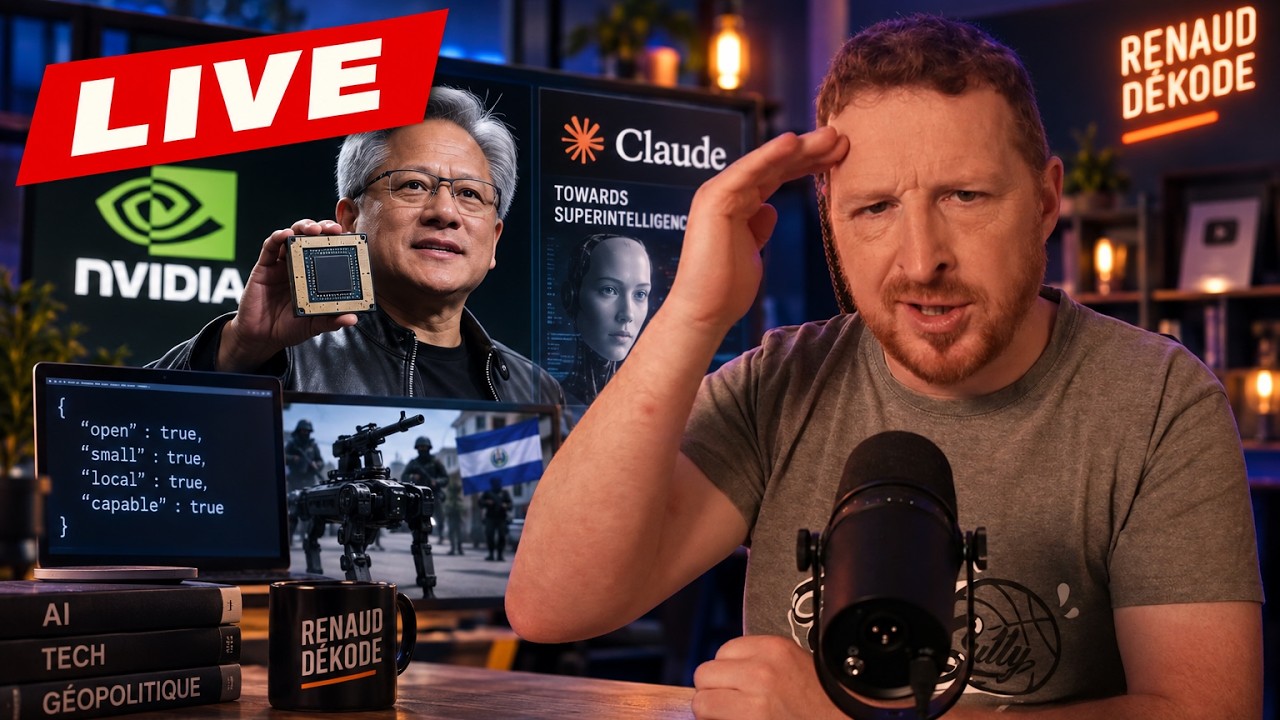
Jensen is back, la Super-Intelligence aussi ! L'actu IA est dingue + Interview Robotique !
Jensen is back, and so is Superintelligence! The AI news is crazy + Robotics Interview!
Keywords
Summary
246 words
Critical Evaluation
Value of the Information & Strength of the Argument
The informational value lies mainly in curation and framing rather than in disclosure. The host does a real job of agenda-setting: he groups under one heading themes that mainstream coverage treats separately (chip-industry valuations, frontier-model claims, small local open models, autonomous weapons governance, service terms and conditions), and he repeatedly connects them to a single question — what remains under individual control when models and robots become cheap and ubiquitous. The most useful pedagogical contribution visible in the transcript is the explicit distinction between a model and the ‘harness’ that surrounds it, with the concrete example of a chat interface versus a versioned model, justified by the observation that a large part of the general public conflates the two and therefore misjudges what can be run locally, what can be self-hosted, and what depends on a provider. This is a clarifying move, not a novel one, and it is delivered as a reminder of a previous episode rather than argued from first principles.
The argumentation itself is uneven. The autonomous-weapons sequence has a discernible structure — observe that the technology enablers (cheap humanoid platforms, simulation-trained policies, embedded perception) are converging, observe that negotiations in Geneva have been postponed to 2028, invoke the nuclear precedent as a counterfactual, and conclude with a normative claim that a binding agreement should be reached now. That is a coherent policy argument, but each of its premises is asserted rather than evidenced: no treaty text, no negotiating record, no casualty data, no timetable of capability milestones. The rhetorical force comes from escalation and lexical intensity rather than from the strength of the evidence. Elsewhere, reasoning gives way to enumeration: models and products are named and praised (‘it’s a banger’, ‘it codes locally and well’) with no benchmark, no parameter count, no comparison baseline and no discussion of failure modes. The super-intelligence framing is accepted at face value, with no attempt to interrogate what ‘proving’ a conjecture would actually entail or whether the claim as reported in the press corresponds to what was demonstrated. Counter-arguments are occasionally staged — the host says he likes to introduce contradictory information to ‘shake up the neurons’ — but in the transcribed portion this remains an intention rather than a method. Overall: high heuristic value for a curious listener who wants a map of the week’s questions, low probative value for anyone who needs to know whether the underlying claims are true.
Scientific Rigor, Source Quality, Title Accuracy
On scientific rigour, the show operates at the level of commentary, not of verification. Claims of consequence — an AI having proved the Riemann hypothesis, the arrival of super-intelligence, an open model matching the state of the art on small hardware, an armed robot in Haiti — are introduced as headlines to be discussed and are never traced back to a paper, a preprint, a benchmark table or a technical report. The vocabulary is loose in exactly the places where precision matters: ‘super-intelligence’ is used without a definition, ‘proves’ is used without distinguishing a formal proof assistant output from a search heuristic, and model names are floated without versions or provenance. The host is explicit that part of the content was suggested by viewers in the comments, which is a legitimate editorial practice but is not a source hierarchy. The one item with a checkable policy substance, the postponement of UN talks on lethal autonomous weapons to 2028, is attributed to ’the latest news from Geneva’ with no document, no forum name beyond the UN, and no date, which makes independent verification needlessly difficult for the listener.
Source quality follows from this: the only link in the description is the show’s own community website, offered as a service to viewers rather than as documentation. No press articles, no institutional pages, no academic references are provided. The argument therefore rests entirely on the host’s authority as a long-standing technology commentator, an authority based on track record and consistency rather than on traceability. In mitigation, the format is transparent about being a live opinionated review, and the host does flag uncertainty in places (he announces openly that he will bring contradictory information, and he corrects himself on air). That intellectual honesty is real but does not compensate for the absence of primary sourcing on the most consequential items. A minimal improvement would be to name, on screen and in the description, the outlet or document behind each headline.
On title/content fit, the announced segments — Jensen Huang, the super-intelligence claim, the model news, the robotics interview, the armed-robot story — are all explicitly scheduled in the opening minutes and match the described running order, so the title is not misleading about subject matter. It is hyperbolic about magnitude: ‘dingue’ and ‘Super-Intelligence’ promise a threshold event, while what is delivered is a weekly round-up with commentary. No comments were available for this note, so no audience trend is assessed.
823 words
Title / Content Match
The title's announced segments (Jensen Huang/Nvidia, a 'super-intelligence' claim, AI news, a robotics interview, an armed robot) do correspond to the topics the host explicitly schedules in the first half hour, so the fit is broadly honest; the wording ('dingue', 'Super-Intelligence') is nonetheless hyperbolic for what is essentially a weekly news round-up with commentary.
Quality & Reliability
4/10
A long live news-review format in which most items are relayed from memory or from the host's own reading, without citation of primary documents, without dates or reference numbers, and with a strong editorial voice (outrage about autonomous weapons, enthusiasm about new models). The only link supplied in the description is the show's own website, which is a community platform rather than a documentary source. Several assertions are stated as established facts (an AI 'proving' the Riemann hypothesis, a model called 'Inkling 2') without the underlying evidence being shown or named. The tone is openly opinionated and conversational, which is legitimate for the genre but does not build verifiable reliability.
Key Moments
Markers derived by PSI from the transcript: the creator did not define chapters.
- Cold open and welcome: the host sets the day's frame (tech, web, AI, digital, robotics) and announces that the second half of the show will be an interview devoted to robotics and AI.
- Exchange with the robot co-host, used to make the editorial point that a robot is 'not much' without an AI inside it — the hardware/software distinction that structures the whole programme.
- Programme announcement: Jensen Huang/Nvidia, the claim that an AI has 'proved' the Riemann hypothesis and that super-intelligence has arrived, a model replacing development managers, a small open US coding model, and an armed robot in Haiti.
- First 'kick' item: UN negotiations on lethal autonomous weapons, described as stalled and postponed to 2028 with Russia singled out as the blocking party; the host draws an explicit parallel with the nuclear non-proliferation precedent.
- Pedagogical core: the distinction between a model and its 'harness' (chat interface versus versioned model), argued as indispensable public knowledge for judging what can run locally versus what depends on a provider.
- Scheduled start of the news review (announced on air for 12:30), where the Nvidia/Jensen Huang, Riemann/super-intelligence and open local model items are expected to be developed.
- Scheduled start of the second part (announced on air for 13:15): guest interview on what robots and AI can actually do, framed through an undersea perspective.
Cited Sources
- Renaud-Dekode.fr — official show website (chats, news, forums, free tools) — Only link supplied in the video description; it points to the host's own community platform and is not a documentary source for any of the claims made on air.
Concurring Sources
- Convention on Certain Conventional Weapons (Wikipedia) — Confirms that autonomous weapons are discussed within an existing UN conventional-weapons framework, consistent with the show's account of talks being extended rather than abandoned.
- Lethal autonomous weapon (Wikipedia) — Supports the general framing that the enabling technologies (perception, autonomy, cheap platforms) are converging, which is the premise of the show's governance argument.
- Autonomous underwater vehicle (Wikipedia) — Consistent with the announced undersea-robotics interview: subsea autonomy is a mature field where robots already operate without human presence.
- Nvidia (Wikipedia) — Background for the Jensen Huang/Nvidia segment and the valuation figures mentioned in the title and description.
Dissenting Sources
- Riemann hypothesis (Wikipedia) — The encyclopaedic state of the art is that the conjecture remains open; any claim that an AI has 'proved' it requires a formally checkable proof, which the show does not present or reference. This is a tension between the show's headline framing and the verifiable record, not a contradiction of a documented statement made in the transcript.
- Superintelligence (Wikipedia) — The literature treats 'superintelligence' as a contested and variously defined concept; the show uses it as an established fact of the present, which is a stronger claim than the referenced material supports.
Contribution & Novelties
The programme’s originality is not in the facts it reveals but in the way it assembles them. It puts on the same agenda, and within the same hour, the industrial and financial dimension of AI (Jensen Huang, Nvidia), the frontier-claim dimension (a model allegedly proving a major conjecture, ‘super-intelligence’ declared imminent), the practical and local dimension (a small open model that codes on modest hardware), the governance dimension (stalled UN talks on lethal autonomous weapons) and the everyday-legal dimension (AI clauses appearing in bank terms and conditions). Read together, these items sketch a coherent thesis that the show states more or less explicitly: capability is accelerating faster than the institutions and the public vocabulary that would be needed to govern it, and the practical counterweight available to individuals is literacy about what actually runs where — hence the insistence on the model/harness distinction and on local, self-hosted tooling. The undersea-robotics interview, announced as the second part, is the other distinctive element: it proposes an unfamiliar vantage point from which to judge what robotic systems genuinely do well, far from the humanoid-army imagery used elsewhere in the programme. The result is a useful weekly map of questions rather than a set of verified answers; the listener gains orientation and vocabulary, not evidence.
Pour aller plus loin :
- Lethal autonomous weapons — Background on the category of systems at stake in the Geneva talks discussed in the show’s opening segment.
- Convention on Certain Conventional Weapons — The UN framework under which discussions on autonomous weapons take place, useful for verifying the state of negotiations.
- Riemann hypothesis — Essential for judging what ‘proving’ the conjecture would actually mean, and why a claim of that kind deserves scrutiny.
- Autonomous underwater vehicle — Technical context for the undersea-robotics perspective announced for the interview segment.
- Superintelligence — Conceptual background on the term used in the title, and on the debate about what would count as evidence for it.
- Anthropic — Reference point for the model releases discussed, useful for checking versions and stated capabilities.
338 words
Radar Profile
The profile is that of a broad, high-volume news review: information quantity and topical breadth stand well above the midpoint, while technical depth and source quality sit in the lower half, and overall reliability is dragged down by the absence of primary documents. The resulting shape — wide at the base, flat at the top — describes an agenda-setting and literacy-oriented programme rather than an investigative or technical one.