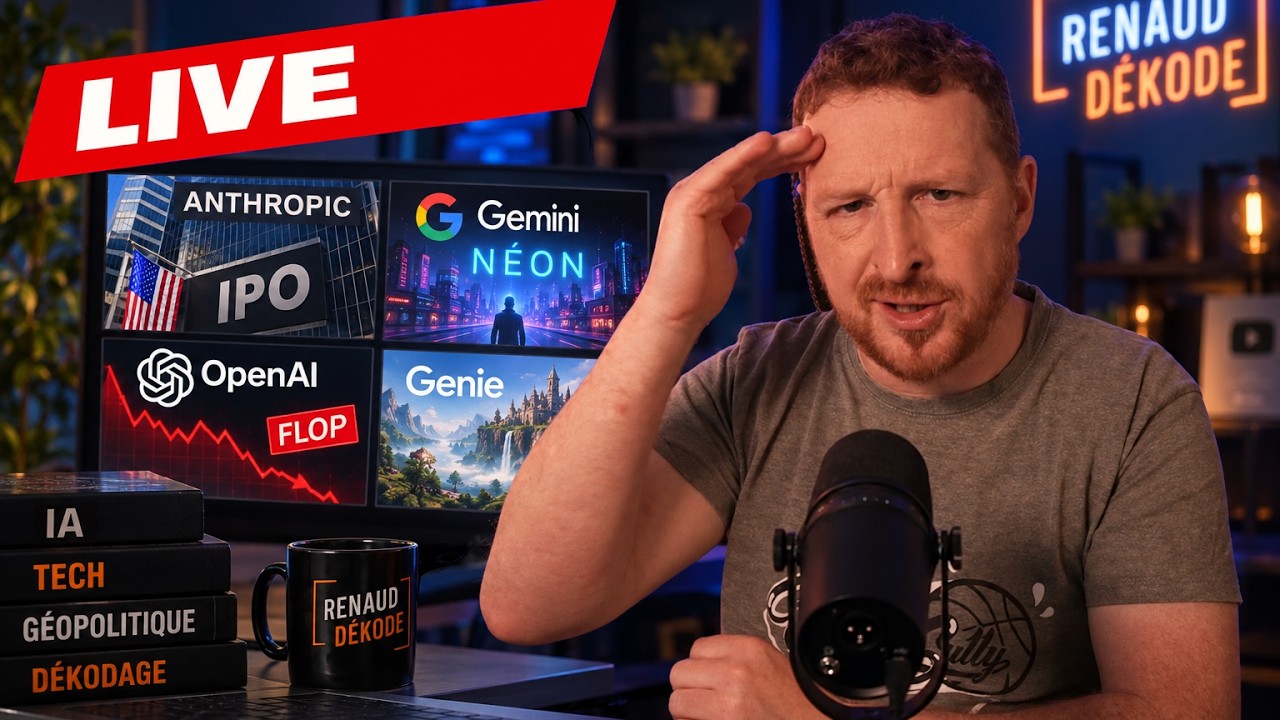
Anthropic casse tout, Gemini Néon est dingue, OpenAI floppe, Genie est bluffant + IA, le Harnais
Anthropic breaks everything, Gemini Néon is crazy, OpenAI flops, Genie is stunning + AI, the Harness
Keywords
Summary
214 words
Critical Evaluation
Value of the Information & Strength of the Argument
On the material actually available, the informational value is thin. The transcribed segment is almost entirely relational and logistical: welcoming viewers, describing the show’s formats, promoting the paid community, reading chat. Almost no factual claim is made, and therefore almost nothing is either substantiated or refutable — the value of the segment lies in orientation (what the show will cover, on what schedule) rather than in content. The one passage with real informational substance is the GPU/NPU distinction: the host explains that GPUs, built for parallel sequential work, have historically carried inference, and that NPUs are processors dedicated to AI workloads. The definition is accurate at a textbook level but remains at the level of analogy (‘you give it a task, it runs through all the parameters, then produces the next token’), with no figures, no comparison of architectures, no memory-bandwidth or throughput discussion, and no named chip or vendor. Argumentation, properly speaking, is largely absent from the transcript: the host states, announces and comments rather than argues. Where a thesis does appear — that there are both underrated and overrated models on the market, and that money will dominate the day’s headlines — it is asserted in a single sentence without supporting evidence, benchmarks or citations. The editorial framing (‘understand / think / act’, the stated refusal to simply rehash the previous week’s Microsoft coverage) does suggest a deliberate effort to avoid pure repetition, which is a point in favour of the format’s design; but design intent is not the same as delivered argument. The available text therefore supports neither strong endorsement nor strong refutation of the show’s substantive claims: they simply are not there to be examined.
Scientific Rigor, Source Quality, Title Accuracy
Scientific rigour cannot be assessed positively from the transcribed portion, because no scientific source is used in it. No paper, benchmark, leaderboard, technical report or dataset is named; no quantitative claim is made that would require one. The only external reference is the show’s own website, given twice for community and subscription purposes, which functions as promotion rather than documentation. The technical vocabulary used (GPU, NPU, inference, token) is employed correctly, which indicates basic literacy, but correct vocabulary is not sourcing. On source quality, the segment is closer to a talk-radio register than to science communication: authority rests on the host’s persona and on his presence at a trade event, not on cited evidence. Concerning title/content adequacy: the title enumerates six specific items (Anthropic’s market record, Gemini 4 Neon, GPT-6.2 Astra, Genie 4, the Starlink-free missile, an explainer on ’the harness’) presented as a factual bulletin; the transcript confirms that these are planned for the show and announces the news block for roughly 12:30 and the explainer for roughly 13:15, but none of them is delivered within the available text. The title is therefore consistent with the show’s announced programme while remaining unverifiable as to the substance actually delivered. No viewer comments were supplied, so no audience trend is analysed here.
505 words
Title / Content Match
The title promises a dense AI news bulletin plus a conceptual explainer; the transcribed opening delivers only the preamble to that bulletin, so the promise is plausible but unverifiable from the available material.
Quality & Reliability
3/10
The available transcript covers only the opening segment of a 3h17 live show: greetings, jet-lag banter, community/club promotion and channel housekeeping. Almost none of the headline claims announced in the title (Anthropic's stock record, Gemini 4 Neon, GPT-6.2 Astra, Genie 4, the Starlink-free missile guidance, the 'harness' explainer) actually appears in the transcribed portion, so no claim can be assessed on its evidence. The one substantive technical passage (GPU vs NPU) is a correct but very general definition. No source, paper, benchmark or dataset is cited in the transcribed text, and the single external link in the description is the show's own website, i.e. self-promotion rather than documentation.
Key Moments
Markers derived by PSI from the transcript: the creator did not define chapters.
- Opening: the host returns from San Francisco with severe jet lag, greets his regular audience and sets the tone for the live show.
- Presentation of the show's website and of the paid 'Klub' subscription: e-learning paths, guides, forums and the Thursday private workshop.
- Reading live comments from Twitch, YouTube, TikTok, Facebook and LinkedIn; the host invites questions, corrections and counter-arguments.
- Explanation of the weekly editorial structure — 'understand' on Monday, 'think'/interview on Wednesday, 'act'/tutorial on Friday.
- On-screen rundown: news block scheduled around 12:30, viewer reactions, then the concept explainer around 13:15.
- A poll is announced for the audience, framed as a deliberately difficult single-choice question.
- Recap of the previous week's San Francisco and Microsoft Ignite coverage, with an explicit decision not to repeat that material.
- Answering a viewer's question on NPUs: GPUs used historically for inference versus AI-dedicated neural processing units.
Cited Sources
- Renaud Dékode — official show website (forums, chats, free tools, Klub subscription) — The only external link in the video description; presented repeatedly during the opening as the community hub and the entry point to the paid 'Klub' offering. It is an in-house promotional link, not a reference for any factual claim.
Contribution & Novelties
The genuinely original contribution visible in the transcript is editorial rather than scientific: a three-part weekly architecture that separates understanding a concept (Monday), confronting it with an outside practitioner (Wednesday) and applying it hands-on (Friday), combined with an explicit editorial rule of not re-litigating an event already covered the previous week. In the transcribed portion, the only substantive explanatory content is the GPU/NPU distinction, delivered as a short refresher for viewers who half-know the term — a pedagogical move rather than a new finding. The headline items announced in the title (a stock-market record for Anthropic, a new Gemini iteration, a new OpenAI model, Google’s Genie, autonomous guidance without satellite connectivity, and the notion of an agent ‘harness’) point to genuinely fast-moving topics, but the transcript does not contain the analysis that would let a reader evaluate them; the note therefore records them as announced, not as demonstrated.
Pour aller plus loin :
- Transformer (deep learning architecture) — Background for the model releases discussed; the architecture behind most current LLMs.
- Neural processing unit — Direct reference for the only technical passage actually present in the transcript (NPU vs GPU for inference).
- Graphics processing unit — Context for the host’s claim that inference has historically run on GPUs.
- Starlink — Context for the announced item on missile guidance without satellite connectivity.
- Agent ‘harness’ / scaffolding (tool-calling loops, context management, evaluation harnesses around a model) — the announced second-half explainer topic; cited by name only, as no single canonical reference exists.
249 words
Radar Profile
The profile is dominated by a very low information quantity in the available material, with technical level and information quality clustering in the low-middle range: the host handles vocabulary correctly but does not develop arguments. Overall reliability sits slightly above the quantity score because nothing stated is actually wrong, merely thin and unsourced. The shape is that of a chat-driven live format, not of an evidence-based briefing.