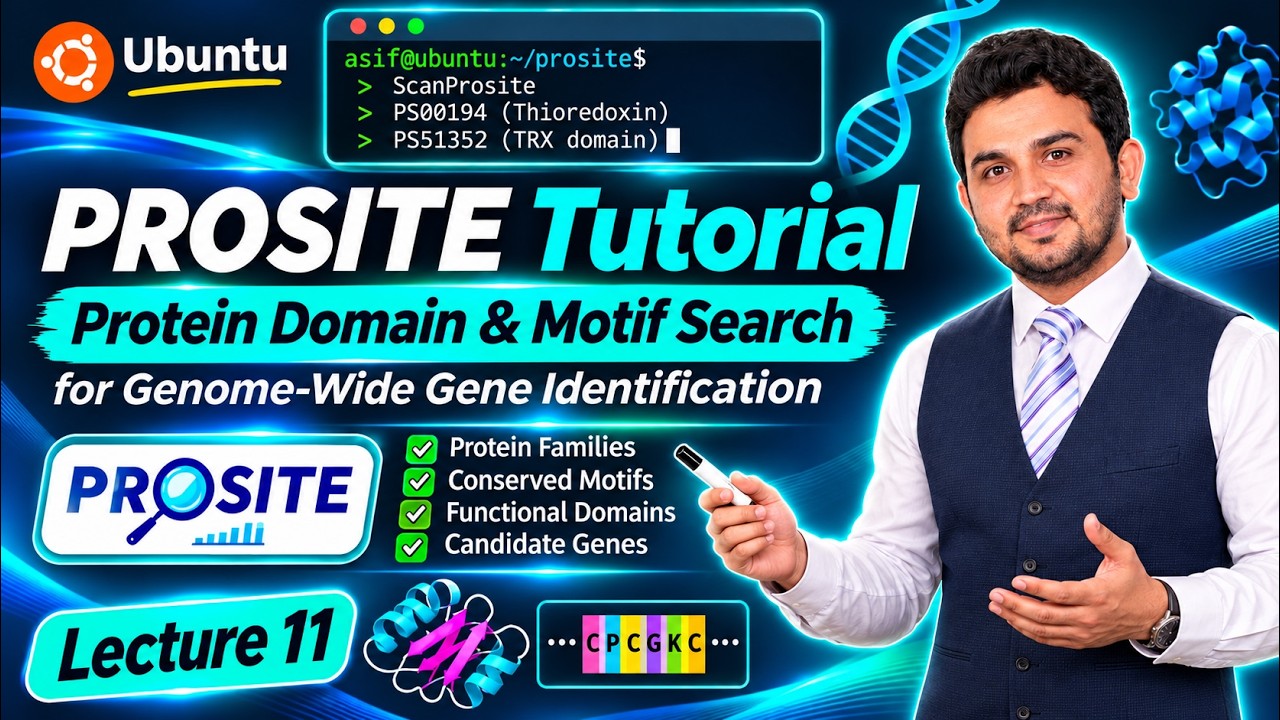
How to Use PROSITE for Genome-Wide Gene Family Identification | Protein Domain & Motif Search
Keywords
Summary
311 words
Critical Evaluation
Value of the Information & Strength of the Argument
The informational value lies in showing a real, unedited workflow rather than a polished slide deck: the viewer sees how a local PROSITE installation is verified, how a positive control is used as a gate before scaling to a full proteome, how single-profile scans differ from genome-wide scans, and how results from PROSITE are cross-checked against Pfam and PANTHER to recover candidates missed by earlier searches. That practical texture — including the failure modes of file paths, missing scripts and incompatible options — is genuinely useful to someone reproducing the pipeline. The argumentation, however, is thin. Almost no conceptual explanation accompanies the commands: the difference between a PROSITE pattern and a profile is asserted rather than taught, the choice of the two discovery thresholds is never justified, no false-positive or sensitivity estimate is offered, and the biological meaning of the candidate list is only sketched at the very end. Reasoning is delegated to a chatbot whose suggestions are accepted or rejected empirically on screen, so the logical chain is ‘paste, observe error, paste again’ rather than ‘state hypothesis, define criterion, test’. The presenter’s own caveat that the 29 PANTHER loci may be true or atypical QWRKY-related genes, and that most map to the RING/U-box superfamily rather than to the target family, is honest but undercuts the framing of the exercise as gene-family identification: no criterion is given for deciding which hits belong to the family and which are domain-level coincidences. The conclusion therefore rests on counts and visual inspection of output files, not on an articulated inferential argument.
Scientific Rigor, Source Quality, Title Accuracy
Rigour is weak by conventional scientific standards. The only references provided are the official PROSITE and ScanProsite pages, which do document the databases and the scanning interface, but no publication describing PROSITE, no PANTHER or HMMER reference, and no literature on the gene family under study is cited; the methodological choices (profile versus pattern search, threshold selection, de-duplication rule) are made ad hoc during the session. Reproducibility is also limited: the commands are shown as pasted snippets, path handling is corrected implicitly, and the final workflow exists only in the presenter’s terminal history and in a chatbot conversation, so a viewer cannot reconstruct the exact script from the video alone. Numbers reported (twelve and nine candidates, seven shared, 17/31/12 and 14/8/9 PANTHER hits, 29 new loci) are read off screen without accompanying tables, file names or statistical context. On title/content fit, the video does deliver a PROSITE/ScanProsite demonstration and does address genome-wide candidate discovery, but it drifts substantially into installation debugging, chatbot-assisted repair, PANTHER model handling and a forward reference to BLASTP, so the title over-promises the coherence and the step-by-step framing of the content.
458 words
Title / Content Match
The title promises a step-by-step PROSITE/ScanProsite tutorial for genome-wide gene family identification, and PROSITE searching does occupy part of the video; however, a large share of the runtime is spent on installation troubleshooting, chatbot debugging, PANTHER model downloads and a BLASTP teaser, so the fit is only partial.
Quality & Reliability
3/10
A screen-recorded practical walkthrough of genuine, well-established tools (PROSITE/ScanProsite, pfsearch/pfscan, HMMER, PANTHER), but the session is improvised and driven by trial-and-error dialogue with a chatbot: commands are pasted, fail, and are corrected on camera without prior explanation. No primary literature, no methodological justification for the thresholds used, no statistics, and no validation of the newly found loci — the presenter himself says the hits may be true or atypical QWRKY-related genes and would need later validation. Biological claims (gene counts, family assignments) are reported from on-screen output only, without controls beyond a single positive-control test.
Key Moments
Markers derived by PSI from the transcript: the creator did not define chapters.
- Verification that the PROSITE files are downloaded and that the Pfam accession identifier of interest is already present in the local list.
- Installation of the Pfam toolset; confirmation that pfscan v3 and pfsearch v3 are functional by opening their help pages.
- First small test scan before scaling up; it fails with a 'no such file or directory' error, diagnosed as a working-directory path problem.
- Positive control finally passes on the Arabidopsis sequence, establishing that the scanning setup works before the full proteome run.
- Switch from pfscan v3 to pfsearch v3 after the warning that pfscan is inefficient for single-profile searches, and re-run of the corrected control.
- Genome-wide results summarised: twelve Arabidopsis and nine rice candidates, seven gene-level matches per species and no new loci at this stage.
- PANTHER HMM models downloaded and validated in HMMER format, then six searches run with hits counted at two discovery thresholds.
- De-duplication identifies 29 newly detected PANTHER loci, most belonging to the RING/U-box superfamily, with the explicit caveat that they remain unvalidated candidates.
- Closing announcement that BLASTP-based discovery will be handled in the next episode.
Cited Sources
- PROSITE — protein families and domains database — Official database used throughout the tutorial for pattern, profile and accession-ID lookups; given in the video description.
- ScanProsite — protein domain and motif scanning tool — The scanning interface whose underlying local executables (pfscan/pfsearch) are installed and tested on camera; given in the video description.
Concurring Sources
- InterPro — integrated protein family and domain classification — Integrates PROSITE, Pfam and PANTHER signatures, and supports the video's premise that signatures from different databases are complementary and should be cross-checked.
- PANTHER classification system — Documents the PANTHER HMM models downloaded and used in the second half of the tutorial for the extended candidate search.
- HMMER — profile hidden Markov model software — Reference for the HMM-format models and search methodology invoked when running the PANTHER models locally.
- UniProt — protein sequence and annotation knowledgebase — The proteome/annotation source typically used for the Arabidopsis and rice sequence sets, and the natural place to check whether the newly detected loci are annotated.
Contribution & Novelties
The distinctive contribution is procedural rather than conceptual: it documents a COMPLEMENTARY discovery strategy in which PROSITE pattern/profile searches are run locally on full proteomes after BLAST, Pfam HMM and PANTHER searches, on the premise that some candidate genes escape detection by those methods. It also illustrates an increasingly common research practice — using a conversational AI assistant as an interactive troubleshooter for command-line bioinformatics — and shows both its utility (rapid diagnosis of path and option errors) and its limits (the assistant proposes scripts that were never created, and the user must iteratively validate every step). Finally, the episode concedes an important negative result: for this particular gene family, the PROSITE-based extension added no new loci at the gene level, while the PANTHER extension produced 29 new loci that belong overwhelmingly to the RING/U-box superfamily and are not annotated as family members, which is a useful reminder that domain-level hits are not gene-family membership.
Further reading:
- PROSITE user manual and documentation — explains the difference between patterns (regular expressions) and profiles (weight matrices), the exact distinction the video applies without explaining: https://prosite.expasy.org/
- InterPro, the integrative database that consolidates PROSITE, Pfam, PANTHER and other member databases — useful for cross-checking the kind of overlapping hits discussed here: https://www.ebi.ac.uk/interpro/
- HMMER project page — reference implementation of profile hidden Markov model searches of the type invoked for the PANTHER models: http://hmmer.org/
- PANTHER classification system — source of the HMM models downloaded and validated in this episode: https://www.pantherdb.org/
- Protein domain (concept) — background on why domain-level hits do not automatically imply gene-family membership, the central interpretive issue raised in the final section: https://en.wikipedia.org/wiki/Protein_domain
- Sequence motif (concept) — background on short conserved signatures and their higher false-positive rate compared with profiles: https://en.wikipedia.org/wiki/Sequence_motif
288 words
Radar Profile
The profile is heavily skewed toward technical procedure: a moderately high technical level reflects genuine command-line tooling (local PROSITE installation, pfscan/pfsearch, HMMER, proteome-scale scanning), while information quality and overall reliability sit low because the reasoning is improvised and unvalidated. Quantity of information is middling — many concrete commands and counts are shown, but a large fraction of the runtime is spent on errors and chatbot exchanges rather than on transferable explanation.