Shrier Family Topics In Rehabilitation Science Seminar: Dr. Aaron Wong, November 2026
Title history
- Shrier Family Topics In Rehabilitation Science Seminar: Dr. Aaron Wong, November 2026 — observed on 20261120-0527 UTC (YouTube)
Keywords
Summary
153 words
Critical Evaluation
Value of the Information & Strength of the Argument
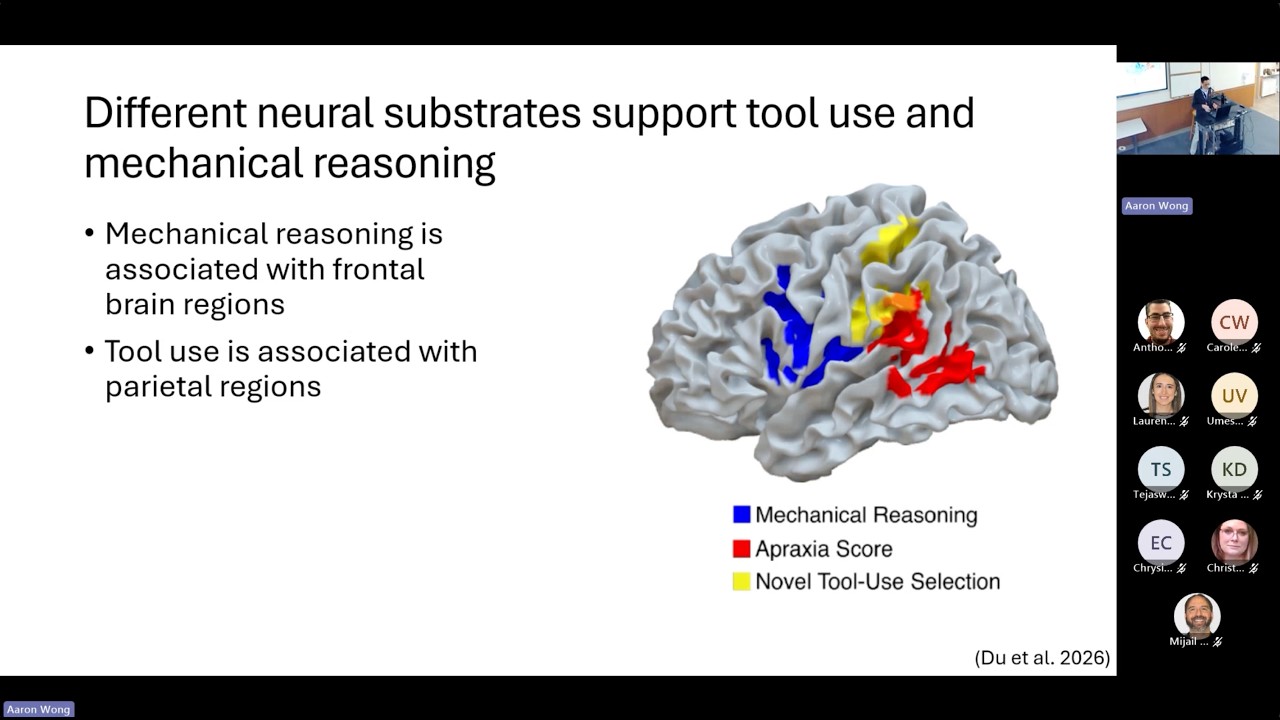
The value of the information is high as it challenges long-held assumptions about mechanical reasoning as a prerequisite for tool use, offering novel evidence for dissociation. The argumentation is strong: the speaker uses careful experimental designs that separate tool use from other cognitive constructs, and he employs correlational and lesion-based analyses to support conclusions. He candidly discusses unexpected findings, such as the lack of correlation with the tool sequencing task, which adds nuance and intellectual honesty. The presentation effectively builds a case for automaticity in tool use and highlights underappreciated deficits like sequencing and awareness.
Scientific Rigor, Source Quality, Title Accuracy
The scientific rigor is evident in the use of controlled tasks, multiple measures, and the logic of dissociations. However, the talk does not explicitly cite external publications, relying instead on the speaker’s own ongoing research, which is typical for a seminar but limits verifiability. The title accurately matches the content, and there is no apparent mismatch. The presentation is well-structured and follows standard scientific communication norms, though the lack of detailed methods and statistics in the seminar format reduces the ability to fully assess reliability.
195 words
Title / Content Match
The title accurately reflects the content: a seminar on processes underlying tool use, with specific insights from limb apraxia. The content directly addresses these topics.
Quality & Reliability
8/10
The talk presents rigorous experimental designs using dissociation logic to test cognitive hypotheses, with behavioral and lesion-based evidence. The findings are supported by multiple experiments and appear methodologically sound, though the lack of external citations and details about sample sizes and statistical methods in the talk limits absolute certainty.
Key Moments
Markers derived by PSI from the transcript: the creator did not define chapters.
- Introduction and learning objectives
- Discussion of mechanical reasoning as a potential process for tool use, including the Rube Goldberg-inspired task
- Presentation of sequencing ability as a core deficit in apraxia, with multiple task correlations
- Exploration of awareness of one's own performance, showing half of apraxic patients lack error awareness
- Summary and concluding remarks on the three processes and their implications
Contribution & Novelties
The talk provides original contributions by systematically testing and refuting the mechanical reasoning hypothesis, proposing sequencing as a core deficit, and identifying error awareness as a critical factor. It integrates behavioral and neural evidence to refine the understanding of apraxia and tool use.
Pour aller plus loin :
- Apraxia - Wikipedia — Relevant overview of the disorder discussed.
- Rube Goldberg machine - Wikipedia — Illustrates the concept used in the mechanical reasoning task.
- Tool use - Wikipedia — General context on tool use in humans and animals.
87 words
Radar Profile
The radar profile shows high scores in technical level and reliability, indicating a sophisticated and well-founded presentation. The quantity of information is moderately high, while the quality is strong. Overall, this reflects a dense, expert-level seminar with solid empirical grounding.