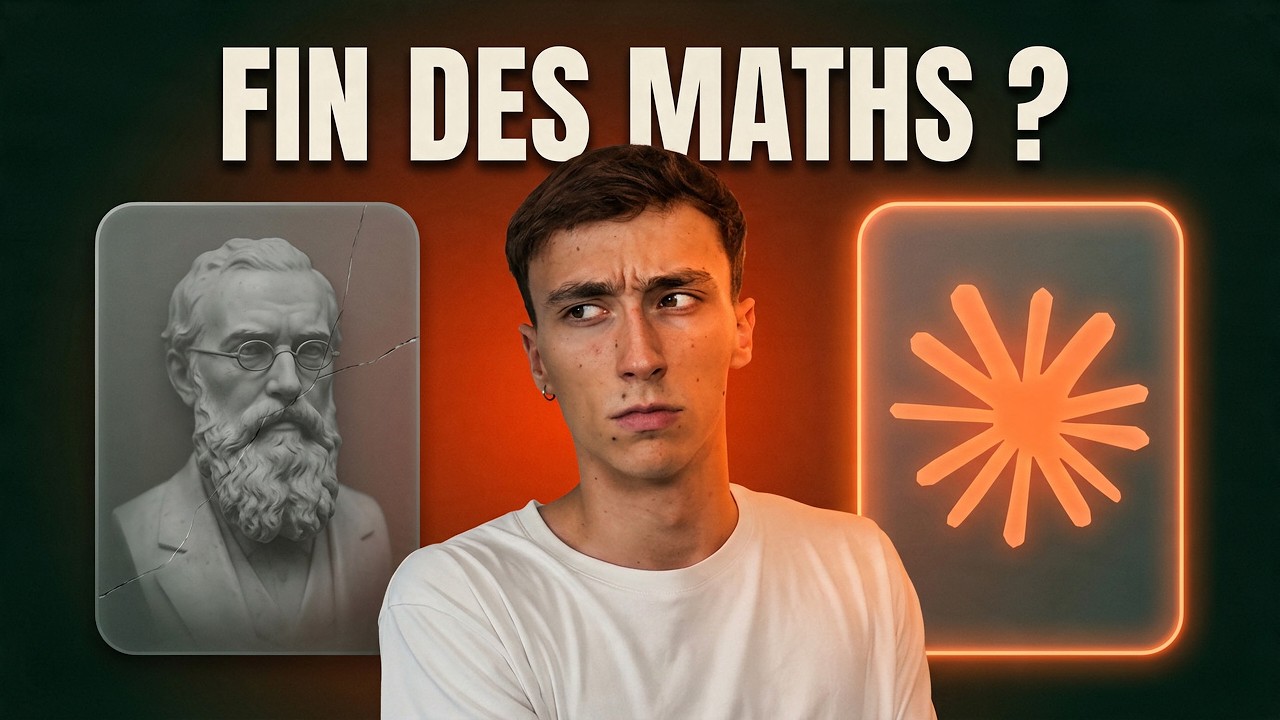
On réalise pas ce qui vient d'arriver aux mathématiques (actu IA)
We don't realize what just happened to mathematics (AI news)
Keywords
Summary
306 words
Critical Evaluation
Value of the Information & Strength of the Argument
The informational value is high for a news round-up: rather than listing releases, the episode devotes most of its runtime to a single model and reconstructs its architecture step by step, from layer stacking to the routing of the middle-block output back into the input, including the token-level mechanics (a 2304-number embedding, a 64-number gate compression, separate scaling of the original input and of the carried-over message). The argumentation is unusually explicit about trade-offs. The host states the two naive loop designs and their failure modes — feeding the output of layer 17 back into layer 6 breaks a layer that never learned to read that distribution, and pure re-injection of the input makes the second pass recompute the first to the digit — and then presents the mixed solution as the actual contribution. He also refuses to over-claim: the loop is said to add reasoning depth but not memory, a knowledge-only question-answering test barely moves (6.3% to 7.3%), and marginal gains vanish beyond three passes. The demonstrations are concrete and partly self-critical: the meeting-brief task is judged on relevance rather than impressiveness, and the host admits the generated game page would be matched by a comparable dense model. The weaker side is that the argument rests heavily on the lab’s own reported numbers, presented as ‘spectacular’, with no attempt to interrogate benchmark selection, no external replication of the reported deltas, and no discussion of what a three-pass loop costs in latency for long generations. A few quantitative statements slide past each other (input processing rate versus output rate, RAM thresholds quoted from a third-party quantisation page), and at least one model name and version is garbled badly enough to mislead a viewer unfamiliar with the field.
Scientific Rigor, Source Quality, Title Accuracy
The documentary base is solid in aggregate: the description lists the lab’s announcement, a technical blog post, the repository containing the model code, an interpretability write-up on the gates, a research variant with a variable number of passes, a public benchmark aggregator, Notion’s manifesto, the mathematical note and its proof-assistant certification material, plus the two small-model project pages. These are overwhelmingly primary or near-primary, and the description is clearly separated from the promotional link. Inside the video, however, these references are rarely named at the moment a figure is used: the RAM requirement is attributed to a third-party quantisation project, the benchmark position to a named aggregator, but most performance deltas are simply presented as coming from ’the lab’. The mathematical segment is the least rigorous. The host hedges verbally (‘seems to be resolved’) but the segment’s framing still implies an established breakthrough, whereas the material attached is a short note whose status depends on a formalisation step that the video never discusses; the accompanying proof-assistant blog post and finite-field verification page are listed but not explained, so a viewer cannot judge what was actually checked. The Notion segment is explicitly opinionated and is presented as such, which is legitimate. On title/content fit, the promised mathematical revelation is a short item at the end of a long model-architecture feature, so the title overstates one segment and understates the real subject. A short advertising break of roughly ten seconds is present and has no bearing on the assessment.
549 words
Title / Content Match
The title foregrounds a mathematical breakthrough (the Riemann hypothesis), but that segment occupies only about two and a half minutes of a twenty-seven-minute episode; the bulk is a deep dive into a locally runnable model and its looped architecture. The title therefore announces a narrower and more spectacular subject than the content delivers.
Quality & Reliability
6/10
The episode is anchored on primary material (the lab's announcement, a Hugging Face technical write-up, the released code, an interpretability note) and the host gives concrete, checkable figures: parameter counts, active parameters per token, RAM requirements, tokens per second measured on his own machine, and benchmark deltas with and without the loop. He also states the limits of the loop explicitly (reasoning depth, not knowledge; gains saturating after three passes). Weaknesses: several figures are relayed without naming the source at the moment they are used, some model names and version numbers are garbled or plainly wrong, throughput numbers fluctuate within the same demo, and the mathematics segment leans on an unverified claim whose status is presented with more certainty than the underlying document supports. The overall register is enthusiastic and occasionally promotional.
Chapters
- Inkling 2 Mini : le meilleur modèle IA en local ?
- Démos en local : du code et du vrai travail
- Une architecture qui boucle sur elle-même
- Comment Inkling mélange question et réflexion
- Ce que la boucle apporte : réflexion, pas mémoire
- Le manifeste de Notion : les AI Factories
- Ce qui me gêne dans la vision de Notion
- L'hypothèse de Riemann démontrée grâce à Claude ?
- Une IA qui génère des images en 78 millisecondes
- Des avatars vidéo de 10 minutes à partir d'une photo
Cited Sources
- Thinking Machines — Inkling 2 Mini model announcement — Primary source for the model's release, size, licensing and intended enterprise positioning.
- Artificial Analysis — Inkling 2 Mini model page — Aggregator used for the intelligence/speed/cost comparison against other small open-weight models.
- Hugging Face blog — the loop architecture explained — Technical reference behind the layer-repetition and gate explanation.
- Goodfire — interpreting the gates of Inkling 2 Mini — Interpretability work on what the per-layer gates actually let through.
- Hugging Face Transformers — modular_inkling2_loop.py — Reference implementation of the looping block and its gating mechanism.
- Thinking Machines — variable-pass research variant (TML-d24-varloop-research) — Source of the one-, three- and multi-pass comparison figures on agentic coding and long-context retrieval.
- Notion — A New Shape for Work — The manifesto on 'AI factories' and shared enterprise agents discussed and criticised in the episode.
- Levent Alpöge — remark on the Riemann hypothesis — The document behind the claimed mathematical result attributed to Claude.
- Lean prover community — certification post on the Riemann hypothesis — Proof-assistant material cited for the formal verification claim.
- MIT — verification resource on the generalised Riemann hypothesis — Numerical verification material cited alongside the claimed result.
- Jeveration — model page — Project page for the image generator presented as producing an image in 78 milliseconds.
- LongCat Video Avatar 1.6 — Hugging Face model card — Model card for the avatar system said to generate more than ten minutes of video from a single photo.
Dissenting Sources
- Mathematical consensus on the Riemann hypothesis (status: unproven) — The hypothesis is not an established theorem, and the video's own phrasing wavers between 'seems to be resolved' and a genuine announcement. A short note plus proof-assistant certification does not by itself settle the question, since everything depends on whether the formalised statement matches the intended one — a point the episode does not address.
External References
Contribution & Novelties
The episode’s real contribution is pedagogical rather than editorial: it offers a step-by-step public reconstruction of a looped transformer, including the design dead ends that make the solution intelligible. Two points stand out as genuinely useful framing. First, the separation between what looping buys and what it does not — the large gains on agentic coding and long-context retrieval against a near-flat result on a closed-book knowledge test make the ‘reasoning versus memory’ distinction concrete rather than rhetorical. Second, the insistence that the gates start closed during training, so that the second pass initially reproduces the first exactly and only gradually diverges, which explains why the loop can be retrofitted onto an already-trained model without destroying it. The episode also usefully documents that the loop represents roughly 0.1% of parameters while carrying a large share of the reported capability gains, and that variable-pass research shows saturation after three passes — a caveat rarely stated in launch coverage.
Pour aller plus loin :
- Mixture of experts — Background for the 26-billion-parameter / 3.4-billion-active trade-off that underpins the model’s 20 GB footprint.
- Transformer (deep learning architecture) — The layer-stack model the episode assumes throughout, useful for situating the ‘middle layers’ claim.
- Riemann hypothesis — Necessary context for judging the status of the claimed result discussed in the final section.
- Lean (proof assistant) — Explains what proof-assistant certification does and does not establish, the missing link in the mathematics segment.
- Speculative decoding — The technique the host credits for pushing throughput from roughly 35 to 50 tokens per second; worth reading about separately, as it trades a small verification model against a larger one.
271 words
Radar Profile
The profile is strongly skewed towards density and technical depth, with information quantity and difficulty both high for a news format. Quality and reliability sit a notch below, reflecting the reliance on self-reported laboratory figures and the thin, over-framed mathematics segment. The shape is that of a well-prepared technical explainer wrapped in an over-promising headline.