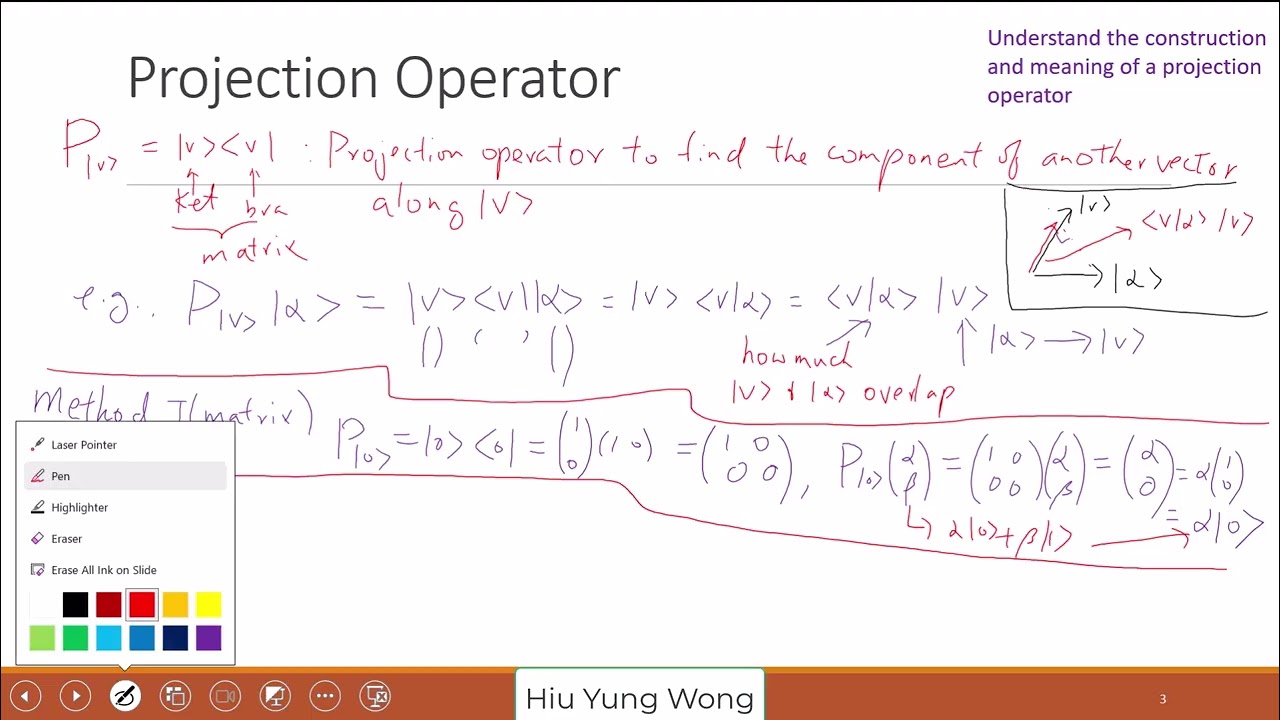
L7 Projection Operator, Measurement, Hilbert Space and Tensor Product
Keywords
Summary
85 words
Critical Evaluation
Value of the Information & Strength of the Argument
The lecture provides a clear and logical exposition of projection operators, building from basic definitions to practical applications in probability calculations. The instructor uses multiple examples and interactive questions to reinforce understanding. The argumentation is rigorous, with step-by-step derivations and emphasis on avoiding common mistakes such as confusing complex squares with magnitudes. The value lies in making abstract linear algebra accessible and connecting it directly to quantum measurement.
Scientific Rigor, Source Quality, Title Accuracy
The scientific rigor is high; the instructor adheres to standard quantum mechanics formalism, correctly applying Dirac notation and linear algebra. However, no external sources are cited beyond the course playlist, and the content is standard textbook material. The title accurately describes the lecture’s scope for projection and measurement, but the mention of Hilbert space and tensor product is not addressed in the provided transcript, potentially misleading expectations. The video has only 4 views and 1 like, but that does not affect quality.
165 words
Title / Content Match
The title mentions Hilbert space and tensor product, but the transcript focuses on projection operators and measurement; these topics may appear later in the video, but the available transcript does not cover them explicitly.
Quality & Reliability
8/10
The lecture is delivered by a professor, presents standard quantum computing formalism with step-by-step derivations and worked examples. The content is accurate and clear, though it remains introductory and does not include critical discussion or citation of external sources.
Key Moments
Markers derived by PSI from the transcript: the creator did not define chapters.
- Introduction and assignment reminders
- Definition and intuition of projection operator
- Worked example: projecting onto |0⟩ with matrices and Dirac notation
- Connecting projection operators to measurement probability, deriving Born rule
- Example with three-dimensional state and probability calculation for |1⟩ and |2⟩
Cited Sources
- Course Playlist: Quantum Computing, TCAD, Semicond by Hiu-Yung Wong — Referenced in video description as course materials.
Contribution & Novelties
This lecture provides a clear and systematic introduction to projection operators, essential for understanding quantum measurement. It does not introduce new theory but offers an accessible derivation of the Born rule from projection matrices. For deeper exploration, readers can consult the following resources:
- Projection-valued measure — Formalizes projection operators in quantum mechanics.
- Born rule — The fundamental probability law in quantum mechanics.
- Hilbert space — The mathematical setting for quantum states.
- Tensor product — The basis for multi-qubit systems.
These references complement the lecture’s material and provide rigorous definitions and contexts.
91 words
Radar Profile
The radar profile likely shows high scores in quality and reliability, moderate in quantity and technical depth, reflecting a solid fundamental lecture with room for advanced applications.