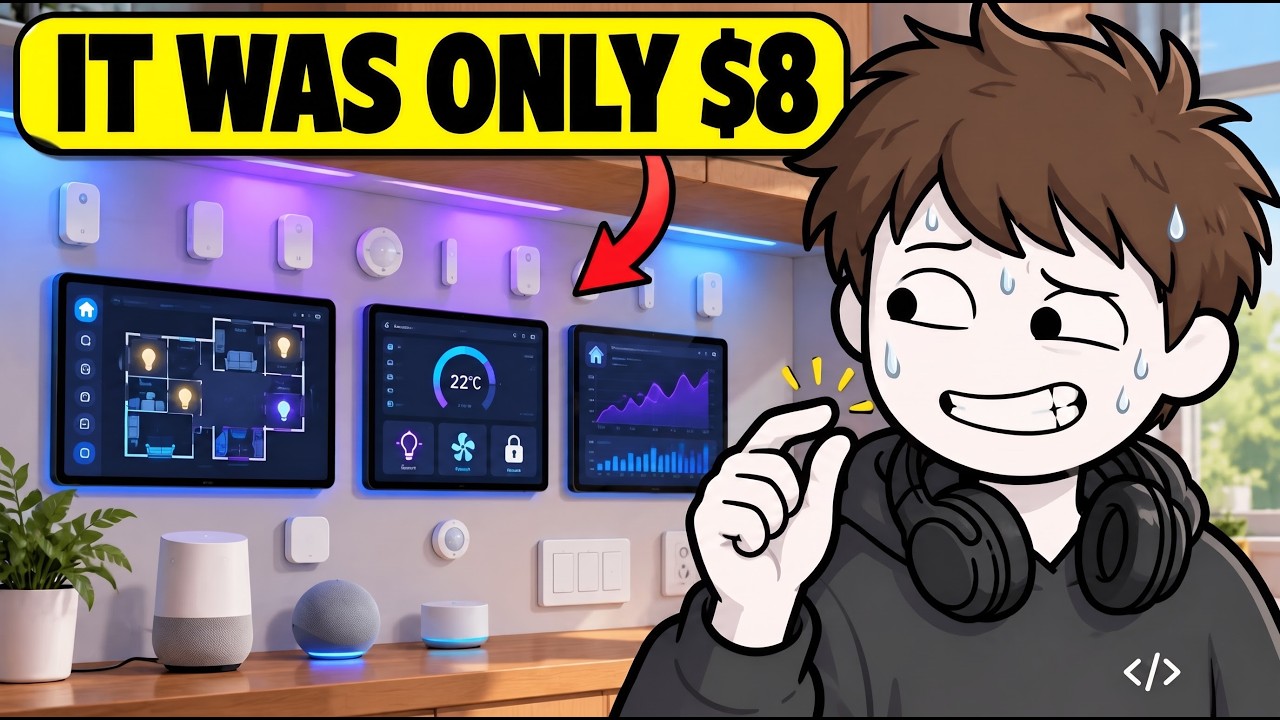
Your Life at Every Level of Home Automation (Smart Plug to Home Assistant)
Title history
- Your Life at Every Level of Home Automation (Smart Plug to Home Assistant) — observed on 20261031-2252 UTC (YouTube)
Keywords
Summary
133 words
Critical Evaluation
Value of the Information & Strength of the Argument
The video’s value lies in its engaging, story-driven approach that illustrates the escalating complexity of smart home systems and the psychological trade-offs. It effectively uses concrete examples (e.g., the laminated instruction card, the fridge leak sensor saving the floor) to ground abstract concepts. The argumentation is coherent, moving from predictable beginner pitfalls (e.g., wall switch cutting power to smart bulbs) to advanced but still relatable issues (e.g., motion sensors failing for stationary people). It draws on credible academic references (Cowan, Bainbridge, Wiener) and current industry events (Google outage, Wemo shutdown) to support its claims. However, the perspective is anecdotal and deliberately satirical, which limits the depth of critical analysis; it does not offer quantitative evidence or systematic comparison.
Scientific Rigor, Source Quality, Title Accuracy
The video demonstrates good rigor by citing specific sources: the Home Assistant blog, Open Home Foundation factsheet, Nabu Casa price change, 9to5Google on the outage, PCWorld on Wemo, and Home Assistant’s myQ integration page. It also references academic works (Cowan 1983, Bainbridge 1983, Wiener 1989) by name. These sources are credible in their domains. The title matches the content perfectly, as each level corresponds to a distinct stage of automation maturity. The creator notes that the video is commentary and satire, which tempers expectations of formal scientific rigor. Overall, the use of sources is adequate for a popular science/comedy documentary, and the title is accurate.
238 words
Title / Content Match
The title accurately reflects the content: it systematically explores home automation levels from an $8 plug to a full Home Assistant setup, intertwined with the human experience.
Quality & Reliability
7/10
The video presents factual data (prices, dates, statistics) and cites recognizable academic works and industry sources, but it is presented as commentary and satire rather than a rigorous scientific analysis, thus moderate reliability.
Chapters
Cited Sources
- What the Heck? 2026 (Home Assistant) — Cited regarding the lead developer's confession about his own family's experience and the homework assignment for November.
- Open Home Foundation annual report factsheet — Cited for the statistic that over 2.2 million households run Home Assistant, up over a quarter in a year.
- Green price change (Nabu Casa) — Cited for the Home Assistant Green price change from $99 to $199.
- Google Home hub outage (9to5Google) — Cited for the August 18th Google Home outage that made routines silent.
- Wemo shutdown (PCWorld) — Cited for the Belkin Wemo cloud shutdown on January 31st, rendering the plugs without service.
- myQ and ratgdo (Home Assistant) — Cited for the workaround using ratgdo to regain garage door control after Chamberlain blocked outside apps.
- Cowan, More Work for Mother (1983) — Referenced for the historical analysis that household appliances did not reduce overall housework but raised the standard of 'done'.
- Bainbridge, 'Ironies of Automation', Automatica (1983) — Referenced for the concept that automation leaves humans with the rare difficult failures and leads to skill degradation.
- Wiener, NASA Contractor Report 177528 (1989) — Referenced for the three questions pilots asked about computerized cockpits, paralleling family questions about smart home devices.
Concurring Sources
- Home Assistant blog: What the Heck? 2026 — Aligns with the video's claim about the lead developer's family and the initiative to involve household members.
- Open Home Foundation factsheet — Supports the growth statistics for Home Assistant adoption.
External References
Contribution & Novelties
The video provides a unique narrative frame that captures the emotional and social trajectory of home automation, contrasting the technical progression with the human experience. It synthesizes existing research (Cowan, Bainbridge, Wiener) and applies it to a contemporary context, offering a fresh perspective on the ‘smart home’ phenomenon. The originality lies not in new technical insight but in the relatable, cautionary storytelling that reveals the psychological costs of automation unchecked.
Pour aller plus loin :
- Home Assistant — Open-source home automation platform central to the video’s later levels.
- Matter (standard) — A connectivity standard aimed at unifying smart home devices, relevant to interoperability issues.
- Ruth Schwartz Cowan — Historian whose work ‘More Work for Mother’ is cited to explain how automation changes household labor.
- Ironies of Automation — A 1983 paper by Lisanne Bainbridge; seminal work on how automation degrades human skills, applicable to smart home control.
- Thread (network protocol) — A low-power mesh networking protocol used in many modern smart home devices, key to understanding device communication.
168 words
Radar Profile
The radar profile shows a well-balanced episode with strong quantitative detail (8), solid technical depth (8), and good quality (7), but slightly lower global reliability (7) due to its satirical and opinionated nature. The high information quantity and technical level indicate a content-dense educational piece, while the fiabilté score reflects the need for cross-checking in a formal context.