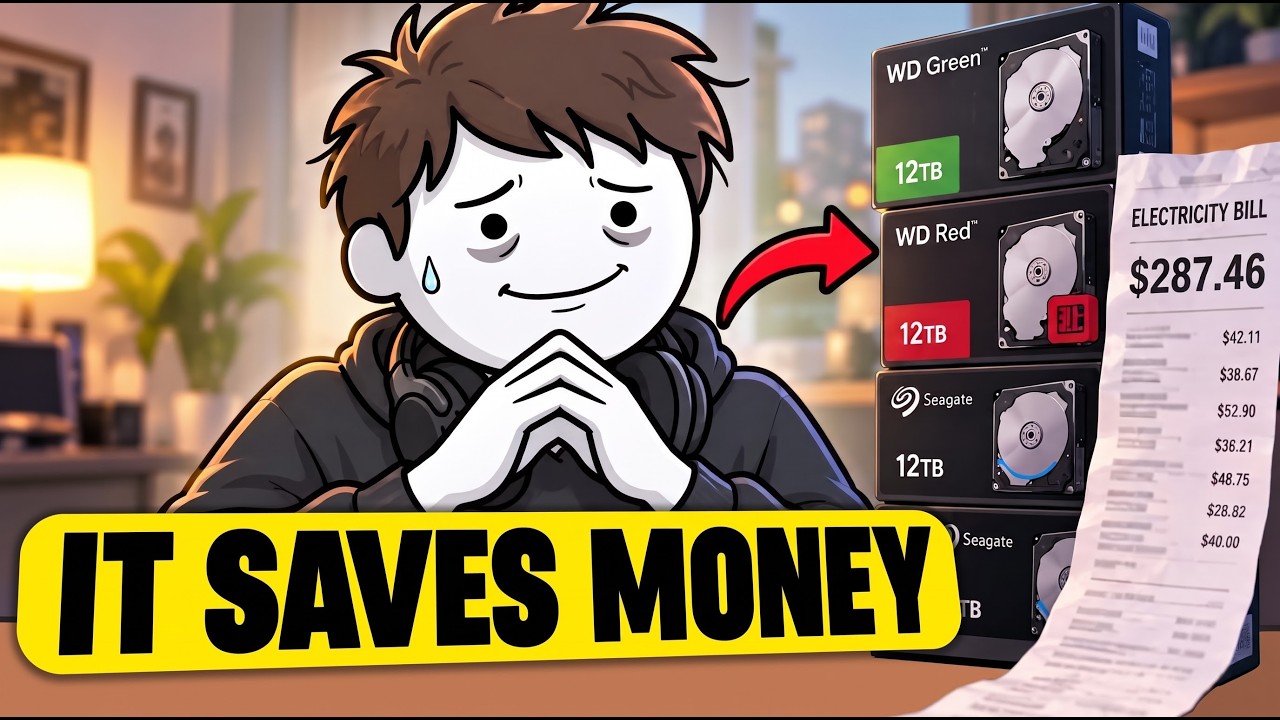
Why Some People Are Obsessed With Home Servers? (It's Not the Money)
Title history
- Why Some People Are Obsessed With Home Servers? (It's Not the Money) — observed on 20261031-2327 UTC (YouTube)
Keywords
Summary
153 words
Critical Evaluation
Value of the Information & Strength of the Argument
The video’s argumentation is compelling and well-structured, using a narrative that intertwines personal anecdotes, psychological research, and real-world examples. It effectively challenges the surface-level justifications and reveals deeper motivations. The evidence is presented with clarity, and each excuse is systematically refuted with both psychological theory and case studies. The rhetorical style is engaging, though some may perceive a slight bias toward justifying the hobby despite the acknowledgment of its irrationality. The value lies in its accessible translation of academic concepts into relatable scenarios, making it insightful for both enthusiasts and outsiders.
Scientific Rigor, Source Quality, Title Accuracy
The video cites a range of sources: peer-reviewed studies (Aronson & Mills, Buehler et al., the 2025 Maribor study), established theories (reactance, serious leisure), and documented public incidents (PlayStation, Insteon, LastPass). These are reputable and relevant. The title accurately frames the content, and the chapters help structure the argument. However, some sources are secondary (e.g., media reports) and not all claims are directly from primary academic papers. The title’s assertive question is answered convincingly. Overall, the source quality is high and the title-content alignment is excellent.
192 words
Title / Content Match
The title precisely matches the content: the video explores the psychological motivations behind home server obsession, backed by research, and clearly explains why it's not about money.
Quality & Reliability
8/10
The video references well-known psychological studies (Aronson & Mills, Buehler et al., reactance theory) and current events, but presents them through a highly engaging narrative that may oversimplify some nuances. Sources are credible but not all are peer-reviewed.
Chapters
Cited Sources
- Enshittification (Wikipedia) — Definition of the term coined by Cory Doctorow, used to describe the degradation of online services.
- awesome-selfhosted (GitHub) — Curated list of self-hosted apps, referenced as a resource with over 300,000 stars.
- Insteon Shutdown (Hackaday) — Case study of a smart-home company shutting down servers, illustrating loss of user control.
- Reactance Theory (The Decision Lab) — Reference for psychological reactance, the desire to restore lost freedom.
- LastPass Breach and Plex vulnerability (The Hacker News) — Example of security risks in self-hosting, linking an engineer's home computer to a major breach.
- Aronson & Mills (1959) severity-of-initiation study — Original study on cognitive dissonance and the effort-justification effect.
- Buehler, Griffin & Ross (1994) planning fallacy — Study on the planning fallacy, showing optimistic predictions of task completion.
- Mazis & Settle (1972) Miami phosphate ban — Research on psychological reactance to a detergent ban, demonstrating increased desire for restricted items.
- PlayStation Discovery removal (BGR) — News story about purchased content being removed, used to illustrate loss of ownership.
- US Home Electricity Rates — Data source for average electricity costs, used to calculate server running expenses.
- Hrgarek & Nemec Zlatolas (2025) study on self-hosters — Peer-reviewed study of over 2,100 self-hosters, identifying enjoyment as the primary motivator.
- Serious Leisure (Robert Stebbins) — Explanation of the serious leisure concept, linking hobbies to identity and skill development.
- xkcd #1319 'Automation' — Comic illustrating the ironic trap of automation, cited to emphasize the planning fallacy.
- Your Life at Every Level of a Homelab (DevPsyche video) — Related video from the channel, expanding on homelab levels.
- Your Life at Every Level of Running AI Locally (DevPsyche video) — Related video on local AI, relevant to self-hosting themes.
- Your Life at Every Level of Networking (DevPsyche video) — Related video on networking, part of the channel's series.
- Psychology of People Who Refuse to Use the Cloud (DevPsyche video) — Related video on cloud refusal, similar psychological themes.
- Every Type of Person Who Killed Their Subscriptions Explained (DevPsyche video) — Related video on subscription cancellation, aligns with the video's topics.
Contribution & Novelties
The video’s original contribution is its synthesis of existing psychological research and real-world examples to explain a niche subculture’s motivations, effectively debunking rational reasons and revealing emotional drivers. It packages academic findings in an accessible narrative, making it valuable for both self-hosters and those trying to understand them.
Pour aller plus loin :
- Cognitive dissonance theory — Foundational concept in psychology, directly related to Aronson & Mills’ study.
- Planning fallacy (APA) — Overview of the bias described in Buehler et al.
- Psychological reactance theory — General explanation of the phenomenon used in the video.
- Serious leisure on Wikipedia — Description of the concept by Stebbins, expanding on the video’s discussion.
- Enshittification (Cory Doctorow’s essay) — Original essay explaining how platforms degrade, relevant to the ‘can’t take it away’ excuse.
129 words
Radar Profile
The radar profile shows high scores across information quantity, quality, and reliability, with slightly lower technical depth. This suggests a well-researched, accessible video that balances scientific rigor with engaging storytelling, appealing to a broad audience while maintaining substance.
💬 Positive – The 30 comments express strong resonance with the content, with many viewers sharing personal reasons for self-hosting, adding humor and further validation, often stating the video 'called them out' affectionately.