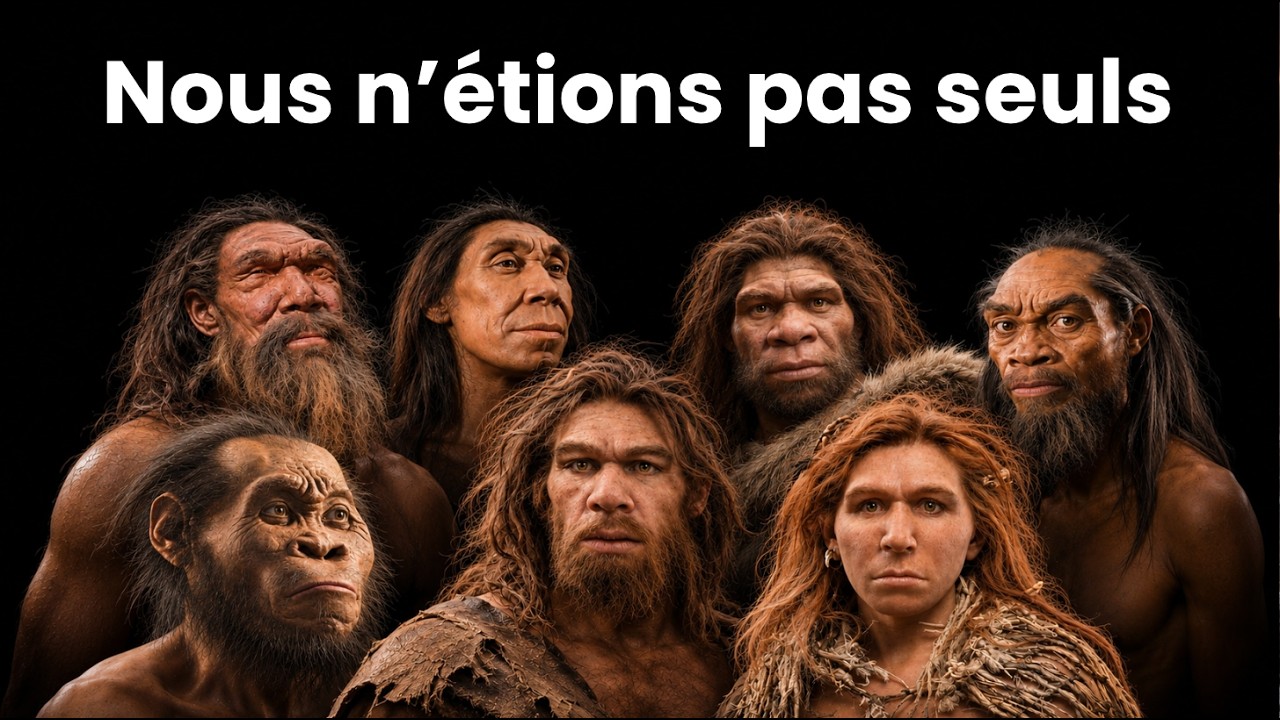
On a découvert d’autres Humains
We Discovered Other Humans
Title history
- On a découvert d’autres Humains — observed on 20261123-0615 UTC (YouTube)
Keywords
Summary
159 words
Critical Evaluation
Value of the Information & Strength of the Argument
The video offers substantial educational value by synthesizing current paleoanthropological knowledge and presenting it in an engaging, accessible manner. The argumentation is coherent: it disputes the simplistic ‘march of progress’ iconography by providing concrete examples and genetic evidence. Each species is contextualized with anatomical features, adaptive traits, and key discoveries (e.g., the Denisovan finger bone, the Flores skeleton). The case for interbreeding is supported by specific percentages of DNA contributions and a known hybrid individual. The line of reasoning is logical, moving from the most familiar Neanderthals to progressively more obscure species, culminating in a reflection on what defines humanity. The use of comparative anatomy and evolutionary mechanisms (insular dwarfism) strengthens the scientific basis. However, the video occasionally blends confirmed facts with hypotheses (e.g., the exact role of Homo heidelbergensis as a common ancestor) without always explicitly flagging the level of evidence, though this is common in science communication.
Scientific Rigor, Source Quality, Title Accuracy
The video demonstrates strong scientific rigor: it cites an academic book by Antoine Balzeau and several Wikipedia articles related to hominin species. These sources are reputable, though Wikipedia is not a primary source; however, the video’s narrative is consistent with peer-reviewed research published in high-impact journals (e.g., Nature) on Denisovan DNA and Neanderthal introgression. The description also credits paleo-artists for animations, indicating attention to visual accuracy. The title accurately reflects the content: the video indeed presents other human species discovered. The chapter structure (provided in the description) helps clarify the organization. While the video simplifies some details for lay audiences, it does not make unsupported claims. No comments were provided, so public reception could not be assessed.
281 words
Title / Content Match
The title accurately reflects the content: the video presents several non-sapiens human species that coexisted with our ancestors.
Quality & Reliability
8/10
The video provides a well-structured, accurate overview of multiple extinct human species, grounded in current scientific consensus. It distinguishes between known facts and hypotheses, and the presented genetic evidence (e.g., Denisovan admixture, Neanderthal interbreeding) aligns with mainstream paleoanthropology. Minor simplifications for accessibility do not compromise overall reliability.
Chapters
Cited Sources
- Denisovan - Wikipedia — Background information on the Denisovan species and its genetic legacy.
- Homme de Denisova - Wikipedia — French-language article on Denisova hominins, complementary to the English source.
- Homme de Florès - Wikipedia — French-language article on Homo floresiensis, the 'Hobbit' species.
- Homme de Néandertal - Wikipedia — French-language article on Neanderthals, covering anatomy and interbreeding.
- Homo (genre) - Wikipedia — General article on the genus Homo, providing taxonomic context.
- Une Brève histoire des origines de l’humanité – Antoine Balzeau — Main book reference mentioned in the description, used as a basis for research.
- Le grand silence – Théo Drieu — Book by the author, linked from the description, but not directly about hominins.
Contribution & Novelties
The video’s original contribution lies in its synthetic, narrative-driven presentation of multiple archaic human species, emphasizing that Homo sapiens was not alone but part of a diverse hominin bush. It effectively communicates the genetic admixture evidence (e.g., Denisovan DNA in present-day populations) and the concept of insular dwarfism with accessible analogies. Its novelty is not in original research but in the clarity and emotional framing that challenges the conventional linear evolution icon.
Pour aller plus loin :
- Insular dwarfism — Relevant to Homo floresiensis’ small size evolution.
- Interbreeding between archaic and modern humans — A synthesis of evidence for Neanderthal and Denisovan gene flow.
- Paleogenetics — The field that enabled the Denisovan discovery, with a Wikipedia overview of ancient DNA techniques.
121 words
Radar Profile
The radar profile shows a balanced distribution with high scores for quantity and quality of information, moderate technical level, and strong reliability. This suggests the video delivers comprehensive, accurate content with accessible explanations, making it suitable for a general audience interested in human evolution.