CCU Graduate Algorithm 2024 10/11
Title history
- CCU Graduate Algorithm 2024 10/11 — observed on 20261026-0006 UTC (YouTube)
Keywords
Summary
150 words
Critical Evaluation
Value of the Information & Strength of the Argument
The value of this lecture lies in its clear step-by-step presentation of classical reductions in computational complexity. It solidifies understanding of NP-completeness by demonstrating concrete transformations, such as SAT to 3SAT, and explaining the logic behind auxiliary variables. The argumentation is rigorous, with careful attention to the if-and-only-if conditions required for reductions. The lecturer also provides intuition behind tricky constructions, making the material accessible despite its depth. However, some proofs are only sketched, and the lecture relies on assumed prior knowledge of concepts like strongly connected components. Overall, the reasoning is solid and follows standard academic approaches.
Scientific Rigor, Source Quality, Title Accuracy
The lecture does not explicitly cite external sources, relying instead on classical results attributed to Cook and Karp. The presenter mentions key theorems and historical figures without providing references, which is typical for a lecture setting. The title accurately reflects the content: it is the tenth lecture in a graduate algorithm series, and the content matches that context. The teaching style is rigorous, but since no external sources are given, the accuracy is based on the presenter’s authority and the well-established nature of the topics. The title is appropriate and does not mislead.
205 words
Title / Content Match
Titre conforme au contenu: la vidéo est le 10e/11e cours de l'algorithme de graduate CCU, abordant la complexité NP-complétée.
Quality & Reliability
8/10
Lecture provides rigorous proofs and reductions, but relies on stated, unverified knowledge; overall reliable for educational purposes.
Key Moments
Markers derived by PSI from the transcript: the creator did not define chapters.
- Introduction, recap of previous lecture on NP-completeness and the first NP-complete problem (circuit satisfiability).
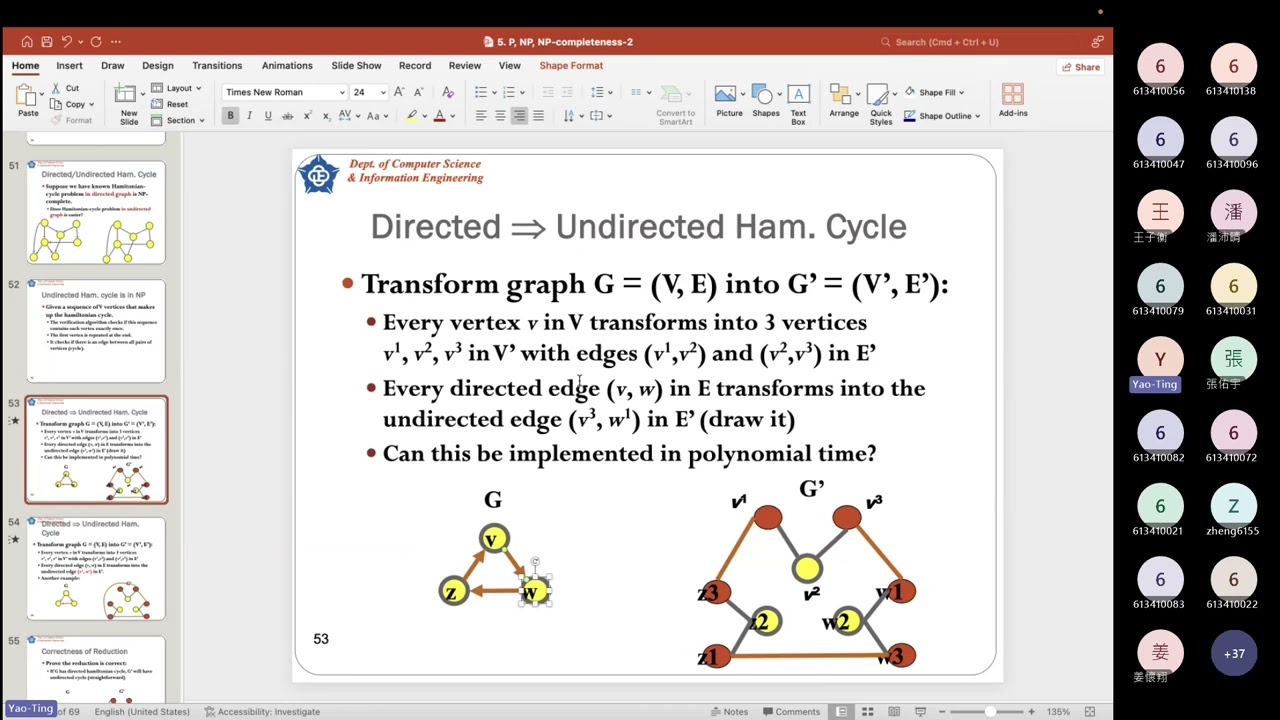
- Discussion of directed vs undirected Hamiltonian cycle and the reduction technique using auxiliary vertices.
- Open problems: Graph Isomorphism and the Pancake Flipping problem, and their classification status.
- Introduction to the Boolean Satisfiability (SAT) problem, definition, and conjunctive normal form (CNF).
- Detailed proof that 3SAT is NP-complete by reducing general SAT to 3SAT with auxiliary variables.
- Discussion of 2SAT being in P, construction of implication graph, and the strong connectivity check.
- Final summary, assignment of exercise to prove all k-SAT (k≥4) are NP-hard, and conclusion.
Contribution & Novelties
The lecture’s contribution is pedagogical, providing a thorough walkthrough of fundamental reductions in computational complexity. It offers clear explanations and visuals to demystify the transformation from SAT to 3SAT and the polynomial-time algorithm for 2SAT. While not presenting new research, it excels in making these results accessible and in emphasizing the critical thinking behind reduction techniques.
Pour aller plus loin :
- Cook-Levin theorem — Directly related to the first NP-complete problem discussed.
- NP-completeness — Provides context for the complexity classes covered.
- Implication graph — Key to the 2SAT algorithm explained.
- 2-satisfiability — Further details on the polynomial-time solution.
98 words
Radar Profile
The radar profile shows strong quantitative and technical content, with high scores in information quantity and technical level, while quality and reliability are slightly lower, reflecting the reliance on the instructor's claims without external verification.