CCU Graduate Algorithm 2015 P and NP
Title history
- CCU Graduate Algorithm 2015 P and NP — observed on 20261026-1010 UTC (YouTube)
Keywords
Summary
164 words
Critical Evaluation
Value of the Information & Strength of the Argument
VALUE OF INFORMATION: The video provides a solid introduction to computational complexity, clarifying common misconceptions (e.g., NP does not mean ’non-polynomial’ but ’non-deterministic polynomial’). It effectively uses concrete examples (shortest path, Euler path, TSP, SAT) to illustrate the difference between problems solvable in polynomial time and those whose solutions are merely verifiable in polynomial time. The argumentation is logical and well-paced, building from simple cases to the formal definitions and the inclusion relation P ⊆ NP. The explanation of decision problems as a reduction from optimization problems is valuable for understanding complexity proofs. SOLIDITY OF ARGUMENTATION: The reasoning is robust and mathematically sound, avoiding overclaiming. The instructor carefully distinguishes between finding a solution and verifying a proposed solution, and demonstrates through examples why NP problems are considered ‘hard’ only tentatively. The presentation of P vs NP as an open problem is accurate and appropriately cautious.
Scientific Rigor, Source Quality, Title Accuracy
SCIENTIFIC RIGOR: The lecture adheres to standard computational complexity theory, presenting definitions consistent with textbooks. The instructor explicitly mentions the reliance on Turing machine concepts, though avoids formal machine descriptions for accessibility. The examples (TSP, SAT, Hamiltonian cycle) are canonical and correctly described. SOURCE QUALITY: The video primarily relies on the instructor’s expertise; no external citations are provided or required for this introductory level. The content aligns with established knowledge in the field. TITLE-CONTENT ADEQUACY: The title precisely reflects the lecture’s scope—‘CCU Graduate Algorithm 2015 P and NP’—and the content indeed focuses on explaining P and NP classes. The title is academic and descriptive, matching the video’s nature.
268 words
Title / Content Match
The title accurately reflects the content: a graduate-level algorithm course lecture on P and NP problems.
Quality & Reliability
8/10
The video is a rigorous lecture by an academic instructor, covering foundational concepts of computational complexity with clear definitions and examples. The information is accurate and well-structured, though it stays at an introductory level without covering advanced proof techniques.
Key Moments
Markers derived by PSI from the transcript: the creator did not define chapters.
- Introduces the topic: classifying problem difficulty and defining P and NP.
- Discusses shortest path and TSP as contrasting examples of polynomial vs exponential time.
- Introduces Euler path and Hamiltonian cycle, highlighting the difference in difficulty.
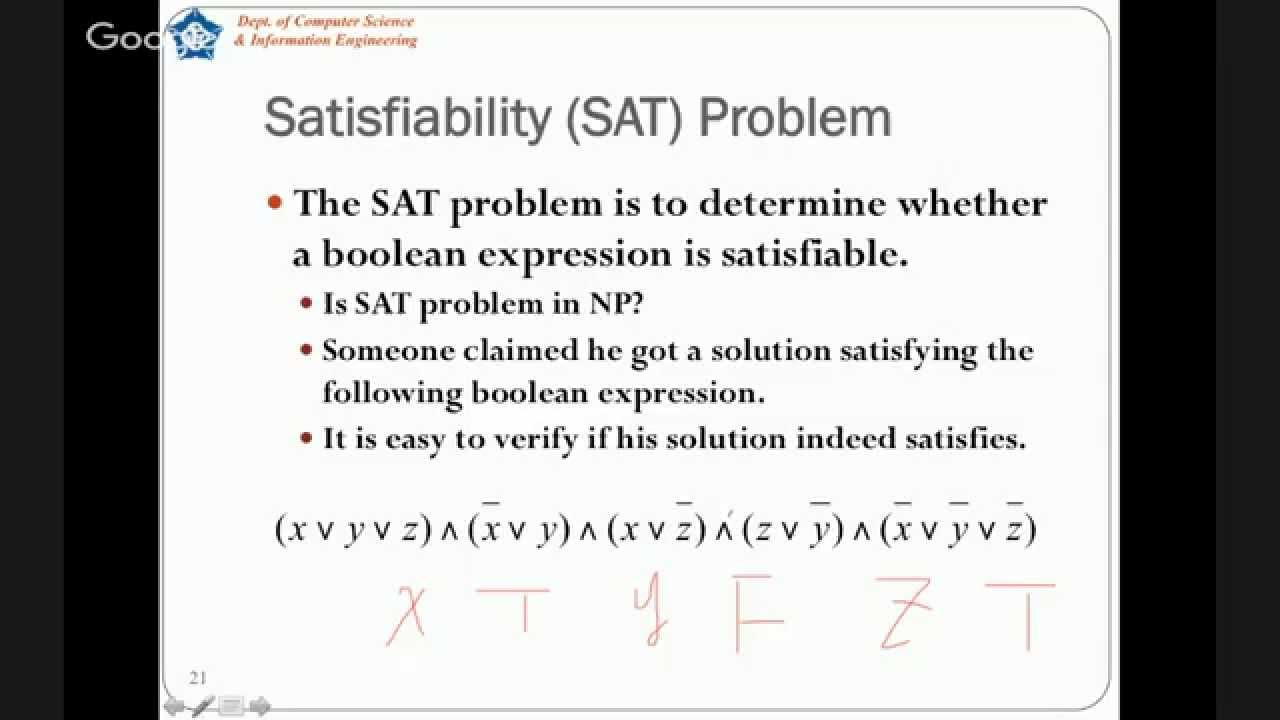
- Explains the SAT problem and why it is NP, emphasizing the verification aspect.
- Formally defines P and NP, clarifying the relationship P ⊆ NP.
- Concludes with a discussion of the P vs NP question and practical implications.
Contribution & Novelties
This lecture provides a clear, pedagogical distinction between P and NP, emphasizing that NP is about polynomial-time verifiability rather than hardness. It corrects a common misunderstanding and offers intuitive examples. While it does not present novel research, it serves as an effective educational resource for graduate students.
To go further:
- P versus NP problem (Wikipedia) — Central open question in computer science directly related to the lecture’s topic.
- NP-completeness (Wikipedia) — Extends the discussion to the hardest problems in NP, relevant for further study.
- Turing Machine (Wikipedia) — Foundational model used in the definitions of P and NP, helpful for formal understanding.
102 words
Radar Profile
The radar profile shows high reliability and moderate technical depth, with strong scores in information quantity and quality. The relatively lower technical level reflects the introductory nature, making the content accessible while maintaining scientific accuracy.