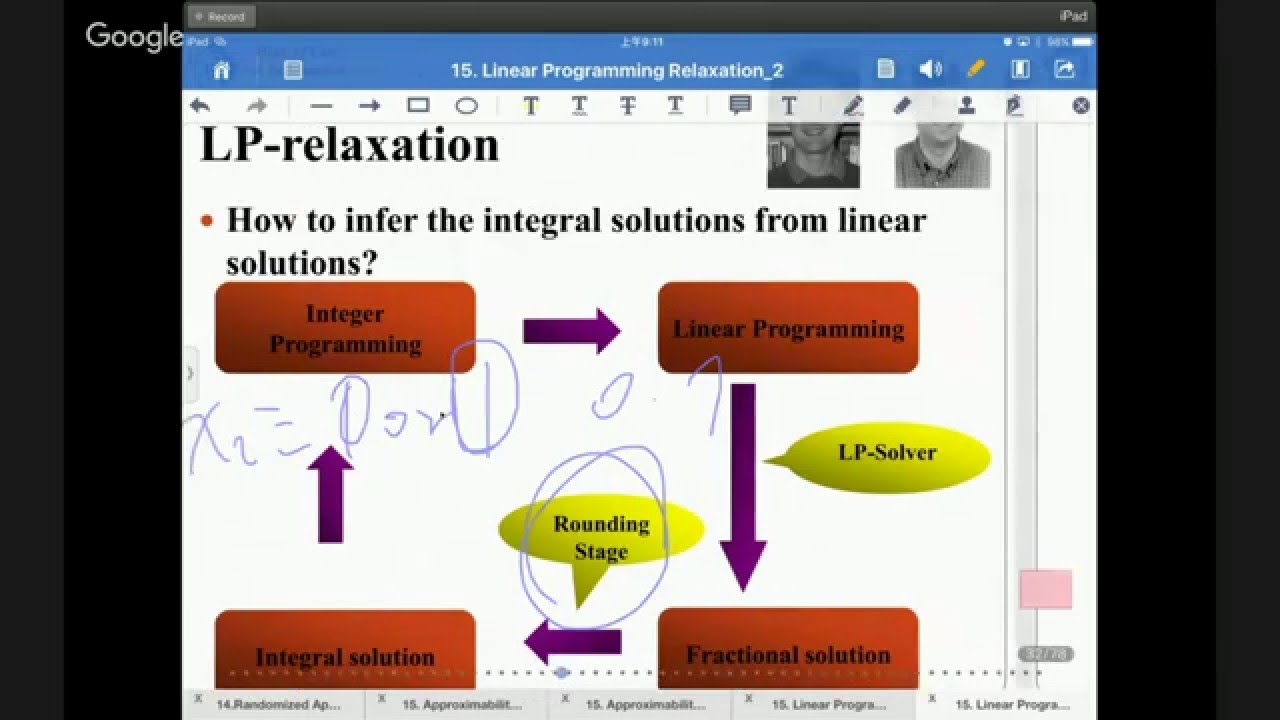
20151215 Computer Algorithms-Linear Programming Relaxation Part II
Title history
- 20151215 Computer Algorithms-Linear Programming Relaxation Part II — observed on 20261026-2036 UTC (YouTube)
Keywords
Summary
193 words
Critical Evaluation
Value of the Information & Strength of the Argument
The value of this lecture lies in its thorough mathematical treatment of a classic approximation algorithm. The argumentation is solid: it builds from known facts, introduces a clever reduction to integer programming, then carefully derives a probability lower bound via a chain of inequalities. The use of the arithmetic-geometric mean inequality to simplify the product of probabilities is elegant and well-explained. The final combination of the LP-based approach with the naive random assignment to achieve a 0.75 ratio demonstrates a deep understanding of the problem’s structure. The logical flow is clear and step-by-step, with the presenter explicitly pointing out pitfalls (e.g., notation errors) and offering intuition behind each transformation.
Scientific Rigor, Source Quality, Title Accuracy
The lecture is rigorous in its mathematical derivations, but it does not cite any external references, relying entirely on self-contained proofs. The title accurately reflects the content: it is the second part dedicated to linear programming relaxation, and the video indeed delves into a specific application (Max-SAT). The absence of sources is not a major flaw for a tutorial lecture, but the lack of citations to foundational works (e.g., Goemans-Williamson or historical papers) is a missed opportunity. The logical consistency of the proof is strong, and the presenter acknowledges minor typos, which adds transparency. No viewer comments were provided, so no analysis of public reception is possible.
231 words
Title / Content Match
Titre and content align well; the video covers the second part of linear programming relaxation techniques as announced.
Quality & Reliability
8/10
The lecture provides a rigorous mathematical derivation of the LP relaxation method for Max-SAT, with clear step-by-step explanations, though no external sources are cited.
Key Moments
Markers derived by PSI from the transcript: the creator did not define chapters.
- Review of the 4-step LP relaxation framework
- Introduction to the Max-SAT problem and its relation to CNF
- Encoding Max-SAT as an integer program with auxiliary variables
- Explanation of how constraints enforce clause satisfaction
- Linear relaxation and obtaining fractional solutions
- Randomized rounding method and its probabilistic nature
- Mathematical derivation using inequalities to prove the 1-1/e bound
- Combining with naive algorithm to achieve 0.75-approximation
Contribution & Novelties
This lecture provides a pedagogical and detailed walkthrough of the LP relaxation method applied to Max-SAT, demonstrating how to transform a combinatorial problem into an integer program, relax it, and apply randomized rounding. The original contribution lies in the clarity of the proof that each clause is satisfied with probability at least 1-1/e, using accessible mathematical tools. The synthesis of the LP-based approach with the trivial random guess to obtain a 0.75-approximation is also nicely presented, offering a practical insight not always covered in standard textbooks.
To go further:
- Linear programming relaxation — Core concept behind the method.
- Maximum satisfiability problem — Background on Max-SAT and its hardness.
- Randomized rounding — Technique used in the algorithm.
- Approximation algorithm — General context for performance guarantees.
124 words
Radar Profile
The radar profile shows strong scores in technical level and information quality, reflecting the mathematically intensive and well-structured nature of the lecture. The quantity of information is moderate, as the video focuses deeply on one example, and the overall reliability is high due to rigorous derivations.