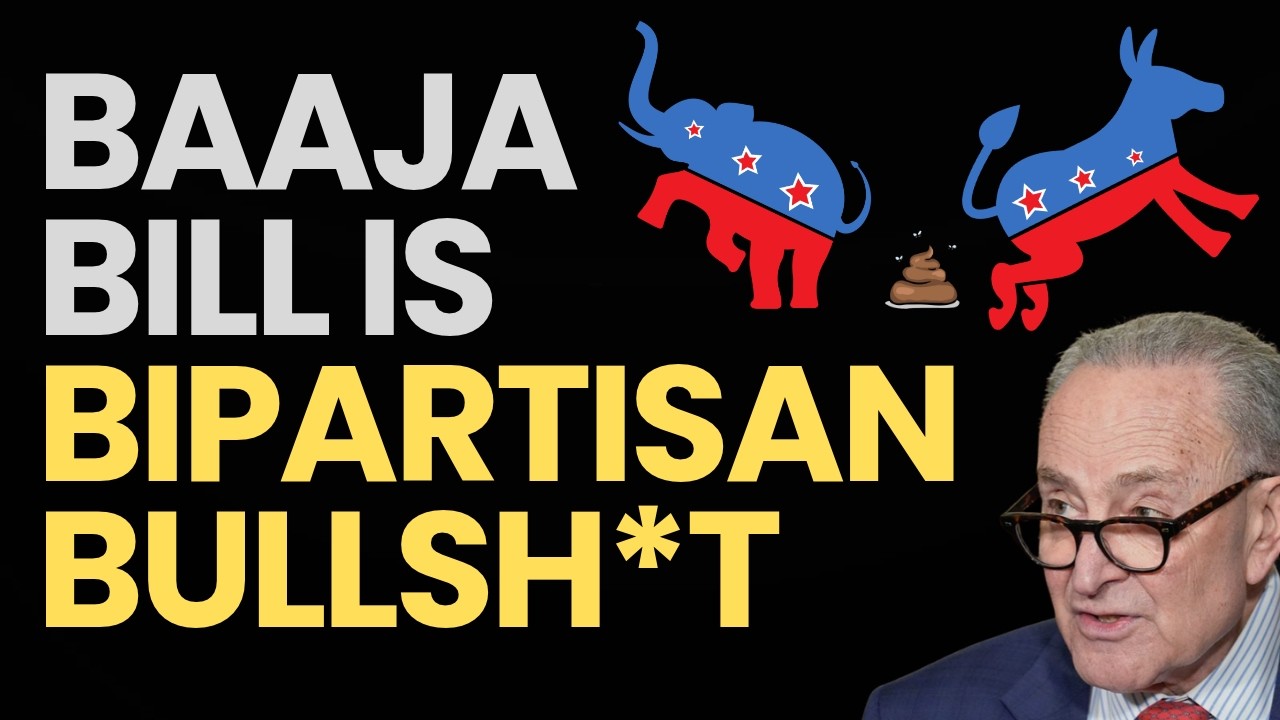
BAAJA Explained: The Senate's Last-Minute Corporate Giveaway
Title history
- BAAJA Explained: The Senate's Last-Minute Corporate Giveaway — observed on 20261121-0241 UTC (YouTube)
Keywords
Summary
169 words
Critical Evaluation
Value of the Information & Strength of the Argument
The video provides valuable context on a complex legislative maneuver, explaining the process of substituting a bill and the implications for environmental and permitting laws. It effectively uses sources like EarthJustice and ACLU to support its claims, and the historical parallel to the CFMA is insightful. The argumentation is coherent and passionate, but it is clearly one-sided, presenting only the negative interpretation and dismissing any potential benefits of the bill without thorough analysis. The video’s strength lies in its investigative clarity, but it lacks counterpoints, making it persuasive rather than balanced. Additionally, it includes a promotional segment for the channel’s own products, lasting approximately 3 minutes, which is separate from the core analysis.
Scientific Rigor, Source Quality, Title Accuracy
The video cites specific external sources: the bill text on govinfo, an EarthJustice analysis, an Axios report on lobbying, and a Politico article on ACLU warnings. These are credible and directly relevant. The presentation of legislative details is accurate, though the interpretation is heavily opinionated. The title is precise and matches the content. No user comments were provided for analysis.
188 words
Title / Content Match
The title accurately reflects the content: the video explains and critiques the BAAJA bill as a corporate giveaway in a lame-duck session.
Quality & Reliability
7/10
The video cites several external sources (EarthJustice, ACLU via Politico, Axios) and references a primary legislative text. However, it is a one-sided opinion piece with strong rhetorical language and no counterarguments, which limits its analytical balance.
Key Moments
Markers derived by PSI from the transcript: the creator did not define chapters.
- Introduction to lame-duck sessions and the bill's passage.
- Explanation of the legislative maneuver to insert BAAJA into an unrelated House bill.
- Details on the bill's provisions: narrowing environmental reviews, court limits, and taxpayer payments.
- The amendment exempting internet companies and potential implications for detention centers.
- List of lobbying groups and corporate backers behind the bill.
- Historical parallel with the Commodity Futures Modernization Act.
- Critique of the rationale and proposal for alternative energy and grid policies.
- Outro and promotion of UNFTR products.
Cited Sources
- BAAJA Bill Text (Senate) — Primary legislative text of the bill discussed.
- EarthJustice Analysis of BAAJA — Provides analysis of the bill's impact guide.
- Axios: Permitting deal lobbying blitz — Reports on the lobbying efforts behind the bill.
- Politico: ACLU warns permitting bill could give way to ICE detention centers — Covers ACLU concerns about the bill's scope.
Concurring Sources
- EarthJustice Analysis of BAAJA — Aligns with the video's critical view on environmental impacts.
- Politico: ACLU warns permitting bill could give way to ICE detention centers — Supports the concern about potential misuse of the bill.
Dissenting Sources
- BAAJA Bill Text (Senate) — The bill text itself is neutral; the video interprets it negatively. Discordance arises from the video's interpretation, not the source.
External References
Contribution & Novelties
The video’s original contribution is a clear, critical narrative that connects the BAAJA’s legislative technicalities to broader patterns of corporate influence and deregulation in American politics. It effectively uses the lame-duck context and historical precedent to argue against the bill, which is rarely covered in mainstream media. The explanation of the substitute amendment process is particularly valuable for a general audience.
Pour aller plus loin :
- Lame-duck session — Explains the political context and consequences of lame-duck sessions.
- Commodity Futures Modernization Act — Historical precedent for deregulation passed in a lame-duck period.
- Data center — Overview of data centers and their energy and environmental impacts.
- Permitting reform — Discusses the policy debates around streamlining energy project approvals. (Note: I am not fully certain of the exact URL; if unsure, omit URL as per instructions.)
134 words
Radar Profile
The radar profile shows high scores in quantity and quality of information, moderate technical depth, and a somewhat lower global reliability due to the one-sided presentation. This suggests a well-researched but opinion-driven piece with strong factual grounding but limited perspective.