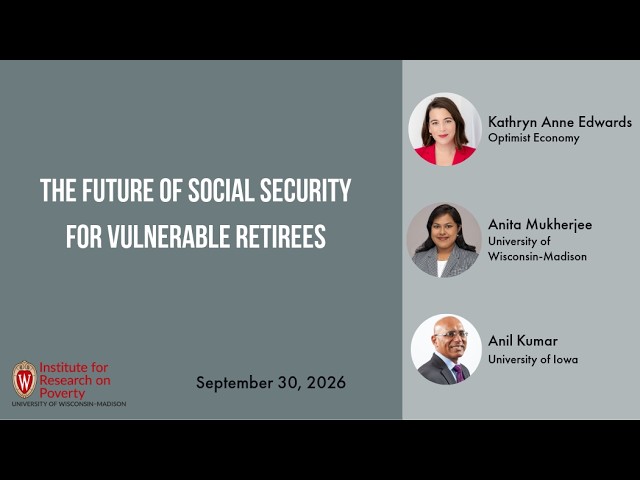
The Future of Social Security for Vulnerable Retirees
Keywords
Summary
206 words
Critical Evaluation
Value of the Information & Strength of the Argument
The value of the information lies in its clear breakdown of the Social Security funding mechanics and the nuanced discussion of how retirees actually use assets. The argumentation is robust, drawing on data from the Health and Retirement Study and historical policy changes. Each presenter provides evidence-based perspectives, and they acknowledge uncertainties, such as the unknown legal outcome at trust fund depletion. The panel effectively connects technical details to real-world implications for vulnerable populations, offering a well-reasoned case for why Social Security cuts would have severe consequences. The argumentation is solid, though it remains at an expert level without overreaching into political advocacy.
Scientific Rigor, Source Quality, Title Accuracy
The rigor is high: speakers cite authoritative sources like the Social Security Trustees Report and the Health and Retirement Study, and they clearly distinguish between scheduled benefits and payable benefits. The title accurately captures the content, as the webinar consistently focuses on the future of Social Security for those most reliant on it. The presentation is well-structured, with each speaker building on the prior analysis. While no external links are provided in the description, the internal evidence and expert qualifications lend credibility. Adequation between title and content is exact, with no misleading elements.
211 words
Title / Content Match
The title accurately reflects the content, which focuses on the impact of Social Security shortfall on vulnerable retirees.
Quality & Reliability
8/10
The webinar features recognized experts presenting research-based evidence on Social Security's financial outlook, with transparent discussion of uncertainties.
Key Moments
Markers derived by PSI from the transcript: the creator did not define chapters.
- Host introduces the webinar and the three panelists, outlining the structure and rules for Q&A.
- Kathryn Anne Edwards explains the OASI trust fund depletion timeline, noting the shift from 2033 to 2032 and the impact on the election cycle.
- Edwards discusses the potential for combined trust fund depletion and the conflict between the Social Security Act and the Anti-Deficiency Act, highlighting legal uncertainty.
- Anita Mukherjee presents Health and Retirement Study data showing that many retirees keep or grow assets, and that consumption tracks income rather than wealth.
- Mukherjee emphasizes that assets are psychologically sticky and that planning horizons and defaults affect spending, making benefit cuts more impactful.
- Anil Kumar introduces his research on the effects of smaller Social Security checks, comparing early claiming to a potential across-the-board cut.
- Kumar concludes that poverty rises for older retirees who lack alternative resources, and the panel opens for Q&A.
Cited Sources
- 2026 Social Security Trustees Report — Cited by Katherine Anne Edwards as the basis for depletion projections and payable benefit percentages.
- Health and Retirement Study — Used by Anita Mukherjee to analyze asset accumulation and consumption patterns among retirees.
- Social Security Act and Anti-Deficiency Act — Mentioned by Edwards to illustrate the legal conflict arising at trust fund depletion.
- Research by Engelhardt, Kumar, and Gruber (historical early-claiming study) — Referenced by Anil Kumar as the basis for understanding the impact of smaller checks on poverty.
Contribution & Novelties
The webinar offers a multi-perspective analysis of Social Security solvency, integrating trust fund mechanics, behavioral evidence on asset spending, and historical poverty impacts. Its novelty lies in directly connecting the projected benefit cuts to the lived financial behavior of vulnerable retirees, highlighting that even retirees with assets may be unable to adjust. The discussion of the legal unknown at depletion adds a crucial dimension often overlooked.
Pour aller plus loin :
- Social Security (United States) — Overview of the program, its funding, and policy debates.
- Social Security Trust Fund — Details on the OASI and DI funds, depletion projections, and historical borrowing.
- Health and Retirement Study — The dataset used in Anita Mukherjee’s analysis, covering financial and health data on older Americans.
- Life-cycle hypothesis — Theoretical framework on consumption smoothing, relevant to discussions of asset decumulation.
136 words
Radar Profile
The radar profile shows high reliability and information quality, with moderate technical complexity. The quantity of information is substantial, but the presentation remains accessible to a non-specialist audience. This balance suggests a rigorous yet approachable seminar tailored to policymakers and practitioners.